You are Emitting RF. Devices Like Signal-Trace Tracks Your Signature
Transcript
Machine-transcribed by YouTube. Expect errors in names, commands and version numbers.
Hey friends, some of you know that I'm a licensed ham radio operator and because of this interest, I've always been partial to studying the features and effects of RF or radio frequency.
Here's my Kenwood HT radio. And this particular unit requires a ham license. Whenever I hit the PTT button, I have to announce my call sign so I'm identified.
What you're going to hear about today is a bit different. I've talked about this in several viral videos over the years, and what I predicted then is now coming true. That radio will be used for surveillance. You're all emitting an RF signal. Also, you may not know that this RF signal coming from you also emits some sort of signature, which is like a call sign. And that means that someone can combine this with other data and track fine movements in ways you never thought about. This is being commercialized and once this sort of tracking becomes dense enough, we will have created a web of surveillance that truly makes me think of some futuristic police state. You'll
hear about a company called Leonardo and a product called signal trace. This is just the industrial version of what I've already demonstrated to you in prior videos. I'm going to describe the mechanics completely of how this can all work. And surprisingly, a lot of what I say is already in the marketing materials of [music] signal trace. On top of this, some of this is already in use in federal buildings, for example. This is not theory. I'm going to give you a lot of technical details so you understand the accuracy of what I'm talking about. Let's dig in. Stay right
there.
building scenario. I've used the example of a secure building in the past to demonstrate the features I'm going to be talking about. I made some theoretical example of a federal building of some agency. Again, all theoretical from my end, but hauntingly accurate. So, you enter the building and pass through security with a metal detector. Maybe you thought that was it. You head to the security desk. If you're a guest, maybe they hand you a guest ID and as far as you're concerned, that was all that happened. But under the hood, the camera took a photo. Your ID is scanned and now it is matched to the photo. The hidden steps are now an RF scan to detect your RF signature. And then you go to your destination in the building. And now the RF tracking begins.
If you later disappear and don't exit or you linger after hours or you're not in an assigned area, expect that several triggers will happen and where you are may be immediately known because of that RF signature. These come from seemingly benign transmissions that now signal your presence and even your identity. And the scary part is how this is now being turned into a wide area scan and not limited to some building
broadcast RF versus reflected RF. There
are several ways you can emit RF. The first way is via a power broadcast. This method requires a power source and typical devices in this category would be phones, Air Tags and wireless earbuds. So you are emitting this for sure. The next method of transmitting an RF is reflective. Meaning some device sends you a pulse of RF and your device may be configured to reflect that signal even though it has no power. The most common version of this is the RF ID.
This one emits a signal only as a reflection. So devices need to pulse the RF to you and then listen to the return.
The third way that some of you imagine could happen is that you have nanobots in your blood from a COVID vaccine and this does Bluetooth. Okay, cancel this one. This is not on the list, but stick around if you want to know the real threats, not imagine ones. What I'm going to talk about now are the different sources of RF signals that you emit. This is important and what you will learn later on is that it doesn't have to be one signal. It's a collection of RF patterns coming from you that now translate into an RF signature. Let's enumerate the specific RF signals by band that you should be aware of.
Wi-Fi broadcast. All devices that can connect to Wi-Fi are transmitting a probe broadcast. That probe is doing channel hopping which is on 2.4 GHz channels 1 to 13 and a lot
more on 5 GHz. For example, your phone
looks for the presence of Wi-Fi access points in your connection list [snorts] and ask via a broadcast announcement if that access point is there. It repeats this on all channels in sequence. This is a unique announcement because the broadcast includes a MAC address that is specific to your device. Some of this is randomized, by the way, but we'll get to that. This is a continuous thing, and I actually wrote some software to prove this could be used for tracking. However, the problem is that a consumer 5 gigahertz version of a scanner wasn't available at the time. So, I set that project aside. Hackers know that you can send a command to a router to actually block your internet access based on this announced MAC address
BLE broadcast. The more common way nowadays to send an RF signal is via Bluetooth and specifically the subset of Bluetooth signals is the stronger one called Bluetooth low energy or BLE.
This particular signal transmits a MAC address that is unique to your device. The MAC address also identifies the product and this is also sent in the 2.4
GHz range. Same general range as Wi-Fi.
BL uses the in between frequencies between the Wi-Fi channel. So there's no collision. This 2.4 4 GHz range and the
5 GHz range is inside the unlicensed
industrial band called ISM. BLE broadcasts are now used to announce your devices for Bluetooth pairing. They also used to send Air Tag messages and these are the signals used to do mesh networks. Mesh networks are a special kind of BLE message where the message can be retransmitted or relayed if the message contains a relay code. The unique thing about B is that it is a fairly strong signal. It can go up to 600 ft if it is unobstructed like a line of sight signal outdoors, meaning it can really see around the block. This is a pulse signal that's very brief and that's why very little energy is used.
Pay attention to BLE as it is in every device and is actually the easiest to track. Now, any device with Bluetooth can emit BLE. This means that is not only your phone or laptop. It includes your earbuds and your car. By the way, BLE includes some phase information in the transmission data. This means that a listener can detect the direction of the BA signal just based on computing the phase information sent with the broadcast upon detection. This makes it even more precise and enables devices like iPhones to detect distances in inches. RFID. The reflective version of RF transmissions is very common with RFID.
Your credit cards also have NFC chips which are also reflective but by design was for detection within inches. But
some chips are the normal RFID types that can send a longer range reflector message. For example, your US passport, passport cards, and EDL driver's licenses that have RFID. This means that
if someone points the appropriate antenna at you and transmits at the required frequency, your RFID will send a response back at a distance that doesn't require you to leave your car. This is used, for example, to automatically do scans when entering or exiting US borders. And many of you don't actually understand how common RFIDs are. If you buy some product from some store, the RFID could still be in the product. For example, your tires, all four plus your spare have RFID that can be used to send tire pressure information, but they all emit specific serial numbers that are unique. So, think of this. If the serial number signature of the tires match some other signal, then you can be traced.
RFIDs can use many frequencies from HF to microwave and that defines the distances for detection. And while the FCC states power limits for projecting an RF, obviously someone can send a stronger signal. That means the stated range of the RFID could be longer than the specs. This could be true of rogue players or three-letter agencies.
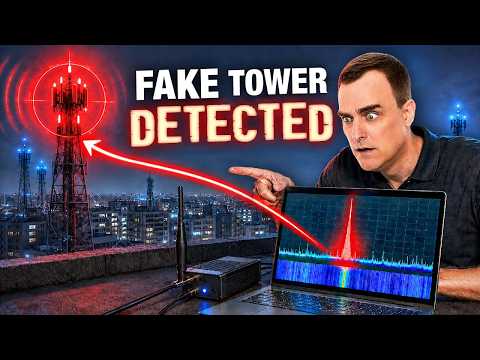
Ise catchers. The next level of transmission is the cell network transmission. If you have a SIM card, your phone is constantly pinging the towers around you to check signal strength and pass credentials. This is used to track phones with MC catchers. This is very common to spot the presence of devices within specific areas like in government buildings for example and embassies. So in some places
like Washington DC, this is very dense and the detection devices are projecting fake cell towers. The common name for
the original version of this was Stingray and was used heavily by law enforcement and you can make personal units that duplicate Stingray. The point is that if your SIM card is active, you are reporting yourself as present to a nearby Stingray device. And this is used as evidence in court of your whereabouts in the past. The MZ is very specific as it reveals your identity information as recorded by the carrier. The building sensors.
Now that you understand the basic signals you emit, let's go back to the building example I used earlier. In this environment, a secure facility will hand you a badge that's equipped with 13.56 MHz RFID. That's one
possibility. So, you're already trackable all over the place. And that badge may be used to open doors or run the elevator. But on top of all that, the electronic signature of your presence was also captured. They would have determined your IMY from the phone, the MAC addresses and device types on you via BLE, including your earphones. If your iPhone is turned off, it still transmits a message to simulate an Apple Air Tag BLE, so it is identifying you non-stop.
Your Wi-Fi MAC addresses are being recorded as well.
Softwaredefined radio. The mistake is in assuming that individual frequencies need to be tracked, and that seems difficult since there's a lot of them. Actually, it's easy to just capture a range of RF discovered in your presence and attach it to your identity, like your captured photo and picture of your ID or your license plate. This is something called an SDR or softwaredefined radio. Basically, it means a receiver can capture all frequencies in the devices design range in one moment, which could be low frequencies like 13 MHz to 20 GHz microwave as is common now in many ham radios. This is a single capture of all frequencies done by software, not someone turning the dial and listening in like you're tuning a radio.
You can even visualize all the instant frequencies in a waterfall display in new ham radios. So in a matter of seconds, your RF signature across all bands is captured and saved to a file.
So the pattern of signals around you is in itself a unique identifier as you have a unique collection of devices. In case you didn't know this, not only are the MAC addresses unique, they actually state the product and the manufacturer. Going back to the building example, you are covered on many layers. First, they got your ID card on entry. Then, they issue you a trackable badge. Then, they capture the electronic signature of your presence. If you suddenly disappear or not return after hours or go to an unauthorized section or you seemingly return by the trace of your electronics is found on site after hours, this can only be a security trigger. If they need to retrieve information from the signal, it is also a piece of cake to replay the RF and then using digital modes convert the signals to their text versions.
signal trace. A company called Leonardo, an Italian defense contractor, sells ALPR or automated license plate readers like Flock. But this company can also attach a separate product called signal trace. This is basically what I've just been talking about here in the building. So a device like this is placed on a light pole and together with the ALPR they capture not just the license plate but also a full RF signature.
Again capturing all frequencies as you pass by and then extracting repeating identifiers in the messages. It's not even necessary for the SDR to capture and decrypt the messages. The heathers of those broadcasts alone will identify them as earbuds, air tags, iPhones, car Bluetooth, enhanced driver's license, passport, high RFIDs, store RFIDs, and
so on. Since this is just a full RF
spectrum scan as received by the SDR radio, it doesn't have to be processed on site. The SDR data is just filed by timestamp and stored on a server and that can later be used to find signatures of people based on corroborating data like license plates. An AI could scan the RF files and pick out identifying elements and stored in a database in text form for quick search.
So the result is that someone could search for an RF signature and then discover that you've changed your license plate. This should be obvious too if you've changed car.
The density problem. While signal trace is a new product and frankly there are no indications that this is in mass use yet, it clearly exists as a technology and it is being sold to governments often as an adjunct to the flock type cameras. The problem here is density. As a high number of these sensing devices are placed everywhere, then it becomes an RF sensing device that goes beyond even internet use. In theory, even if I just use a ham radio, it could trigger a sensor nearby
and identify where I just use the radio. This could also be used to pinpoint a more exact location of your phone than cell towers. This is the problem with density. This is the exact problem even with flocked. A few flocked devices at big intersections may not raise so much alarm. But once you control the traffic by having thousands of these and recording ingress and egress at key points in a city, then you basically can lock every individual into a grid square that is more precise than a cell tower triangulation. combined with a dense presence of signal trace type devices then basically your every move is covered and this is not theoretical we are already tracked heavily via Wi-Fi triangulation from our phones though that is done mostly by Google and Apple but a wide range of SDR
receivers which capture RF data in many light post is a very scary act of surveillance it can be used to track someone who just happens to be nearby by
Mac randomization. Now, some of you will claim that I'm just giving you FUD because there's something called MAC randomization on phones which would limit the identification of specific devices by Mac. I caution you in thinking you can get around this. I've researched this for a long time and I will tell you right now that by tracking precise locations of BLE signals, you can tell that a device changed MAC address.
I've done this manually so I know an AI can easily figure this out. Plus, your other devices do not have MAC randomization. Earbuds don't. Air tags don't. Car Bluetooth, RFID, none of these are randomized. And even with randomization, I know it is an iPhone 11. Yes, I know the iPhone models of my neighbors. The nanobot theory. Now, some of you are still caught up with the COVID vaccine nanobot theory, so I will address it very briefly. If you actually believe in Bluetooth nanobots, then you can test it. I've already stated the tools that are widely available, SDR. So this test is so easy to conduct. I don't believe you can hide this with millions of potential broadcasters.
Second, from a ham radio point of view, you cannot do broadcast well with the human body, which is mostly water. Antennas have to be resonant at the frequency you wish to use. And if anything, bodies block signals. And thirdly, you need a power source to broadcast unless your signal is reflective, in which case the body will just block the signal. So take that as you wish, but this is the reality I operate from, which is a science-based approach on RF.
How I would build this. Now, here's a concept that I can offer in a future video topic. I can actually build software to detect BLE specifically since everyone has that. And there are already BLE listening tools that can convert the signal to text. There are devices you can buy like this that already report on BLE traffic on the airwaves. So you don't even have to worry about all the digital modes and conversions. As I said earlier, BLE is directional. The receiver, the correct kind of receiver can actually not just detect the BLE signal and specify the distance. It can actually accurately determine the direction. Think about this with a security angle. You could actually put a BLE sensor in your house and have it alert you if someone is approaching, not by facial recognition, but by digital signature. So, even if they're sneaking in the back, you could have your security system detect this.
Combining this with a home assistant and you've got a super duper security system that is like the building security I was talking about. This is where we can fight back because you can do reverse surveillance. I'm sure this will be an interesting topic, so I will likely build this solution.
Final thoughts. So, we have new threats with these RF tracking devices. While I talked about this in theory years ago, I knew it was easy to build since I could have built it myself. Now, I see evidence from companies like Leonardo that this is already in production. Stay tuned. It will likely proliferate because that's what governments like to do.
Folks, I hope you enjoy the video and its revelations. I just want to add a few plugs for those who are interested. First, I published a book called Your Mind is the Product, and this is available on Amazon in both paperback and Kindle versions. To support this channel, we have products and services that are important tools for your privacy journey. We have Brax mail for unlimited aliases and privacy. We have Brax virtual phone for private phone numbers. We have Bra SIM unlisted for identityfree self service. We have BitesVPN with new stealth features. All these are on our store on store.bra.mme.
Our sister company Bra Technologies Inc. is doing a community fund raise. As you know, it has successfully launched the Bra 3 phone. Many new products are in the pipeline. If you're interested in finding out what this investment opportunity is all about, please visit invest.brastec.net. You can also visit brac.net if you're interested in purchasing a Brax3 phone.
Thank you to those who support us on Patreon, YouTube memberships, and locals. Your kindness is appreciated. See you next time.