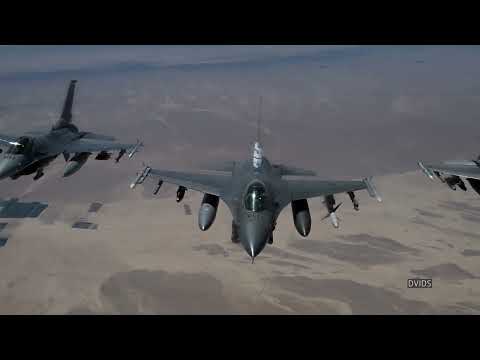
Why the first operational F-15EXs are a very big deal
Transcript
Machine-transcribed by YouTube. Expect errors in names, commands and version numbers.
For the first time ever, operational American F-15 EX Eagle 2s dropped live bombs in exercises held in Nevada earlier this month. But I think there's still some people out there who don't fully understand just how different the Eagle 2 is from its Eagle predecessors.
So, let's run down what makes it special. Now, the Eagle 2 packs powerful new F-110 GE129 afterburning turbo fan engines that each offer a whopping 29,500 lb of thrust under afterburner. Now, that means this new F-15 EX offers more than 11,000 lb more thrust than you
could draw out of earlier F-15s. And all that added juice comes coupled with an extremely advanced flybywire control system that allows for even greater maneuverability with test pilots reporting that they can even make the Eagle 2 do things that is usually only possible for thrust vectoring fighters like the F-22, meaning aircraft that have jet engines that can be oriented somewhat independent of the aircraft. The Eagle 2 does not have that, but can fly like it does. And remarkably, pilots are safer than ever while they push the limits because the flight computer in the aircraft allows pilots to fly right up to the hairy edge of damaging the airframe without exceeding it consistently over and over again.
Something that you used to have to do by feel. And even that hairy edge is further out than ever before with the Eagle 2's reinforced airframe rated to withstand 9G maneuvers in standard flight. and as much as 12gs in emergencies. Now, the Eagle 2 is so powerful, in fact, that Boeing's Rob Noatne, a former Air Force F-15 test pilot turned executive director of F-15 business development, even caused quite a bit of controversy back in 2024 when he told the press that the Eagle 2, while flying in a clean configuration with no weapons or fuel tanks or pylons, could reach speeds approaching Mach 3. Now, that claim was soon retracted by Boeing, and the aircraft's official top speed as disclosed by the US Air Force is the same as both previous Eagle iterations at a respectable Mach 2.5.
Now, all of that power and aerobatic control is great for air shows, but like the Eagles that came before it, the F-15 EX is focused squarely on the fight,
increasing its payload capacity from the Strike Eagles 23,000 lb or the original
Eagle's 16,000 to a whopping 29,500
lb worth of hate distributed across 23
hard points. And that means this supersonic fighter can carry more ordinance further than the B-29 bombers that dropped the atomic bombs on Japan in 1945. And all those munitions can be
delivered to targets with a high degree of accuracy thanks to the jet's onboard ANAPG82 V1 active electronically scanned array radar or via one of several targeting pods. And while the F-15EX carries the same two seat layout as the Strike Eagle, the fighter is designed to be able to fly with a solo pilot or a two-person crew, depending on what your mission requires. Now, when there are two crew members on board, the aircraft offers dual digital helmet-mounted queuing systems, making it possible for either person in the cockpit to orient the jet's weapon systems using nothing more than their line of sight. And when you combine all of that performance with a dedicated new ANALQ250 V1 EPAW electronic warfare suite, you
end up with a jet that may not be anything close to stealth, but is nonetheless really hard to shoot down. According to the director of operational testing and evaluation, the Eagle 2 has proven so effective in long-range air combat in testing that it's even been rated as quote operationally effective
against fifth generation or stealth fighters. And all that capability comes with one heck of a shelf life. While most modern fighters are designed to withstand operational lifespans of 6,000 to 8,000 flight hours, the reinforced airframe on the Eagle 2 is rated for an insane 20,000 hours. That means you'd
have to buy more than two F-35s to get the same number of flight hours as you can get from one F-15EX.
Now, the Eagle 2 may be an incredibly advanced fourth generation fighter, but it does still boast one of the biggest radar cross-sections of its generation, meaning the Eagle 2 has no intention of hiding. It wants you to know where it is because it wants you to come pick a fight. And while stealth may be all the rage these days, I can't help but respect that.