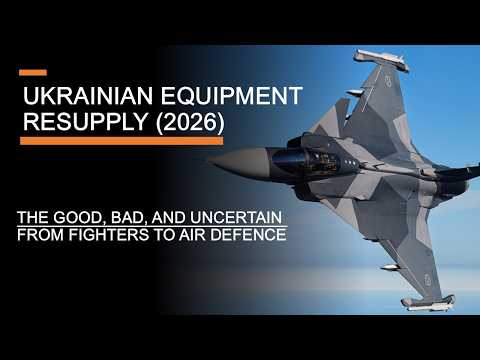
Ukraine Getting Gripen Fighters as Drone War Intensifies
Transcript
Machine-transcribed by YouTube. Expect errors in names, commands and version numbers.
All right, please welcome back to the channel threetime Mucci award-winning professor Justin Bronc, a senior fellow at the Royal United Services Institute joining us from London. Justin, it's been too long. How are you? >> I'm well, thank you. And apologies. Yeah, it has been too long. Been uh busy busy. Lots of lots of travel. >> So, you mentioned travel. you were up in Sweden and that's a lovely segue to our
first topic which is something that you've talked about on the channel literally for years which is the Grippen. So, let's restate your belief
that the Grippen is the right airplane for the Ukrainian Air Force and do you
think that the addition of what are they getting 150 of them will uh change the the calculus of the war in any way? The Grippen um is uh I mean I've I've long believed and we we've discussed this a lot on the channel since kind of late 2022, early 23 that it is uh not only a
really impressive little airplane and very very impressive given its size and and kind of uh relatively low cost and efficiency in terms of operating relative to to bigger twin engine jets for example. Uh but it it's kind of pretty much ideally suited to Ukraine's particular uh operating context because it was built for Swedish requirements before they joined NATO and where they were uh expecting to have to defend themselves alone against a massively larger Russian force with exactly the um you know advanced SU35 series flankers. the same SA21 to S400
uh series longrange air defense systems, similar missiles, similar EW systems from a dispersed primarily conscript operated force which is amazingly close to what Ukraine is having to do in terms of fighting with a citizen army from a relatively dispersed posture quite a operating locations against a much bigger Russian force that deploys those same uh groundbased air defense layered systems and fighters. So, in that sense, the Grippen is uh a clear fit. It's significantly easier to maintain and operate, especially in a dispersed location, compared to the F-16s, which are doing well in Ukraine, but are not having a particularly decisive impact. They're just uh doing well in terms of bolstering Ukraine's ability to uh conduct defensive counterair uh coverage particularly against cruise missile salvos and they've also shot down a lot of Gan and Gabbera oneway attack and and decoy drones uh as well as conducting glide bomb attacks near the front lines and things. And then perhaps most importantly of all the Grippon uh both the E model which is the new generation Grippen which is being built for the Swedish Air Force, Brazilian Air Force, now Colombian Air Force. Uh but uh Ukraine has signals its intent to buy between 100 and 150 of the new Griffin Ease. They've just signed a contract yesterday at the time of recording. So that would be the 30th of June uh 2026
for an initial 16 uh to be delivered in 2029 2030. But crucially that deal now
comes with an explicit statement that 16 of the older Charlie Delta model Grippons. So the existing model which the Swedish Air Force fly along with various countries like Czech Czecha, Hungary, South Africa, Thailand, they will be delivered over the coming 10 months. So coming in around in early 2027 with pilots and ground crew already training in Sweden. That is a more obviously uh time relevant uh development for the kind of assessing the ongoing course of the war which is at a potentially quite pivotal stage. Um we can go into why in a bit but also not only are the Charlie Deltas coming uh you know in in the relatively short term but uh it's now been confirmed both by President Zalinsky when he was in Sweden to sign this agreement and then also by uh the Swedish defense minister Paul Yansen uh in Kev uh on 1st of July that
they will be coming with quote long range air-to-air munitions and that means the meteor missile. The meteor is
really really uh interesting for the Ukrainian air force because it offers the ability to finally threaten credibly the sui 34 fullbacks that are dropping hundreds of glide bombs a week on Ukrainian positions near the front and also on Ukrainian cities like Kharkus near the front. We hear an enormous amount about bombardments of Ukraine by oneway attack UAVs like the Shahed 136, the later Russian Gan 2 and three variants of the Shahed 136. But it is worth considering that according to Ukrainian sources over the last couple of years, they've uh taken about 110 to 120,000 Shahed 136 type one oneway attack UAVs from Russia. That that's clearly huge, but they've taken more than 150,000 glide bombs uh over that same period. And so the glide bombs are much more destructive. They have vastly heavier explosive payloads. They're much harder to intercept. In fact, they're basically impossible to intercept sustainably. And they've had a much bigger impact in many ways because of the the the demolition that they're able to do of specific Ukrainian fighting positions over time on the relatively fixed front lines. More recently, the glide bombs have also been used, unfortunately, pretty effectively to target Ukrainian UAV teams operating near the front lines uh and also to bombard cities and logistic centers um relatively near the front. So, it's really critical to find a way to stop these things being delivered. They are typically dropped from about 60 to 70 km behind the Russian front lines by SU 34s. So the Russian fullback, which is a twin seat sideby-side adoption, a sort of adaptation of the original flanker, and they're dropping these from high and fast. So they they loft them up to high and fast altitudes and speeds about 60 to 70 km behind the front line. And then as soon as they've dropped, they'll peel off and go back, which means that firstly, you have to time an interception attempt very, very closely because you have to kind of be in position to make a run at trying to launch a missile at them. uh as they make their run in over only a minute or two to actually deliver those glide bombs. Um so as they they themselves are coming towards the front line areas. Um and then your weapon has to arrive uh with sufficient speed uh well remaining kinetic energy at those high altitudes to intercept them especially as they maneuver when they assuming they get an active um homing kind of warning from their radar warning receiver when the missile goes active even if they haven't detected the initial shot. And with Amram, the Ukrainian variants that they're likely to have access to, Bravo and Charlie variants, the weapon might have those kind of ranges, if you were launching it from really high and fast and could support the weapon all the way out to the the intercept to give it lots of maximum amount of data and lots of guidance to optimize its flight profile.
But that's not really possible with the F-16s um because they're and wouldn't be possible with Grippon either by the way because they they are popping up for as little time as possible when they're close to the lines even if they do pop up because they're then in the overlapping threat ranges from lots of Russian groundbased air defense systems. And they're also having to deal with longrange missiles being lobbed by Suko 35s as fighter caps on the Russian side from high and fast as well. So you can't
really do that sustained high and fast concept of operations around which the American Amram was designed. Uh the Meteor is different the weapon that the Grippon is coming with because uh although you will still have those tactical challenges of trying to be in the right place at the right time able to support the weapon in flight which is not trivial. Um it has a ramjet
propulsion system. So a smaller rocket motor to begin with, but then ramjets which take over um for most of the flight. And that means that it arrives in longrange shots like this with significant energy with still uh power being applied from that ramjet propulsion as opposed to a traditional air-to-air missile where you have an initial rocket motor burn that might get the missile to a higher speed initially, but then for most of that flight time on long-range shots, the speed is just degrading because you've only got the energy you started with with that initial motor burn. So that the meteor can not quite chase down adversary aircraft, but it can it can maneuver more aggressively uh with more energy in that kind of terminal phase at longer altitudes, particularly if it's being fired from lower down against a higher target. Meteor is not compatible with the F-16. It's not compatible with Mirage 2000. So the two fighters that Western fighters that Ukraine currently operates, but it is being supplied um it appears with the Grip and Charlie Deltas. really exciting uh in terms of the potential ability finally for the Ukrainian air force to push those C34 launches back and at least pull significant areas behind the Ukrainian air bits of the front line out of range of most those glide bombs. Even if it's not possible to routinely push them back far enough to completely negate glide bomb threats, it should really help once those jets are in country. Uh provided they're used right. So, let's uh pull up and go big picture here as we normally do when we're talking about Ukraine.
Let's start this part of the discussion with the Institute for the Study of War battle map. This one is from yesterday at 1:30 Eastern time.
So, normally I comment that this really hasn't changed a whole lot for the last 3, four years, but what I noticed since the last time we brought this map up is there's a lot more light blue around the northern rim. Is there anything else here at the 30,000 foot level that jumps out at you? >> I think the biggest thing that that uh we should be uh you know frankly pleased
and grateful about is that firstly that there isn't a huge change as you say. Um the momentum last year all through 2025
and indeed for a lot of 2024 was grindingly in Russia's favor and they
were just slowly grinding taking ground
uh so that the the the overall shape of the various areas control didn't change a huge amount uh besides the the um pocket up in Sunumi where the Ukrainians went on the offensive into into a part small part of Russia and would were eventually pushed out. But the the front was just slowly and grindingly advancing with the Russians moving uh slowly westwards albeit at huge cost. There's been a real change over the past um 5 and a half months. So basically since mid January essentially what you're seeing is that at the moment the Russians aren't really gaining net territory and in some of some of the last couple of months Ukraine has actually retaken more ground than it's lost. That is great to see and it is due
to a few factors um in terms of change trends. Firstly, the Ukrainian mobilization and uh training overhauls that uh Minister Federov, new minister of defense since mid January uh has been spearheading seem to be working well in terms of getting a greater proportion of the people who are u mobilized into the
front and reasonably well trained enough that they stay there. Um so the Ukrainian force as a result has actually been growing slightly each month in this year. Um in terms of net balance between casualties and uh new uh trained recruits going into units. Um that had not been the case for quite a while before this. Uh so u that's a hugely important change. Secondly, on the Russian side, they are consistency consistently losing more casualties in terms of killed and seriously wounded and captured than they are managing to recruit each month. Uh, and that has also been the case consistently since the beginning of the year and was not the case through last year and a lot of 2024 where the Russian force was continually growing despite very high casualties. that momentum matters.
Albeit the Russians still have a very large force um employed uh around kind
of 600,000 troops uh committed. There's still a lot of pressure on the on the Ukrainian uh lines, particularly south of Daetsk uh around kind of the Prosk area, but the Ukrainians have been managing to to inflict staggering casualties on the Russians. Um they just keep increasing. It's it's it's I mean it's horrible to watch but it is really really significant that the Russians are having to despite uh their efforts to
recruit more from foreign mercenaries essentially uh from around the world particularly Latin America and Africa they are still failing to get enough people to sign contracts in Russia and from outside to replace their losses. So they are having to resort to forcing conscripts to sign contracts um because Russian conscripts are not allowed legally to serve outside Russian territory except in uh in wartime which uh the Russian leadership insists this is a special military operation. It's not a war. Um so uh the Russian force is being just about sustained, but they're having to essentially break their own rules in order to do that. And that's in the context of a an increasingly visibly successful Ukrainian long-range strike and mid-range strike campaign which we can talk about as well. One of the really fascinating things in if you look deeper into the Russian recruitment crisis um that they are increasingly facing uh is that they are particularly
struggling to recruit enough drone operators near the front lines because essentially because of the increasing um dominance of relatively deep uh strike
operation in terms of interdiction and strike operations for a frontline small drone. um using a lot more fixedwing uh sort of loitering munition type UAVs on both sides. Um there's increasingly kind of contested zone up to about 40 50 even in some places 50 km behind the actual front line positions on each side. What that means though is that uh each side's drone teams have to basically be at their own infantry front lines or even in some cases beyond their own infantry front lines in order to get their own drones far enough to be competitive if you like in this sort of midstrike. I'm mixing up doctrinal terms here, but but that that kind of constant attempt to cause casualties among uh reinforcement re rotations, logistics, resupply artillery units, etc. and opposing drone teams. And because they have to do that infiltration, not just through several tens of kilometers that are themselves being swept by hostile drones, but then set up near or even in some cases beyond their own front lines in concealed hides and then operate for continuous periods.
That means that they have to be not only very technically trained, they have to be able to fly and operate racing drone type FPVs which are quite difficult to use um from a flying you know remote flying point of view as well as lodge ammunition type UAVs. They need to have a very good understanding of the electromagnetic spectrum to be able to monitor and more to the point understand what different electronic warfare techniques being used at different points in time around them mean for their own UAV operations. they need to have uh the ability to modify and repair and service and tweak their own drones in place. So, it's a very technical skill set, but then in addition, they also need to have good infantry skills because they need to be able to infiltrate often at night those tens of kilometers from where they can get off vehicles safely and then get to the front line areas and then also set up concealed positions and move semi-regularly between concealed positions in order to operate their UAVs without being detected and struck.
That's actually a difficult cohort from a human capital point of view to recruit. And increasingly the areas that Russia can recruit from in terms of getting people to sign voluntary contracts are ever more do are ever more
um skewed towards areas of the country that are incredibly deprived or really gullible people from pretty unfortunate backgrounds who are desperate and therefore are more vulnerable to being recruited from parts of Africa, um South
America, other bits of the world and they tend not to be population groups that have a high level of technical education or indeed a level of education in general which uh makes them suitable to teach quickly those kind of technical skills and indeed also the health that they need to get the infantry skills side of things. Um the Russian response so far seems to have been to double down on just pushing more operators forward
which has meant less training uh and has actually increased their losses. So, at the moment, the Ukrainians seem to have an increasing advantage in not just uh
some aspects of the long range and certainly mid mid-range uh strike drone campaign, but also on the battlefield um because they are managing those recruitment and training dynamics better than the Russians for now. >> So, that notion was furthered with these
optics as you mentioned, long range strikes all the way to Moscow. this kind of amazing footage there of that refinery top coming off looks like a flying saucer. These long range
UAVs going downtown Moscow. So the terror
effect on the citizenry is something
substantial. The damage it's doing. So we've documented long range strikes over the course of this war before, but this looks to be like next level to me. So, are we seeing a shift in momentum along with the other things we were talking about in terms of this part of the war? >> Uh, there's definitely a shift in momentum. Um, so before we go into why
the Ukrainian campaign is is uh having increasingly obvious and and important effects and doing better, it is worth caveating, of course, that it is still significantly less damaging and involves significantly less delivery of firepower than the Russian long-range strike campaign, which also continues against Ukraine with uh often tens and tens of cruise missiles, several tens of ballistic missiles, and many hundreds of oneway attack UAVs per night. Um they
particularly are able to deploy a lot more of those heavy cruise and ballistic missiles than Ukraine can with a few cruise missiles um at times um to supplement the oneway so the much smaller uh payload carrying oneway attack drones. Having said that, there's a few different factors that are that are coming into effect which are causing significant increases in the effectiveness of Ukrainian long-range strike campaign. One of them is just an increasing availability and technical maturity of lots and lots of different types of oneway attack UAVs. So that is both meaning that Russian air defense and particularly electronic warfare is facing an increasingly diverse range of threats all of which iterate relatively quickly in terms of the software navigation techniques that mission planning techniques that they use. Um so it's a harder set of threats particularly from an electronic warfare point of view to um deal with efficiently. Um whereas Russia has concentrated more on continued iteration of a few types that it produces in greater numbers notably the Gar 2 and three uh and the GA um which has its own advantages and disadvantages as an approach. Um but so firstly Ukrainian uh
and uh European and other other externally supplied oneway attack UAVs are getting better and more diverse. Their navigation in particular GPS spoofing and EW resistant navigation is getting more mature which means that a greater number of them are getting through to target areas. The second thing that I think is contributing to this is that Russian air defense is increasingly feeling the strain. Uh Russia continues to field one of the largest most capable air defense groundest air defense networks on earth but it is nonetheless uh starting to
show strength particularly in shorter range air defense system ammunition. SA22 Pansier in particular seems to be um less effective at the moment. Partly
that is uh visible in a greater number of intercepts being visible in public from larger surfaceto-air missile systems and man pads. So shoulder fire man pads compared to traditionally pansu dealing with a lot of the uh bulk of Ukrainian longrange UAVs. Um and this makes sense because ultimately the Russian system has been dealing with hundreds of Ukrainian UAVs more or less every other day for years now. um and their economy is in a war mode um sort of full industrial production setting.
But even in that context, a country like Russia that ultimately has relatively limited financial resources has had to make prioritization bets. And up to now they are struggling, I think, to um keep some of their previously secondary air defenses that are now primary air defenses when it comes to efficiently engaging oneway attack UAVs at lots and lots and lots of different locations across Russia um adequately supplied. So
that accounts for potentially some more getting through both more of any given way getting through the initial defenses uh that are near the front lines because obviously UAVs have to get into Russia before they're in the depth and then also potentially more surviving uh in the kind of last phase as they approach targets. Uh and then thirdly, I think there's also just an element of Ukraine has picked a very effective primary target set with which to impose visible costs on the Russian regime, which is oil and gas infrastructure. So, first and foremost, it's extremely flammable and it's also very large and extremely difficult to harden in the sense that it's not just large in that you don't need huge accuracy um to to reliably hit
refineries. They tend to be very large sprawling complexes. But it's also a very large target set in the macro sense in Russia because Russia as a primary primarily prochemical export dependent uh country and economy has oil and gas refineries all over the place. And so it
represents a very difficult target set for Russian air defense to provide comprehensive cover over because there's just so many sites you have to defend. And those sites are flammable enough that you can't afford even a few UAVs getting through without risk from the Russian point of view of very serious cascading damage with fire and explosions and all the spectacular effects that we see. But it's also worth uh considering firstly that on its own this would not have much chance of strategically decisive damage against uh the Russian state's ability to continue the war if the leadership decides that it wants to continue. uh Russia can still dig deeper and and sacrifice more in order to sustain military output and and production and activity at the front by imposing further hardship on its citizens if the leadership decides that that is the lower risk thing for them to do politically and so far that is what they have decided to do. But secondly,
it is a very significant nonetheless political um risk factor for Putin and
his immediate uh surrounding Selviki security elite to consider because the core essentially bargain that Putin and Putinism makes with the Russian population but also crucially the Russian elite is that if they
essentially continue to accept a lack of any true democracy, a lack of any real fairness and accountability in government, in economics, uh, an enormous skew towards massive corruption of the elite. The trade-off is that they get to lead a relatively stable peaceful existence and that outside hardship doesn't trouble them. And in that context having such visible uh and
regular strikes on things that by their nature create a very visible spectacle when hit plumes of black smoke that you know cover the sky particularly in Moscow is a very visible challenge to the core narrative that Putin has built around his leadership with the Russian people but also with the Russian elite if you like. And so in that sense it does represent a potentially greater risk to him. It also hurts the pocketbook of a number of the Russian elite personally because a lot of their fabulous wealth as oligarchs is directly connected to owning large shares of the oil and gas companies in the country and so it is hitting them personally in a way that losses at the front don't.
>> Understandably we've been focused on epic fury for the last few months but at the same time we do need to keep our eye on the war in Ukraine. So Justin, thanks for bringing your expertise to bear in this episode and we look forward to talking to you again very soon. My pleasure. All right, that'll do it for this episode. If you're not already a subscriber, become one so you don't miss anything going forward. And in the meantime, I look forward to talking to you again very soon.
[music]
>> [music]
[music] >> You're welcome.