It’s Happening: AI Eats Physics
Transcript
Machine-transcribed by YouTube. Expect errors in names, commands and version numbers.
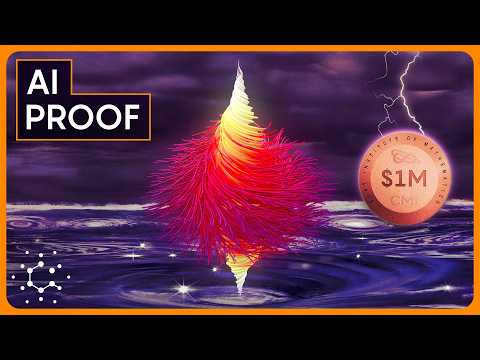
Artificial intelligence is about to hit science big time. After it's taken over mathematics, it's now coming for physics. And that's having a very interesting start. There have now been so many AI derived proofs that I've lost track at this point. No one can deny anymore that AI can deliver new and correct mathematical proofs. The archives being flooded with AI generated maths papers and mathematicians are complaining that AI proofs are incomprehensible and inelegant slop while they weep into their notepads. Then last week, OpenAI released a new batch of proofs, one that makes steps towards resolving a long-standing physics problem, whether Young Mil's theories exist. How relevant is this?
Well, Young Mill's theories are a type of theory that we use in the standard model of particle physics. So, you may reasonably ask, okay, how can they possibly not exist given that the standard model works so well? The reason is that what mathematicians mean by existence is not the same that scientists are indeed everyday people mean. For a scientist, something exists if it's a useful description of nature. For a mathematician, it means to prove that an object with certain mathematical properties can consistently be defined. It might totally be that the mathematical object of a young mill's theory does not exist, but that the calculations that physicists have derived from the idea of young mills theory still works in the sense of making correct predictions. You would then expect that the standard model is technically something close by Young Mills theory. Open eye didn't actually settle the case. At least that's my understanding of the situation as they haven't told us just exactly what they did. But physicists went and complained immediately that it's got no relevance for physics. And just like mathematicians reacted to the Navia Stokes proof, I think they aren't quite honest because if this result had been put forward by a human being, they'd have celebrated it. Meanwhile, physicists themselves have made good headway on dismantling their own discipline. You see, for decades, those physicists who work in the foundations have been publishing papers. By this, I mean not papers that are wrong, though some of them are, but I mean papers that are irrelevant mathematical fiction that teaches us nothing about reality. They invent new particles or forces or indeed entire universes and pretend it's science. The reason they do it is that once you've learned the maths, it's simple and you can get it published and that's the job. This nonsense paper production has completely stored progress in the field. But because it's mathematically simple and doesn't require much creativity, it's something that AI can do now. It's no longer hypothetical. One physicist has used AI to write 100 papers about the one detection of a potential dark matter candidate just for fun. One group has put forward a custom AI to cook up new particle physics theories. Another group did the same for modified gravity and dark matter new theories on demand. And yet someone else has used AI to write a new physics paper a day. And the thing is these papers are now by technical standards basically indistinguishable from all the other nonsense that gets published. What happens next then is going to be interesting. This harden over supply of irrelevant papers will force physicists to acknowledge that most of their own work is also irrelevant. They'll then have to come up with new quality standards and this could finally finally move the field forward. Maybe the first sign of physical super intelligence will be an AI that refuses to generate another dark meta model. What quality standards?
Well, I explained in my book lost in math what it be a useful strategy namely to focus on resolving mathematical inconsistencies. This is also why I think that the open eye young mills result whatever exactly that is might eventually turn out to be useful for physics as well. But this also makes clear where the current bottleneck is. Is that in contrast to mathematics, physicists don't have clearly defined problems of inconsistency that you can feed into an AI. They instead have a lot of illdefined pseudo problems. Like for example, the question of why the fine structure constant is what it is. We just recently saw an AI generated paper about this problem. It puts forward a superc contrived numerical construction.
The thing is though in terms of explanatory power, it's very difficult to beat a constant of nature. Yes, the fine structure constant is actually energy dependent, but that doesn't matter for my point. My point is that if your explanation is more complicated than the thing you're trying to explain, it's not good science. This paper about the fine structure constant is interesting nevertheless not because of its content but because of its origin. It comes from Alexander Whisner Gross. That's the guy who coined the phrase maths is cooked. >> Math is cooked. >> He has a PhD in physics and with two dozen other physicists he's running an institute for physical super intelligence. Their mission is to bring us the second golden era of physics.
Nice idea. The problem is though that AI has been trained on decades of mistakes in the foundations of physics and it's being prompted by people who've made these mistakes. That's not a good starting point. However, I also know that Claude has been trained on my book Lost in Math because Anthropic admitted to violating my copyright. This is why I remain hopeful and on standby for the second golden era of physics. Maybe they should start by figuring out why the first golden era ended. Mathematics is beautiful and that should be true not just for the meaning but also for the type setting. If you want beautiful equations for your papers, slides or videos, I recommend you use Radical Pi from today's sponsor. Radical Pi is an editor for equations where what you see is what you get. It produces instant professional results that rival and often exceed the output quality of Latte. But it's so much easier to use.
Every feature is available through the user interface where you find a huge variety of mathematical and scientific symbols. And you can adjust all the fine details like spacing, line thickness, the shapes of arrows, and even how much an integral leans forward. But wait, there's more. Radical Pi also has tools that let you draw lines and shapes directly inside your equations. It's an amazingly simple to use yet powerful tool. And the best thing, it's not a subscription model. You buy it once and it's yours. Go to radicalpie.com to download a free trial. And if you use my promo code Zabina, you'll get 15% off your personal copy that works forever.
So go and check this out. Thanks for watching. See you tomorrow.