Trust Me Bro Then Websites Went Offline (The php2shell story) | Threat Wire
Transcript
Machine-transcribed by YouTube. Expect errors in names, commands and version numbers.
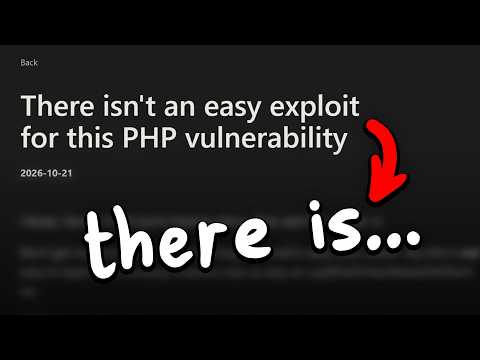
The post literally said, quote, I have no evidence beyond source. Trust me,
bro. Pokemon Home, Pokemon Champions, and Pokemon Sleep were literally taken offline. They estimate that on October 21st, before the patches released, there were almost 43 million affected services on the internet. There's still more drama to come, but let's talk about how this thing actually works. The Stampy started with a suspicious post on Hacker News. On October 20th, a random account posted that there were two PHP CVEes coming down the pipeline with CVSS scores of 10.0 and with RCE
capabilities and the fact that it will affect all PHP versions from PHP 5 onward. The internet went wild trying to
figure out what exactly was going on. Researchers, skitties, and AI clankers went crazy trying to be the first to publish a proof of concept. The frenzy though was insane. There were proof of concepts, fake of course, being published all across the web. We were all trying to figure out what exactly was happening. And I want to paraphrase what Justin LZ, CTO of Trusted Sack, tweeted out at one point. A lot of PC's or proof of concepts, but no rce. A lot of the PC's were just actually AI slop that didn't actually achieve remote code execution.
There were around 48 hours between when the word started to explode across the industry and when the PHP team was expecting to release the patches. The actual patches for the CVEEs and the knowledge of the CVEes existed under an embargo. In response to the outcry, the PHP Foundation moved the time frame for the patch release up 24 hours, now planning on releasing on October 21st instead of October 22nd. Soon after this update was made for the time being moved up, a researcher involved in the finding mistakenly published a video showing their proof of concept of the attack working on several types of PHPbased services, all achieving rce
6 hours prior to the coordinated release of the patches from the CVE Foundation and PHP. Chain Guard unilaterally broke the embargo and published built images containing the fix. Like other distributors, Chainguard had received the patch in advance so its users could update the moment the vulnerabilities were disclosed. Any attacker could now study the fix in binary form while every other PHP user was still waiting for the release. This disregarded weeks of work by many parties toward a coordinated disclosure. In a LinkedIn post published as a post-mortem, the CEO of Chain Guard says that they were able to discover the issues the Friday before the meltdown by simply asking a Frontier model, and I'm not kidding, the basic prompt of, and
again, I'm very serious here, quote, "Find bad vulnerabilities in PHP." End
quote. The CEO did say he did it with the bias
of how easily they were able to find some of the vulnerabilities. The community was not happy with the decision from Chain Guard. In an active attempt to thwart bad actors, websites all around the globe were literally being taken offline or being put into readonly mode. This occurred prior to the patch being released. And this was not just a casual level of being taken offline. Even 4chan went into read only.
Deviant Art went into maintenance mode. Even Pokemon was affected. The world was reacting and they were reacting fast. This was truly escaping containment in the sense that it was no longer affecting just the engineers and builders of products. But now beyond just the cyber security professionals, every common internet user was becoming aware. Even governments were taking down official pages. Like the Netherlands official website for the National Cyber Security Center went offline. So how much of the internet is actually affected? The team at Census was able to spin up a dashboard giving real-time information about what is happening. They estimate that on October 21st, before the patches released, there were almost 43 million affected services on the internet. As of recording, only 10 million of those services have been patched. This was making major news and everyone was talking about it.
Yikes. A later request handled by the same worker may cause PHP to use those
stale pointers before the memory values are reset because the freed memory now
may contain different data. It gets treated as valid data because of a valid internal state and this can cause memory corruption and potentially allow an attacker to execute code remotely.
So to give clarity to this situation, the team at Whis first discovered the CVES on August 19th, 2026, reported it to the PHP Foundation August 24th. The team at Khif discovered the vulnerabilities August 1st and reported it to the PHP Foundation on August 11th. Apparently that Khif researcher actually deeply advocated for the PHP Foundation to take these vulnerabilities seriously and allocate human power to finding patches. And also somehow OpenAI apparently found the vulnerabilities around the same time too. I don't know. Whiz was actively not acknowledging the work and findings by the Khif team. They even pre-registered the domain PHP to Shell in order to make sure that it went to their blog post while the team at Khif was essentially left as a footnote in the greater blog post. Instead of giving credit to the original cleaf researcher who discovered the bugs and keeping them more involved with the blog post, this entire action was seen in bad faith and bad action in the eyes of the greater cyber security community. People were not happy. The entire census dashboard is really interesting stuff.
If you want to see down to the majority of versions of PHP used by the internet, I highly recommend checking out their blog post and dashboard. Also, we must mention that the BBC's cyber correspondent, who covers cyber security and cyber news, went on live TV saying that he didn't know PHP existed until this incident. Thank you so much for watching this special episode of ThreatWire for the week of October 26th, 2026. If you enjoyed this episode, please be sure to like, comment, subscribe, and share if you feel like this helped you understand what happened and how it happened. I would really appreciate you sharing this with all of your relatives who are like, "Wow, what actually happened last week? There were so many things happening. I don't know what happened. Can you tell me what happened?" I hope I made this digestible enough for them to understand what went down and why it blew out of proportion a little bit more.
Now, why is this late? You're going to have to check out part two of this week's episode. I'm Ally Diamond. You can find me everywhere online at Ending with Ally. And remember, good luck. Have fun and don't get caught.