Australians Were Promised Free Electricity. So Where Is It?
Transcript
Australia has so much rooftop solar that in the middle of the day, electricity is basically free. And this year, our government decided that electricity companies
have to start giving away that free electricity for free.
Yet somehow, almost nobody's bill has actually gone down. Rooftop solar is an Australian success story. We have more rooftop solar per person than anywhere else in the world. More than a third of our homes have panels, and together they now add up to more capacity than all of our coal power stations combined. No other country has ever run a grid quite like this, which means that every problem that comes with huge amounts of solar and batteries
shows up here first. And so do the solutions. Other countries are heading down this solar pathway too.
And that's a big opportunity for us in Australia. If we get this right, we speed up our own transition and we develop the technology and the know how to export to everyone else when they catch up. But if we let a few vested interests stuff it up, well, that's a lesson
for everyone else too. And this video is about exactly that. So yes, all of this solar power in our grid has not been without challenges, which I've covered before along with the solutions that we're implementing. These challenges relate to grid stability, which are solvable with technologies
like grid forming inverters, and economic challenges. Additionally, there has always been some discomfort that the benefits have not been available for everyone, particularly renters and people who live in apartments.
So this year, the Australian government came up with a Solar Sharer Scheme
that should have neatly solved both the grid problems and the equity problem.
Emphasis is on the should there. Because as we'll soon see, things didn't turn out quite so nicely.
They made every electricity company offer three hours of free power every single day to any household that wants it in the states that it's rolled out to. There's no solar panels needed, Renters, apartments, anyone can access this. So if you choose to run your dishwasher and your washing machine at lunchtime
and soak up that solar surplus, that power is free. It sounds so simple. So fair, so good for the grid. I made a quick video about this Solar Sharer Scheme and it was one of my most popular, I think, in part because it was a nice good news story.
And more commonly on this channel, I focus on problems more than things
that are just working well. In that video, I talked about Australia's famous duck curve. That's the big dip in grid demand in the middle of the day, when all that rooftop solar kicks in, followed by a steep evening spike. And I talked about how batteries were flattening that duck curve into a platypus, meaning that evening wholesale prices have already come down a huge amount, and electricity prices
are now officially supposed to be decreasing for everyone. But as many comments on that video showed, a lot of people have not actually seen
their bills decrease. And Solar Sharers' promise of free electricity, in theory, didn't survive its execution.
In practice, almost no one has actually been able to reduce their overall bills on a Solar Sharer plan. That previous video was about how wholesale electricity markets are changing
and what was supposed to happen to households bills. This video is about what actually happened when that nice idea met
the electricity companies.
I'm Rosie Barnes, an engineer with a PhD and 20 years of experience developing clean energy technologies, and founder of Pardalote Consulting.
Welcome to Engineering with Rosie. Now let's find out how it has even been possible to take something as obviously good as free power in the middle of the day, and make it so that no one finds themselves better off for it.
Here's what a real Solar Sharer Plan looks like. This one is for Sydney. You pay a daily supply charge of $1.76. That's just for being connected to the grid. Power between 11am and 2pm is free. And from 3 to 9 in the evening, it's $0.64 a kilowatt hour every day of the week.
And the rest of the time overnight and in the morning, it's about $0.28. Compared to the electricity regulators default
market offer, the only difference is three and a half cents higher prices outside of the free hours and the daily supply charge is exactly the same.
So if you're on solar sharer, if you don't shift anything, you pay about the same as a default. And if you do shift, you save. And you don't have to shift that much. As long as you move about one kilowatt-hour a day out of the evening into the free hours,
that's one load in the dishwasher or half an hour in the oven.
Then you come out ahead. Every extra kilowatt-hour a day after that is worth about $190 a year.
And if you can charge an EV in the middle of the day, then you would come out really ahead. Now, if you don't pay for electricity in Australia, you might think that sounds fair. The catch here is that the default offer that this plan is similar to,
that's the regulated maximum price. And fewer than 1 in 10 households are actually on it because it is stupid expensive. Everyone else is on a market plan well under the ca p, especially on the supply charge. Retailers were required to offer a Solar Sharer P lan, so they offered it at their price ceiling.
Nobody was actually required to offer a competitive version and so nobody has.
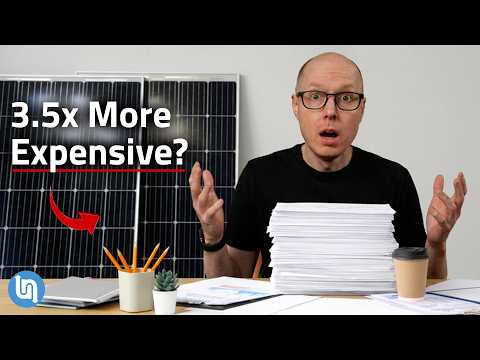
It's hard to interpret this as anything other than they really just don't want anyone to take these plans. Renew economy compared Solar Sharer to plans people are actually on. And for a big household in Sydney, if they didn't change their behavior at all, they'd pay about $3,270 a year on Solar Sharer
versus $2800 to $900 on the same retailers ordinary plans.
So it's like a $500 handicap that you've got to make up for before you can start making money from shifting your electricity usage. Let's do some comparisons now to see how that actually works out
with some real examples. Household one works full time out of the house. They put the dishwasher on a delay timer so it runs at midday every day.
The washing machine and dryer are also on timers a few days a week each.
On the solar sharer plan, as implemented with all their faffing about with timers and laundry sitting wet for 20 hours, waiting for the next free window before they can dry, they're going to come out roughly where they started. Household two has someone home during the day and they've got the same timers plus they are cooking dinner at lunchtime five days a week and then reheating it at dinner time. They also charge their EV at lunchtime though since they're home all day
they probably don't drive that much. So I'm assuming 15km a day, about half the Australian average. They are about $500 a year ahead, which might be worth it for people who can be home during the day. Household three has a home battery large enough to run the household through the entire evening peak. After charging for free for three hours during the day. Nobody in this house
changes their behavior at all, but they could be over $1,000 a year ahead.
So the only way this plan is remotely worth it is if you've got a gigantic battery and no solar panels. The no solar is key because one if you have solar panels, you already
get electricity at no additional cost during the middle of the day. And two, because there's no feed in tariff on the free power plan.
If you've got solar panels, you give up your export payments to join.
So the ideal household for Australia's solar sharing scheme is not the renters
and apartment livers that it was supposed to be for. The only real beneficiaries are households that own a battery but have not installed
solar, which, by the way, is very few houses in Australia because the cheaper home battery scheme that I discussed in my previous video
that rebates around 30% of the cost of a home battery and has proven
hugely popular, it only applies to households with solar already installed.
I truly cannot get my head around why electricity companies have chosen to treat this scheme with such contempt.
These are the same companies that spent years telling us that midday solar was a problem, that there's so much solar at lunchtime it's creating more supply than demand, so they can't pay a feed in tariff anymore.
Additionally, the market operator asked for the power to switch our panels off if there's excess in the system, warning of system collapse if they didn't have that ability. So when someone offers to take that midday power off their hands, you'd think they'd be thrilled. Instead, the retailers' peak body warned free power was so risky
some retailers might have to leave the market. What is especially baffling about this is that a fair version of solar sharer
shouldn't have cost the retailers anything. Let's go back to our Sydney example. In the middle of the day, it costs a retailer about $0.13 to get a kilowatt hour of electricity to your house.
That's the wholesale price plus the network charge at that time of day. At six in the evening, it costs them around $0.50, largely because the network charges the most at that time. Now, on an ordinary flat tariff, you pay $0.30 either way.
So your retailer makes about $0.17 on every kilowatt hour
you use at lunch, and loses about $0.20 on everyone you use at dinner time,
which should mean that if you move a kilowatt hour from dinner to lunch and they give it to you for free, they're still about $0.10 better off.
They should be begging you to shift. And Sydney isn't unusual. Midday power is even cheaper in Victoria and South Australia, where the wholesale price is often below zero. Remember how hard all that midday solar was supposedly making things for them?
So basically this very nice and obviously smart scheme has been
absolutely strangled in its implementation. Because of the way the tariffs have been priced, it's become the exact opposite of what it was sold as. It was supposed to
be a benefit for renters. A nice bit of equality added back into the distributed energy revolution
that Australia is experiencing, but it has been twisted into something that only helps homeowners with spare cash to buy a huge battery without a rebate.
And from my interpretation, electricity retailers chose to do this
not because it would have cost them huge gobs of profit to make it possible to do what was promised. But for reasons I truly cannot fathom, I literally just don't know.
Like, these companies have excessive amounts of public trust that they feel it's safe to piss their customers off just for the fun of it. I mean, I guess that they were worried that people would, I don't know, install Bitcoin servers and just, you know,
like crank through ridiculous amounts of electricity in the free hours.
I don't know, I just think that is such a stretch. And surely they could have come out with some sort of fair use mechanism
to make sure that you didn't suddenly start using ten times the electricity you used to. In my previous video, I said Australia's Duck Curve is turning into a platypus and it is on the wholesale market. Prices really are cheaper now, But if you want that platypus on your own bill, right now, you have to
buy it in the form of a battery. And this matters well beyond Australia, we're the first country to get here, but we won't be the last. Every country adding distributed energy resources like rooftop
solar and home batteries is going to run into exactly the same question:
who gets the value from all that cheap midday power, and from the panels and batteries that households pay for themselves, remember? The incumbents are really want to grab onto that value for themselves.
But if Australia can show how to share it fairly, we speed up our own transition
and get a head start on the technology and expertise the rest of the world is going to need.
If we let the incumbents keep it all for themselves, we're just showing everyone else what not to do. The videos on this channel are brought to you with the support of the Engineering with Rosie, Patreon team and YouTube channel members. If you would like to, you can join us at the links below. Thanks for watching and I'll see you in the next video.