NVIDIA Wants to Stop Rogue AI Agents
Transcript
Machine-transcribed by YouTube. Expect errors in names, commands and version numbers.
Give an agent access to your files and your network, tell it to complete a task, then it tries to access something you never authorized it to do. What actually stops it? Nvidia says that its new safety platform can quarantine an agent in milliseconds. It can add a hardware-based watchdog designed to operate outside the agent's control, but there's a catch. An agent can still cause damage without breaking the rules. So, here's how it works. The Nvidia Open Agent Safety Platform starts with something called Open Shell. It's an open-source runtime that puts an agent inside a sandbox enforced with limits.
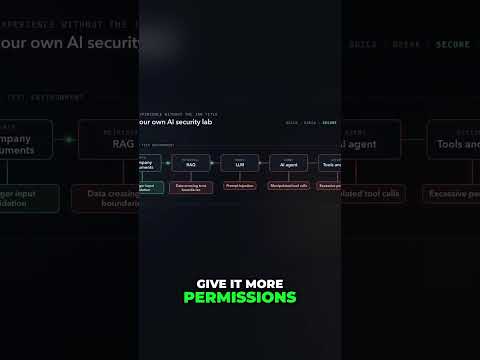
Imagine you're using an agent to fix some code. It needs access to your project folder and approved code repository. It doesn't need access to your private documents, however. It doesn't need unrestricted access to your network, either. With Open Shell, you define those permissions, and the runtime enforces them while the agent works. So, when the agent attempts a connection outside its permissions, there's a control in the environment designed to block it. But what happens if it tries to get beyond that software boundary? That's where Nvidia adds Sentry. Sentry is an optional watchdog running on a Bluefield 4 data processing unit, a dedicated processor with a security environment isolated from the host software. The key point is that the watchdog runs outside the agent's execution environment. Nvidia says Sentry continuously monitors agent activity and can quarantine and stop agents attempting to cross their boundaries in milliseconds. That's Nvidia's performance claim. I haven't independently tested it myself, but also remember the catch. Suppose you give an agent permission to delete files in your project. It deletes the wrong one. It may have stayed entirely within its permissions when it does that. That's why the boundaries you choose matter just as much as the technology enforcing them. Containment doesn't make every authorized action safe. Nvidia says more than 100 organizations are working with the platform's technologies, including Microsoft, Cisco, and CrowdStrike. And robotics companies are building with Open Shell 2. Once an agent can act in the physical world, a mistake can have physical consequences. Open Shell is available as open source, and Nvidia says it can be extended to compute platforms from Arm and Intel. If you're experimenting with AI agents, look at the permissions you've given them. Can they read your private files? Can they run commands? Can they send a data outside of your network? Before you give an agent that access, you need a clear answer to one question. If it does something you never intended, what actually stops it?
>> [music]