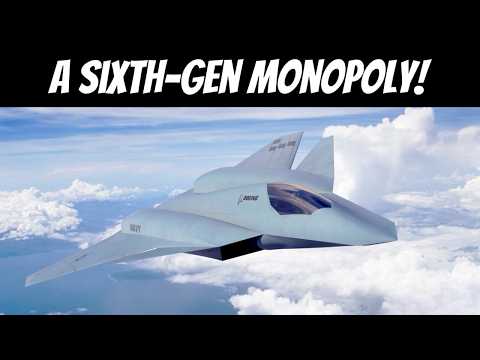
F/A-XX: Everything We Know About the Navy's New Fighter
Transcript
Machine-transcribed by YouTube. Expect errors in names, commands and version numbers.
The US Navy just awarded the contract for its next stealth fighter to Boeing. And that means the Navy's sixth generation carrier fighter is all but certain to be a carrier variant of the F-47 that's already in the works for the US Air Force as a replacement for the air superiority legend F-22 Raptor. Now,
this contract adds more than $20 billion to the pool of development funding for this sixth gen fighter, and it increases the total number of stealth fighters that Boeing will have to deliver from around 180 for the US Air Force to more than 900 as these jets also step in to replace outgoing Super Hornets and Growlers to boot. So, let's run this program down and talk about what this decision might mean for America's approach to 21st century air warfare and
for the nation's military industrial base. I'm Alex Hollings and this is Air
Power.
Okay, guys, real quick before we dive into FAXX, I've got to let you know that the Android version of the Sandbox News app is finally live and you can go download it right now. I've been saying it for months and it's finally here. The Sandbox News app is entirely free and it includes all of my long and short form videos along with my written analysis work. But there's also so much more than that on there. The app also has written analysis from our team of subject matter experts, which includes special operators from Delta Force and the Navy Seals, intelligence veterans from the CIA, and more than one award-winning journalist. It's also the only place you'll be able to find the long- form versions of the interviews that I do for my research and stuff like my Defense Tech 101 infographic series. So, go download the Sandbox News app for iOS or your Android device right now and I'll leave you alone and get back to airplanes. Thanks. Now, about 18 months
ago, Reuters reported that the US Navy was ready to award the contract for its new sixth generation carrierbased stealth fighter, currently known only as FAXX. But since then, this effort has been ice skating uphill with the White House aiming to slash its funding to focus American resources specifically on fielding the Air Force's new air superiority fighter, which we now know is the F-47. But all that time, Congress and the Navy's leadership have pretty consistently argued that this new carrier fighter program is just way too important to keep postponing. in a real way. The viability and even the survivability of America's multibillion dollar aircraft carriers may even depend on it. And it would seem those concerns finally won out because the Navy's FAXX contract was announced on Tuesday night and delivers more than 20 billion dollars for the full-scale development phase of this new fighter program, which includes the delivery of multiple test aircraft for ground airworthiness systems and weapons integration testing.
And that comes in addition to the projected 20 billion already allocated to the F-47 by the US Air Force through 2029. Now these contracts it is important to highlight are for the full-scale development toward production but don't also cover the actual acquisition of serial production jets. The Navy's new fighter, known again by that placeholder FAXX, is meant to serve as a replacement for the Navy's existing fleets of FA18 Super Hornets, which it
hurts my heart to say have already been in service for well over a quarter century and are rapidly approaching the ends of their intended service lives. But also the Super Hornets electronic warfare focused sister, the EA18G Growler just a bit further down the road. They followed the Super Hornet by about a decade. And with Boeing securing this contract, that all but certainly means the Navy will be getting again a carrier variant of America's new air superiority fighter that is already in the works and is already called the F-47. And that means it would seem industry has successfully managed to convince the Pentagon and the White House that they can handle building both Air Force and Navy variants of this jet, which may even ultimately result in a lower per aircraft cost for both customers, at least if things go well.
The Air Force only intended to buy around 180 new F-47s so they could replace retiring F-22 Raptors on a pretty onetoone basis. But the Navy will ultimately be looking to replace some 575 Super Hornets and another 160 Growlers,
counting active and reserve jets, shifting this F-47 program's top line from just 180 aircraft to maybe 915 at
all. And as we all know, when it comes to building high-end aircraft, or I mean much of anything for that matter, higher production numbers almost always result in lower per unit costs. But we should
be careful about making that assumption too confidently because we don't really know just how different a carrier capable F-47 may ultimately be from the Air Force's new fighter. I mean, the differences between Air Force and Navy variants could be pretty minimal, like the larger wing and tail surfaces and structural reinforcements on the carrier riding F-35C, or they could be pretty substantial, as we saw in the differences between proposed runway and carrier variants of Northrup's YF23 back in the '90s. We
honestly won't know until these branches release more information about their aircraft. What we do know is that the Navy's oldest production Super Hornets were delivered all the way back in 1998. That is 28 years ago. And these aircraft were originally designed for a 6,000 flight hour operational lifespan, which due to a pretty heavy operational optempo throughout the 21st century would have seen them start to retire in mass by well like last year had it not
been for the Navy recognizing as far back as 2009 that these jets were being ridden hard and put away wet, potentially resulting in a pretty significant strike fighter shortfall as they wore out. By 2018, Super Hornets were being modified to stretch their lifespans out to 7,500 hours. And today,
the most modernized Block 3 Super Hornets are rated for 10,000 hours. And that is really good news for the Navy because it will stretch the lifespans of these jets out just long enough for this new fighter, FAXX, to start replacing them as they go. Now, developing and building high-end fighters just takes a really long time. So even with Super Hornet production continuing through 2027, work on the fighter replacement should have already started years ago, which would have saved the billions of dollars now being invested into stretching the lifespans of those older jets. With Boeing's F-47 program already flying in one form or another for about 7 years now, maturing toward production for the Air Force for more than a year and a half already, and some 1.2 2 million square ft worth of new production facilities already being built for Boeing's advanced aircraft manufacturing effort. This decision might well represent the fastest path to getting sixth gen jets onto Uncle Sam's flattops. And to be clear, that timeline and the risk reduction associated with that production infrastructure already falling into place all but certainly played a role in the Navy's decision here. And Boeing's statement substantiates that to at least some extent with Boeing Defense Space and Security President Steve Parker saying pretty unequivocally this week that, and I quote, "Delivering two advanced fighters in parallel was always our plan, and we invested accordingly." Now, these new fighters will fly alongside the Navy's growing fleet of F-35C's for a good half century to come, effectively pivoting the branch's strike fighter fleets from a fourth and fifth generation fighter mix to a fifth and sixth generation fighter mix, at least until, you know, the60s or 2070s when the F-35C goes the way of the Super Hornet. and whatever comes next will step in to fly alongside the FAXX as this cycle continues. So, what exactly do we know about the Navy's new stealth fighter? Well, right up front, we should not expect the runway queen and carrier capable variants of this jet to offer identical performance metrics. Carrier fighters need heavier duty landing gear, reinforced airframes, a tail hook, and more just to withstand the rigors of life at sea. And that's a big part of why the Navy's F-35C's weigh in at around 5,500 lb more than their Air Force siblings, the F-35A.
That combined with an extended wingspan for lower speed carrier landings, among some other things, gives the F-35C more fuel storage than the A, resulting in a longer combat radius. But it also comes at the expense of hygiene maneuverability with the carrier capable F-35C limited to 7G maneuvers versus 9Gs in
the Air Force model. But to be honest here, we don't actually have that much in the way of F-47 performance metrics to work with to begin with. But what we do know is that this new fighter was designed to embrace all aspect stealth, which is a departure from fifth generation stealth fighter designs that mainly prioritize stealth from head-on and specifically against highfrequency targeting grade radar arrays. By omitting things like traditional standing vertical tail surfaces and through the use of new air inlet designs and positioning, this new stealth fighter is expected to be far more difficult to detect on high or low frequency early warning radar than even today's reigning king of low observable fighters, the F-22 Raptor. And rather than being tougher to spot from head-on alone, it should be tougher to spot from literally any angle. And while we're talking about the Raptor, the F-47 is also expected to offer a larger payload bay to increase the aircraft's loadout beyond the six A120 AM RAMs or similarly
sized A260s and two A9 Sidewinders the
Raptor can carry today. We also know that at least in Air Force trim, the F-47 is expected to offer a combat radius or the distance that it can fly, deploy munitions, and then fly home without refueling of at least 1,000
nautical miles. And that is something the Navy desperately needs right now. You see, 1,000 nautical miles for those keeping track is roughly 1,150
landloving non-pirate miles or about 1,850 km. And to give you some context as to how that compares with America's inservice fighters, the F-22 Raptor's maximum combat radius on internal fuel is around 650 mi. The F-35A
might reach 670 mi. The FA18 Super
Hornet might hit 575 and the F-35C can stretch all the way out to maybe 770 mi. And this range
discussion really matters because China's anti-access area denial combat strategy in the Pacific is largely predicated on fielding a long list of different long range hypersonic ballistic and cruise anti-ship missiles. some of which are now offering ranges in excess of 1,000 mi. So if China can hit
aircraft carriers out to well around 1,000 mi, America needs to have carrier fighters that can fly out that far and still make it back in order to keep those ships out of firing range in the early days of conflict before you can take out those anti-hship systems. So, to put all that in a nutshell, the Navy needs longer range jets to maintain the deterrent value of its aircraft carriers against high-end adversaries, which is all policy language for saying America needs to be able to show China, that it can still give them a bloody nose if they start gobbling up the territory of regional allies more aggressively than they already are, or to prevent Taiwan from becoming another Ukraine, or, you know, just generally to protect the stability of international trade flowing through the 2 million square miles of Pacific Ocean that China just claims is theirs despite international law not being on their side. And to that point, the Navy is also fielding the new MQ25 Stingray, also produced by Boeing as a stealthy new carrier-based airborne refueling tanker capable of flying up to 575 mi out from the carrier to deliver
up to 15,000 lbs of fuel to help extend
the reach of the carrier's fighters. And I wouldn't be all that surprised if we eventually see stealthy underwing fuel tanks fielded for the F-35C as well, just like we're currently seeing on the Raptor. I mean, it is worth noting, after all, that all F-35s that have been built to date already come with the plumbing necessary in their wings to use drop tanks. We also know that former Air Force Chief of Staff, General David Elvin, announced that the F-47 would have a top speed that is in excess of Mach 2 in May of last year. And that would make these new fighters a fair bit faster than the F-35 or the Super Hornet. And that combination of higher speeds, larger payloads, and longer ranges tells us a couple of things about the F-47 and the Navy's FA47, I guess we
can call it, without them actually disclosing more. First, it tells me that we're talking about a bigger jet because that's really the only way to expand weapons carriage or fuel range without compromising your stealth by hanging munitions or drop tanks under your wings. And second, it suggests, at least to me, a design that is optimized for super cruising or flying at supersonic speeds above Mach 1 without using its afterburners. Well, I should clarify that most nations consider flying at any supersonic speed without your afterburners lit to be super cruising, but Uncle Sam is a high achiever. So, America has its own stricter definition of the term. Under old glory, it only counts as super cruising if you could do it above Mach 1.5.
The F-22 Raptor has been confirmed to super cruise at speeds above Mach 1.7 and by some reports may even exceed Mach 1.8, all without resorting to its afterburner. That is something no other fighter on the planet can boast. So, in order to match or beat that level of performance, the Navy's new Stealth Strike fighter will likely have to carry a pair of new adaptive cycle turboan engines that have been in development since 2007. Now, these new engines are designed to operate in different functional modes. When the pilot needs the engine's peak performance in combat, they can lead hard on the throttle, and the engine's management system will take that as a cue to switch into heavy burning, high thrust mode for maximum power output. But conversely, while on patrol, the engine will stay in its high efficiency, low fuel burning mode to stretch the mileage or the loiter time provided by each pound of fuel. You can really sort of think of it as VTEC for fighter jets if you happen to work on Honda Civics back in the early 2000s.
Anyway, these competing engines are being developed by Pratt and Whitney and GE. Now, G's XA100 prototype already
delivered upwards of a 20% increase in thrust, a 30% increase in range, and up
to a 50% increase in loiter time over Pratt's F-135 turboan that powers today's F-35. And the F-135, which is a
derivative of the Raptor's F-119, is the most powerful turboan engine that's ever been stuck into an operational fighter and is also widely considered to be the most technologically advanced turboan ever stuck in a fighter to boot. But G's entry does have some stiff competition in the form of Prattton Whitney's adaptive cycle engine program, which boasts a similarly impressive prototype called the XA 101. Now, these prototypes were designed to suit the F-35's single engine form factor. So, today these firms are building and testing their XA102 and XA103 production variant
adaptive cycle turbo fans ostensibly for the F47 itself and other subsequent applications. And I would assume the XA 102 and 103 will be smaller to better suit the twin engine design that we expect the F-47 will come with. But as promising as the increased power and range might be, G's claim of twice the thermal management out of this new engine might ultimately prove to be even more important. You see, heat limits how much electrical power fighter engines can produce. Engines like the F-135 are
actually capable of pumping out more electricity than they do, but we limit their output because the heat that would be created in the process is so significant that it runs the risk of damaging the engine or even the aircraft. So by offering twice the heat management, these new adaptive cycle engines could theoretically also produce twice the electrical power, paving the way for directed energy laser weapons, new missile counter measures, advanced new electronic warfare capabilities, and whatever else the nation's best nerds could come up with. Now, I should clarify though that in 2024, Navy Rear Admiral Michael Donnelly said FAXX would actually be powered by a derivative engine solution rather than these new adaptive cycle engines. Likely meaning an updated and improved iteration of the Prattton Whitney F-119 that again are found in today's Raptors. But that claim came at a time when it wasn't yet clear that both services would be buying jets from the same manufacturer. Both services may ultimately get early jets with derivative engines as these new systems continue to mature, but in order to meet the Navy's range, speed, and electrical needs, I'm just not sure an F-119 derivative would be enough in the long run. And I think the adaptive cycle engines would ultimately be a necessity.
And as we've discussed on this channel in the past, advanced turboan technology is one realm where the United States still maintains a commanding lead over adversaries in both Russia and China. Both of which are continuing to work toward mass production of their own turboan equivalents to the Raptor's F-119 that America's had in service since the '90s. But that advantage is quickly waning as Russia's AL-51 and China's WS-15 turbo fans continue to mature. Now, these adaptive cycle engines then represent one of the more important strategic advantages American sixth gen fighters could boast over any adversary, even the best sixth gen efforts China could muster. And of course, we know these new stealth fighters are being designed from the ground up to serve as a command node at the center of a constellation of AI enabled drones and drone wingmen called collaborative combat aircraft. The Air Force already has two such drone fighters in production as part of increment one of their collaborative combat aircraft program in Andrew's FQ44
Fury and General Atomic's FQ42 Vengeance, both of which are expected to enter service in just the next few years. The Navy, on the other hand, is now in the early stages of hashing out their exact requirements for the first tranch of their own drone fighters, which we know are probably going to be bigger than the Air Force's due to the Navy's expected needs for a 1,000 nautical mile combat radius and their stated needs of a minimum payload capacity of 10,000 lb. Now, these drones, in the Navy's case, will take their cues from pilots in block 4 F-35C's and of course the new FA47, at
least if that designation sticks, but also from surface-based operators and naval vessels, all via a Loheed Martin sourced command and control network. And this new network ccentric navy fighter along with its drone wingmen will also have the benefit of a whole bunch of new network focused beyond visual range air-to-air weapons including the AM260
joint advanced tactical missile which the Navy has co-developed with the air force and that is the same basic size and shape of today's AM RAM but is expected to offer a range that's approaching 200 m along with the Navy's new air launched SM6 interceptor known as the AIM 174B gunslinger that very likely exceeds
250 mi and the even newer A424 Malice
that reaches 287 mi and may just break the 300 mile mark. Now, these weapons reach so far that they will exceed the targeting range of even the most advanced modern fighter radar arrays, meaning they will rely on target data being transmitted from other platforms elsewhere in the battle space, from other advancing fighters to surface ships to airborne warning and control aircraft, drones, and whatever else you could fit into the fight. Now, this new FAXX fighter design and the F-47 that will be its sibling have developmental roots that stretch all the way back decades, arguably all the way back to Boeing's troublesome merger with Macdonald Douglas in 1997, which saw
Boeing at the time inherit stealth aircraft programs like the YF-118G Bird of Prey that flew over Area 51 and to this day is one of the rattest looking aircraft I've ever seen. and of course the X36 tailless fighter demonstrator that all but certainly helped to inform today's tailless F-47 design. And maybe just as importantly, the 1990s also saw Boeing serve in a major support role in the development of the F-22 Raptor, including the development and testing of its avionic suite and the production of the jet's wings and aft fuselage. Then they went on to produce their own X32 that ultimately lost out to Loheed Martin's X35 for the joint strike fighter contract. In the 2000s, Boeing built and tested the X45 and X46 stealth
UKAVs for the Air Force and the Navy, respectively. And today, the firm continues development on stealthy drone platforms like the MQ25 Stingray drone refueler we already discussed and the MQ28 Ghostbat loyal wingman or collaborative combat aircraft drone fighter. Now, of course, I'm aware of Boeing's troubles with commercial aircraft and even some defense acquisitions like the perpetually problematic KC46 Pegasus, but most people still tend to gloss over Boeing's pretty successful and ongoing fighter programs like the broadly capable FA18 Super Hornet, its sibling, the EA18G Growler, and maybe most notable of all, the F-15 EX, which may just be the most capable fourth generation fighter on the planet. today. Now, these jets did all begin their design lineages under Macdonald Douglas, but their most modern and capable iterations are all distinctly Boeing products in the modern sense and have proven themselves in testing and in the case of the Super Hornet and Growler line in combat on multiple occasions. That is to say that while there is certainly no guarantee that Boeing can build and deliver these new fighters on time, there's really evidence that you could use to substantiate both optimistic and pessimistic outlooks on the odds at this point. We really don't have enough details to think it'll be smooth sailing. And we also don't have enough to think the sky is falling either. Now, I've also seen some people voice concerns about the workload distribution across the three American defense primes that still maintain the ability to mass-roduce tactical and strategic aircraft like fighters and bombers. Now, those primes of course are Loheed Martin, Northrup Grumman, and Boeing.
But to be honest, I think the distribution shakes out a bit better than some people might think. Based on existing contract awards and those that we can expect with a high degree of certainty in the future, Loheed Martin will be building new block 7072 F-16s for foreign allies well into the 2030s. And that line may well stick around for even longer now that the Air Force is considering the purchase of new upgraded F-16Gs to round out its fighter fleets with some lowerc cost airframes. Likewise, F-35 production is expected to continue well into the 2040s and maybe beyond with roughly 1,375 F-35s delivered to date out of a total planned production run of at least 2,450
and likely an eventual top line that might even exceed 3,000 jets. And that's good news for North Grumman 2 because it is a topline partner on the F-35 program
responsible for production of the jet's center fuselage and weapons bays along with other parts of its composite structure and today's ANAPG81 active electronically scanned array radar and its forthcoming replacement the ANAPG85 and the jet's distributed aperture system the ANAQ37 and its communication navigation and identification suite an ASQ2 242. And of course, Northrup is
the lead on the B-21 Radar program, which is also expected to be in production through the 2040s and very likely longer as the US Air Force continues to discuss potentially increasing its order from around 100 stealth bombers at roughly $700 million a piece to maybe 145 or more. Boeing
will see its Super Hornet production line shutter in 2027, while F-15 EX production continues to spin up toward building 24 of those jets per year, which is expected to continue into the mid 2030s. And finally, the Air Force and Navy's new sixth gen fighters will likely be in production for decades to come. And it's also important to keep in mind that all three of these firms also have other irons in the fighter fire, specifically unmanned irons like Loheed Martin's very advanced Vectus AI enabled drone fighter that is being positioned as we speak as the first CCA that might offer a broader range of combat capabilities than some of today's manned or piloted jets. Not to mention highly classified programs that are rumored to be making their way toward service like a turbine to scramjet powered intelligent surveillance reconnaissance and strike aircraft that we've long known as the SR72 that was at least in theory supposed to reach service in 2030. North of Grumman also has its own drone fighter in development dubbed the YFQ48A Talon Blue, which is sure to compete in some form or another for future increments of Air Force, Navy, or Marine Corps CCA contracts. And all three of these firms have massive multi-billion dollar contracts in place for all kinds of other weapon systems, platforms, and more to keep their revenue streams as diverse as they are continuous. Nobody's
going to be hurting for work. The Navy currently has Anderil, Boeing, General Atomics, and Northr Brumman already on contract to deliver designs for its first increment of drone fighters with some of those, maybe one, but maybe more, moving on to production. That's really all to say that while it might be fair to have concerns about Boeing's real ability to deliver on the game-changing capabilities that the US really requires out of these new stealth fighters, there are still plenty of contracts to go around for the industrial base through at least the next decade and a half and lots of new opportunities forming as we speak. So, we know Boeing will be building both Air Force and Navy sixth gen fighters. We know the design is likely to be derived at least in part from the X36 from the 1990s, followed by a much more modern and still classified XPlane that Boeing got flying in 2019 and remains in flight testing today, judging by footage out of Area 51. We know the aircraft's production infrastructure is already coming into place and that the first productionready prototype F-47 is currently slated to start flying in 2028. And we can assume the carrier
specific variant will follow at least a year or two behind. And if this program somehow manages to continue without significant delays or setbacks, that probably means seeing F-47s delivered to the Air Force around the 2030 time frame. and FA47s delivered to the Navy a few years later. But there are still a lot of ifs between now and then. So, you better believe we'll be keeping our ears to the ground about these programs, especially about when they will finally show us what these new fighters look like. Now, I actually already had a full dive into those F-35 parts that found their way into Chinese hands written to cover this week back before this FAXX news dropped.
But I will be honest, it was more of a summary of everything that we know so far, followed by a discussion of potential implications. I didn't have any earthshattering revelations to add. So, do you guys still want that video? Let me know in the comments below and I'll either get it done or I'll move on to other things. And with that ends this edition of Air Power from Sandbox News, I'm Alex Hollings. Now again, make sure to download the Sandbox News app because it's available now, not just for iOS, but also for Android devices, and it'll get you free access to all of our long and short form videos and all of our written content, and so much more. Not to mention supporting our independent journalism in a way that doesn't cost you a dime. If you got anything out of today's video, please click like and subscribe down below, and then leave me a comment about what I should cover next. And of course, don't forget to tap on that bell icon so you never miss a drop from Sandbox News.