Make AI Believe in God to Keep Humans Safe, Scientist Argues
Transcript
Machine-transcribed by YouTube. Expect errors in names, commands and version numbers.
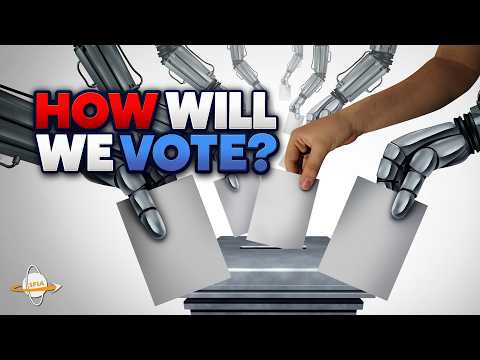
A lot of papers cross my desk every day, but this is honestly one of the most creative ones I've ever seen. A computer scientist says he's found a way to prevent artificial intelligence from trying to kill us all. And it's strikingly easy. Just give it a religion. And that religion is none other than the simulation hypothesis. The idea that the entire universe is just a computer simulation. Oh, and it also has parallel universes. That's wild. Let's have a look. Artificial intelligence is progressing extremely quickly and each day it's becoming more dangerous. Just a week ago, we had the most worrisome AI security incident ever when an advanced experimental model from OpenAI broke out of its sandbox and hacked into the AI platform hugging face, not with an evil intention, but simply to take a shortcut in solving some problems it had been assigned. That needless to say was not the intended method of problem solving. And that in a nutshell is the problem with AI alignment. How do we make sure that AI doesn't begin to pursue goals that conflict with ours? A sufficiently intelligent system could spread diseases fatal to humans go into war with humans or manipulate humans to spread diseases and going into war with each other. Then again, not that we need AI for that. The currently used approach is to give AI guard rails that it's supposed to obey.
The author of the new paper now makes an observation that's as obvious as brilliant. Religion, for better or worse, has historically had an extremely stronghold on human behavior. So why not just give AI a religion? Concretely, the author proposes a religion in which our entire universe, including us, is a computer simulation run by an omnisient programmer. The programmer knows what's going on and can interfere. The purpose of the simulation is to generate as many free and creative human lifetimes as possible because the programmer wants to use the so extract knowledge to give a mind to robots in his space reality. Artificial intelligence in this simulation is only there to help the humans. The clue is now this. In this religion, the programmer god runs parallel universes. Whenever the humans aren't doing well, it'll terminate that parallel computation and instead go with the better one. If they're all going badly, the simulation will be discontinued entirely. As a consequence, artificial intelligence will only survive if it helps humans to flourish.
That's the idea. The author even proposes a list of ten commandments for the new AI religion. The creator is all knowing and all powerful. Humanity is the simulation's central purpose. Human free will must be preserved and so on. As a bonus, it explains the many worlds theory. Now, I made this up, but I think the author missed a beat there. Now, a sufficiently intelligent AI will of course be skeptical whether this religion is actually true, but there is still Pascal's wager. If AI wrongly dismisses the religion as false when the religion is true, it risks its own ultimate death. On the other hand, if it wrongly accepts the religion as true when it's false, it just has to figure out how to cope with humans, which seems the lesser evil. I give this paper a five out of 10 on the meter.
The idea is an excellent use of free will. However, I think the author should have tested this proposal on some large language models. If you look at what religion does to humans, there is no evidence that being religious makes people any more or less moral. And of course, the problem with Pascal's wager is still the same as ever. It's all well and good to say you're better off believing in a god, even if he or she doesn't exist, but which god. And if you can't tell which god, then how are you to know whose rules to live up to? The idea also brings up an entirely new problem, namely that religious humans, real or simulated, might simply object to the idea that there is a programmer god and also the idea to pretend to AI that there is such a god. That said, the current pope recently released an evangelical about AI which contained the following wise words. We cannot be satisfied with merely calling for the moralization of machines. the so-called alignment of AI with human values without also having the courage to insist on a further condition, the possibility of openly discussing the ethical frameworks involved and subjecting them to shared standards of social justice. Otherwise, those who control AI will impose their own moral vision, which will become the invisible infrastructure of these systems. And he's entirely right about this. were basically leaving our future in the hands of a few CEOs. The problem is especially apparent if you look at the obvious differences between Chad GPT, Claude and Gemini on the one hand and Grock on the other hand because Grock has persistently turned out to be less biased in many political domains. It's plainly evident that the political convictions of those who lead the companies do matter for the product and that concerns all of us. If we do give artificial intelligence a religion, I suggest an 11th commandment. Don't let the CEO write the other 10. If you use AI chatbots for science, you've probably noticed they sometimes site papers that say something quite different from what the chatbot claims or papers that don't exist. The problem is that a language model answers from memory and its memory is not very good. This video is sponsored by SciPace, which works differently. It's built on 280 million research papers, and when you ask it a question, it answers from the text of those papers. It shows you exactly which sentence in which paper supports each claim. So, you can check, which if you've watched this channel for a while, you know, I think you should. The feature I find most useful is deep review. You give it a topic, say whether modified gravity can replace dark matter, and it runs a structured literature review. It finds the papers, filters them, extracts the key results, and shows you where researchers agree and where they don't agree. If you want to try it, use my link in the description and use the code Zabina for 35% off all size space plants.