BREAKING: Boeing Wins F/A-XX Contract
Transcript
Machine-transcribed by YouTube. Expect errors in names, commands and version numbers.
Hey guys, uh no notice live stream here.
Uh we just had a uh important announcement that we knew was imminent
most recently because of our conversation with Congressman Rob Wittmann at NAS Ocean Air Show last week. He kind of teased out that the announcement was about to happen. So now
it officially has. So, let me share my screen with you here and let's read what's going on.
So, here's the official announcement from the US Department of War, war.gov.
Headline reads, Department of War and US Navy award contract for FAXX program.
And this is within the hour. It reads, "Today, the Department of War announces a contract awarded by the US Navy to Boeing for the sixth generation FAXX strike fighter under the next generation air dominance and GAD program. Contract
valued at more than 20 billion for the fullscale development phase. The contract procures multiple test aircraft for ground airworthiness systems and weapons integration testing." quote, "The FAXX is a critical pillar in our commitment to maintaining peace through strength. FAXX will dominate contested airspace, extend operational reach, and deliver a decisive combat advantage for the war fighter," said Michael P. Duffy, under Secretary of War for acquisition and sustainment. Quote goes on, "The FAXX platform represents a crucial non-negotiable investment in America's national security and long-term air combat capabilities. We're joining forces with Boeing to field these capabilities rapidly, ensuring our war fighters possess lethal and highlyworked systems required to deter aggression, project undisputed power, and secure absolute air superiority.
FAXX will provide advanced carrierbased power projection that extends the range of most agile and survivable airfields, US Navy carriers, and that has just been proven by Epic Fury. how many bases were hit and how many aircraft carriers were hit during the seven-month war with
Iran. In addition, FAXX will be inop
interoperable with manned and unmanned platforms such as collaborative combat aircraft. We saw
some of the mockups at Tail Hook. They're pretty cool looking and they're bigger than I thought they'd be. They're as big as a regular fighter. and increase the capability of every CCA it teams with. Quote, "This achievement marks a new era for the US Navy," said acting Secretary of the Navy Hunga. "The sixth generation fighter is a generational leap in air superior in air superiority and will provide the world's best aviators with unparalleled capabilities to fight, win, and come home safe. We are excited to partner with Boeing and for our war fighters to continue to dominate the skies and defeat our nation's enemies. Following this contract award announcement, Boeing will deliver the platform to augment and a eventually replace legacy Super Hornets E and Fs
and EA18G Growlers beginning in the 2030s and operate alongside the F-35C.
And the final statement is this next generation strike fighter FAXX will secure the skies and deliver peace
through strength for decades to come.
All right. So that's uh that's the announcement. There's also the first
outlet to cover this actually before the official announcement came out uh were our friends at Breaking Defense. and they they point something out here that that is kind of important to this whole conversation. So, let me bring up their coverage.
So, this is Breaking Defense written by Valerie Inca and Michael Mero
just what less than an hour ago.
Boeing wins next Navy nextg fighter FAXX
competition. So, the Navy has chosen FAXX. Two sources told Breaking Defense ahead of the formal announcement. So, good get for these folks. Okay, here's the important part. The selection locks Boeing in as the sole supplier of sixth generation fighters for the US. In March of 2025, Boeing won the right to develop and produce the Air Force's next gen fighter, dubbed the F47. And you guys remember that roll out in the Oval Office. Two wins collectively mean Boeing has iced out both of its biggest competitors, Lucky Martin and Northrup Grumman, from the sixth generation American fighter jet marketplace for the foreseeable future.
A shocking turnaround for a firm that in early 2025 was at serious risk of ending
its fighter production entirely in the coming years. And it points out that Loheed will continue building the fifth gen F-35 JSF. Per a Pentagon release
that followed the publication of this article. The agreement is valued at more than 20 billion for the fullscale development phase. And the rest is what we just read in the announcement. We read the Michael Duffy quote. We read the Hunga quote. Says Boeing declined declined to comment ahead of the contract award. Of course they did. Um, in a statement, Northrup said that quote, "It offered a highly survivable, digitally advanced sixth generation fighter to the US Navy. We look forward to receiving additional information about their selection, which means we just may protest this award, but we'll have to see. The FAXX program has had a windy path to
this point. Shortly after the Air Force awarded the F-47 contract, there were rumors that we also forwarded on this channel that FAXX would be next, like imminent, like days afterwards. And then the program seemingly stalled out. In July 2025, the White House declared that moving forward with the Navy's fighter would imperil F-47 success, and officials inside the department quarreled over whether to move forward with the jet. Uh again, we we talked about that and and how that was uh maybe an issue at the uh at the administration level, but you know, these uh defense
contractors can can do two things at once. Um and or I guess we'll see uh if they can do two things at once, but I I I don't think that logic was was sound. As we said, I I think this maybe was Secretary Ang wanting to focus on F47
and probably has a promise to President Trump to deliver the airplane. Maybe a low rate production, not not IOC and full rate production by the time President Trump's President Trump leaves office this time, but whatever. Uh, and
it says Congress and Navy Brass, meanwhile, insisted it will be a crucial part of the airwing of the future, and it is. and we'll talk about this uh in a second. The Navy has kept public information about the program to a minimum, though officials have said the FAXX will boast a greater range than current aircraft. Well, I would hope so because this is designed for the high-end fight against China. And so, we need greater range than we have with F-35. We also need greater stick length with whatever air-to-air weapons uh that we develop for FAXX and serve as a stealthy tip of
the spear for the carrier airwing. The next gen fighter is expected to replace the Super Hornet and the Growler, which is interesting. It's going to, I guess, apparently do both the electronic attack and the uh the strike fighter missions.
Yet, the competition for FAXX has been one of the most highly anticipated contract awards for the service outside of its ship building portfolio. Once operational, the new aircraft will join the services warships to complement Lockheed's F-35 joint strike fighter and A2B determined collaborative combat aircraft. The Navy effort will also the Navy effort is also referred to as ENGAD next generation air dominance, sharing the name with the Air Force's F47 program. While many outside
observers previously speculated speculated there may be overlap between the two nextG fighter efforts beyond their names. Navy officials have repeatedly stated that the services fighter will have separate a separate airframe from the air force issuing the joint approach controversially used for the F-35 program. So I'm not so sure that that was actually controversial, but certainly that was a situation. So
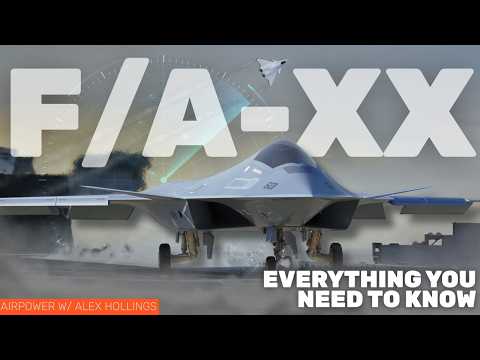
let's take a look at what this airplane looks like. So, here is uh what Boeing mocked up or
what their artist ren rendering was for
FAXX before this award. Uh it's seen there with a uh collaborative combat aircraft with the loyal wingman CCA uh below it. Uh so you can see it's got canards which are interesting. Some folks have pointed out that canards are not stealthy. Um, so here's a another
one that that doesn't have canards. Uh, so whether it's this one or this one, we
will see. My guess based on the canard's piece is it's probably this one. And here's another sort of cool break in the number there over the boat.
And of course, as was just briefed, the
F-47 has already been awarded back in March of 2025. This was the roll out images that were on, you know, drymounted on on easels in the White House when that announcement was made. No other images have really come out since then. There have been rumors of sightings in and around Area 51. Secretary Hegsth did go out there uh you know last year reportedly uh on his way back from the West Coast or actually on his way back from the uh Western Pacific and and check on progress I would assume. So we don't know how it's tracking. We don't know what uh the program's test milestones are. Obviously this is a black program and they're not announcing these things. And certainly FAXX
is going to be the same way. So where
the testing will be done um is is unknown. It's it won't be done in St. Louis and in so far as it's a
black program. It won't be done at places like Puxa River. Um so the you
know developmental testing generally for an unclass or a non uh black program would take place for Navy airplanes at at Naval Air Station Puxit River down in southern Maryland where the test pilot school is. That's where Nav Air is. I worked there for three years on the V22 program right after I got out of the Navy in the early as uh they have a lot of facilities.
they know how to do developmental testing there. Um, but whether or not the FAXX testing will take place there, I don't know. Um, the other thing they
do is once the airplane is through the developmental test team, it goes to VX23 for operational testing. So basically you you start with the you know developmental test go through all of the things that it mentioned in in that that that announcement and let me bring that up again and I'll so we're talking about um
you know ground airworthiness systems and weapons integration testing. So this is you know this is pretty exhaustive. Uh so the idea of rushing this to the fleet uh is is you know kind of not not
something that can be done because as you do a generational improvement and we saw this with F-35, we saw this with
tilt rotor. Every time you have a generational we saw this with F-17 and
B2 you know these these generational improvements come with well we saw it with Ford class carriers. When you do a generational improvement, things are discovered in test that tend to slow the
process down. And this is why the test team exists is to work, let's just say, the bugs out before these things are introduced to the fleet, so that fleet operators and fleet maintainers don't have to do it at their level. So
I know that the Navy would like it sooner rather than later as stated uh by acting secretary cow. Um
you know we need six gen for the high-end fight. Super hornets have done
a lot and more than they were originally planned to do in terms of service life. Remember, Boeing reopened the line
because F-35 deliveries were delayed. So, we've made more Super Hornets, ENFs, than the original buy. Uh, and but
remember that's a fourth generation airplane. And when you're fighting the high-end fight, stealth matters, stick length matters, range matters. So, Super Hornet is not a super long range
airplane. F-35 is not a super long range
airplane. This is why we have heavy tankers. This is why we're developing the MQ25 for mission give is to get our strike fighters out there so that they can a
protect the fleet at range outside of the range of let's just say Chinese hypersonics particularly, but also to
get ordinance on target at range. So, we
need this airplane uh sooner rather than later. But that having been said, when you do the math about developmental test, operational test, all of the other stuff, weapons integration, systems, shipboard integration, all of this stuff, uh we we probably won't see this airplane for another 10 to 15 years.
So, I hope I'm wrong there, but that's uh that's my guess at at this at this point. All right, so let's uh that's the news. Again, I I I'm doing this sort of no notice, like I said. Um but let's let's
bring up the chat and see what you guys are thinking about.
Carrier landbased. This is carrierbased, right? That's the whole point of FAXX. That's why the Navy uh wanted their version of sixthg genad.
And again, we were thinking that uh we'd be getting it right after the F-47 announcement happened. And then when it didn't happen, uh we were concerned and
you know kept the pressure on CNO, N98,
other Navy three and four stars. Well, two, three, and four stars. Uh, and our supporters in Congress. Again, Congressman Rob Whittmann, who's on the House Armed Services Committee that we talked to last week, you guys probably saw that episode. If not, check it out. Uh, did tell us, hey, announcement is coming. He said next week. And turns out that that's in fact true. And, uh, obviously he can't get ahead of the announcement at his level. And uh so you know
we've had proponents on the hill that have kept the press on and now here we go. So yes it's um a carrierbased
version of six gen. If only the dinosaur
fanatic says if only the Tomcat was still here it would have been perfect for this theater. I concur. So, as we've
surmised and as we were just talking about at the 20th reunion last weekend
in Virginia Beach, coincident with the NAS Oceanana Air Show, you can imagine that had we iterated on the F-14 beyond
what the B upgrade and the D was, then
it would have looked like this,
Right. I mean, look at that. You know, you you'd gravitate away from swing wing because
we, you know, arrow engineers discovered you that what we thought was necessary in terms of slow speed, high speed with a better designed wing was not required. You'd get better designed intake. So, you wouldn't need ramps. And the only quarrel I would have here is you need another guy in the airplane to do the CCA mission. So that's another question.
Is this a single seat airplane or is it a tandem seat airplane? We we don't know. Um but obviously as a Rio veteran,
my pitch would be uh let's make it a two
seat airplane, but we'll find out.
Blue two or blue J2K probably will end up costing 120 billion per plane in the age where a $3,000 drone will win a fight. Um I don't think
120 billion is going to be the unit cost. Uh but remember it's a function of
how many airplanes are we going to buy multi-year contracts so forth and so on. You do the math. Uh, and so
I don't know what the target unit cost is going to be. Let's just say it's
probably in the range of 250 million to
$300 million per airplane. Now remember,
was it that a B-21 costs? I want to say
1.3 billion per airplane, you know. So
that starts to approach well not quite aircraft carrier cost but you know it it
that's not not a very uh inexpensive platform. So my guess 250 to 300 million uh blue
J2K would be the the more likely
um unit cost. Tower 55 Boeing has had problems on every single program they have. That is true. Right. So the the
the KC46 had massive amounts of problems uh
end to end with the airframe, with the television for the probe, with all kinds of stuff. So roger that. It's had problems on the commercial airline side.
So, um I have it on good authority that
they have been kind of been read the riot act uh in terms of this award also
came with this asterisk like you're going to have to get your act together and Boeing claims and I think with if
you look at some of the other stuff they've done recently arguably they have got their act together because we can't afford to have this airplane delay beyond what the schedule demands. So if this thing slides into the 2040s and
beyond, it's going to be overcome by events in terms of the peer threat. You
know, this is the same problem with Ford class aircraft carriers is we're kind of
getting them time late and that in in in
essence becomes a soft kill of the platform. So they have been read the riot act. No doubt they've had problems on I don't know about every single program program, but every single high viz program they've had. So, we'll see. But that's a you make a good point. Uh tower 55.
Here we go. Victor Franco, my good friend out there at El Toro at the uh
Leatherneck Aviation Museum. Congratulations on your milestones, everybody. keep your uh eyes on what happens there in Tustin with this museum that Victor is uh is in charge of. Thank you for the $10 super chat and we we were just talking about the uh the history of Boeing and those concerns. So um and you say Kelly Johnson, where are you when we need you? Well, good question. We need a 21st century Kelly Johnson, don't we? So hopefully one will emerge. But like I just said, the concerns are valid, but Boeing has uh
has shown evidence that uh they they've taken a round turn on production, on engineering, on design uh and uh and they're they're ready to tackle this particular uh program.
So CC 206 Delta, how is he going to put his name on it? I guess you're referring to President Trump. Um, well, I I don't
know. There was a rumor that, you know, the F-47, you know, that number is not in sequence, but obviously uh a tribute to the 47th president of the United States by Secretary Hegsth. Uh, I I have not seen what we're calling the F-47 yet. If anybody's seen it, put it in the chat. Certainly, no names have been assigned to the FAXX. This is a non-trivial detail. We care a lot about
the names of our fighters, just like we care a lot about the names of our carriers. You know, we want to get back. And this discussion was happening at both Tail Hook and the air show at Oceanana last week, which is how about cool names like Lexington and Ticonderoga and Yorktown? Why do we got to get all political with naming it for individuals
or politicians on either side of the aisle? So, I support that entirely. So, there are a lot of cool names that you could give a fighter that both have
historical precedent, but also would be new cool names. So, I hope we go that way, but we'll see.
Lime scale 12 says, "We need numbers if we're going to fight with China." Roger that. As my good friend Admiral Sam Paparro, who's Paycom, uh you may have seen his profile in Time magazine recently. If not, check it out. I have a little quote there. Um, it's funny. You talk to a reporter for like a half hour and you get like one line. It kind of mangles what I actually said. But in any case, it's a cool profile of Admiral Paparo, but his classic quote is
quantity is a quality all its own, right? So that is true. So lime scale 12, you make a good point. So I again
it's premature to talk about okay so what is the buy and remember if you look at the history of any fourth gen fifth gen airplane the buy is in the thousands
and this includes F-22 this includes joint strike fighter F-35 A B and C and then what actually is introduced because of budget cycles and adjustments made along the way and service wish list changes it goes down a hot. We were
supposed to have thousands of F-35s and we have hundreds. We were supposed to have thousands of F-22s and we had, you know, dozens,
right? So, we do need numbers. If you look at how mass production works in China and how quickly they're able to produce weapons, now there's no accounting for what their quality is, but again, quantity is equality all its own, right? And this is where things like, hey, it just turns out they got a part of the fuselage and a canopy from an F-35 that was going from Australia to the United States and somehow got sort of sidetracked to Hong Kong. Well, this is a big deal because that allows them to look at the materials in the stealth, to look at the coating on the canopy, things that they probably were just looking at pictures or maybe black market schematics to create their J50 or
their other sixth gen airplanes, but now they have this intel where they can reverse engineer things in a way they couldn't before. So, but they do it
quicker than we do because guess what? Communists don't need congressional authority to you know do what we have in terms of appropriations. Uh but you know
we that that's no excuse. We do need numbers. So uh but I don't know what the numbers are at this time. But you make a great point.
Ken Spliffy Jr. cool name. Bombers are the last platform we have a clear advantage in. the Pacific competitor has caught up.
That is true. So, um well, also
submarines is another platform that we have an advantage in and aircraft carriers is a platform that we have a
clear advantage in, but bombers are also in that.
Venom Cinematic Sub Ward, great to catch the live stream. Well, it's great to have you here, Venom Cinematic.
Some guy 699 says, "The F-18 is not even a Boeing product. It's a McDonald Douglas design. So, out the window with the theory that Boeing has recent experience." Okay, you make a good point. Uh, you know, but acquisitions
are what they are. Uh so uh you know I I
know that it's been Boeing since it was the Super Hornet, right? And so they do have a design if you consider which the Navy did. Well, actually you're right. The the Navy said Super Hornet was not a new start. It was just an improvement to Hornet which allowed them to bypass some of the acquisition constraints. But in reality, it was a new start. you know, kind of a completely different fuselage and so forth. So, they did have some success. They had actually massive success with making Super Hornet, but you make a a good point, and again, we'll be I'm not a fanboy for Boeing. I did work with Boeing on V22 that, you know, it was Bell and Boeing were our two primes. Much different cultures when I first got there. They sort of melded and became one thing, Bell Boeing. Uh, but, you know, at the outset, Bell was the company that made the Huey And it's, you know, we went to their visit the factory in Fort Worth and they had a slick Huey, Vietname Huey on a stick in front of, you know, their their factory and then you go to Boeing and it's, you know, pretty high-tech digital so forth. There was a huge difference at the beginning, but that distance was was closed by the time the assembly facility
opened in Amarillo. So, I'm a fan of Boeing with respect to my experience at V22, but you know, they have had some some issues in recent uh in recent years. So, we we'll see. I'm not defending Boeing is my point.
Walter Bratus uh who's who's always at
our live streams, good to see you, Walter. We're not fighting China, okay? But the national defense strategy lists China as our pacing threat. So we're not
currently at war with China. Correct. But everything we're doing in terms of the National Defense Authorization Act, the pro the program of record, what we want in the future, what we're asking defense firms to create and design is a function of the high-end threat. We're not necessarily trying to do second
world threats like Iran or certainly not going back to the asymmetric threats like Iraq and Afghanistan, you know, where we were doing things like MRAPs and body armor and how do we counter IEDs and that sort of thing. uh you know the uh quadrrenial defense review made a deliberate what they called the Pacific pivot about mid post 911 wars to get
back to the focus on the high-end fight because the Navy got away from war at sea. The Navy got away from thinking about range. We're doing a lot of closeair support on call close air support and that sort of thing and not really thinking about long range strikes and certainly not thinking about some of the stuff that we've done in the Red Sea and North Arabian Sea. Not to mention things we'll have to do if in theory we go to war with with China. Certainly, President Xi's most recent visit were actually rumored and and this what the press has reported that President Trump offered to sell him uh American weapons,
which is, you know, interesting. Uh so
obviously you wouldn't sell weapons to a country that you believe hostilities are imminent, but the National Defense Strategy lists China and you can read it if you want to. That's the pacing threat. So,
Juan Manuel Ventura 8203 says, "Tomcat 21 was a better option than the F-18 Block 2." I'm biased. I concur. Check
out my episode from a few years back about the argument. It's no hyperbole,
no hype. Um, it it really is a
compelling argument, but you know, that's not how acquisitions go. Great question from Stevie Moore. Why can't they make the F-47 just work for both services? Oh, wait. Yeah, you answer your own question, right? So, the history of joint platforms. Um, and I'm just going to do the recent history. So, A7, F4,
F-35, right? So, A7 was, you know, a success story for the most part, right? Um, good friend Hoser. Uh, oh, by the way, Hoser and I are going to do an episode tomorrow, another live stream tomorrow about the mishap that just happened last night aboard Ike. Uh, we have some information. So, uh, look for the heads
up about when that's going to happen. Uh, I I'll if and this is why we subscribe because we get the heads ups. So, that's going to happen tomorrow. Uh so um in any case
A7 F4 F4 another success success story
but the two versions were wildly different or not wildly different were significantly different. You know the B
the the J and the S were different from
the Air Force versions. Um, and there are both parallel path things that uh
seem good on paper, but then once you get into production, it's it's a hassle and it slows down either version. So,
okay, the biggest difference, and Stevie knows this, carrier suitability, right? So, the failure of a desire to make a
joint airplane was the F-111. And you know, God bless Tom Connley for bringing the airplane aboard and going, "This thing sucks around the boat. It's not going to work." That was at the expense of his career because he was told, "Shut up in color and he did not." And that allowed the Tomcat to be fielded. So he is forever
a member of the Tom Cat Honor Society for that. But F-47, if you look at the design and what they want to do to rapid field it, you add carrier suitability to that and that's going to slow it down by many years. So that's what's up with that.
Rick Rick 911. I believe the Air Force sees the B-21 as the answer to a nearpeer war. There will be no bases in range of any fighter. Hell, Iran was hitting out ba hitting out base in bases
in Jordan. Yeah. So, the let's just call it the
status quo. The paradigm has shifted massively. And yes, I'm calling Iran a second world power, but their ballistic missile execution in the current conflict, not a war conflict,
um shows just how it changes the the you
know, SAM rings, the ballistic missile rings changes the force protection plan
and I think in a way that we didn't really think about when we stepped off the line of departure on February 28th. Obviously, we didn't think about it, right? PAB got hit. MSAB got hit in Jordan. Our bases or where we were beded down in Israel got hit, you know, the the folks from KAG 8 and the F-22 squadrons and the the uh the F-16 guys,
the Viper guys, you know, the Jays, the CJs and the uh the other fighter attack version of the F-16. Manama got hit and suddenly we're we're without portfolio for fifth fleet. Go aboard the ship, get out the whole strike groups, two of them have to fade back, so forth and so on. So yes, range
now suddenly matters in a way that maybe we weren't cognizant of before Epic Fury. So Air Force sees B21 as the
answer to a nearper war. This is the same thing they've said since the revolt of the admirals back in 1947. Right? So remember the National Defense
Act of 1947. What was created? The CIA, the US Air
Force and the Department of Defense. So when you call you just say I'm the omni department of defense is now the department of war. That's historically inaccurate. Right? So during World War II and before there were two departments. The department of war was the army and the department of the navy was the navy. Different budgets, different reporting chains decoupled in a way that allowed efficacy in terms of rapid acquisition and fighting wars in various theaters. Of course they coordinated uh you know MacArthur and Nimmits were coordinating the Pacific and so forth. But now they
come together and immediately with the Department of Defense there's one budget and the other thing we thought would happen in the wake of World War II and this pivot happened immediately. In fact, it was already in progress before
the wars both in the Pacific and Europe ended which is we were already looking past the Third Reich and uh the the
Imperial Japan to the communists and the Soviet Union. So we're like, okay, the next war is not going to be conventional. It's going to be nuclear. We very much thought that. So everybody was sort of trying to get platforms that could do the nuke thing. The Air Force had the B-36. And that's where they were making the same claim. You don't need aircraft carriers. We got the B-36. They can go way far away, launch from continental United States, hit any target in Russia, and come back. And the Navy's like, "Oh geez." Okay. Tried to create the United States class that had these kind of bigger airplanes that could deliver nukes. Um that is a
political food fight story where Secretary Forestall was trying to or on the slice supporting Truman's opponent Dwey. Truman discovered this, fired him
and cancelled the United States class. The Navy was freaking out. So, there was this revolt of the admirals that actually happened at Burning Tree Country Club in Bethesda. Uh, and the guys who are members of Burning Tree will explain that's why the beltway is shaped how it is on that corridor is because of Burning Tree Country Club. But in their clubhouse, the revolt of the Admirals went down. And there's a cool picture of Holly testifying in civies before Congress like in their face. He walked up to the table. is just like, you know, not cool with the Air Force takeover of the long-range mission. So, we all know how that played out. We didn't have any nuclear wars after that, thankfully, you know, so we did need conventional warfare. We did need aircraft carriers and that's where the forestall class grew and so forth. So, I think you need
both. Rick Rick, you know, the Air Force may claim that B-21 there. That's their answer. I don't know if it's the answer. You also need aircraft carriers because with advanced hypersonics and long range weapons wherever the B-21s are based. So
I don't know if that's Guam, is that Pearl? Not Pearl or what, you know, Hickham, wherever it is. Um, you know,
the enemy can reach out and touch our bases. It can't get our aircraft carriers that are maneuvering as proved by Epic Fury. So, um I don't deny that
that's what the Air Force thinks, but that's not actually the end all and be all. All right, good questions, guys. This is really a lot of fun uh for a no notice live stream.
JTJ1944. My concern is how Boeing is going to build the FAXX, F47, F15EX, and CCAs all
at once without serious delays. Valid concern, my friend. So, we will see. We will be watching, but that's a lot to have on your plate. I think the logic at DOW is well since
they're already working on F47, they sort of have the sixth gen thing up and
running. Now again, there's little to no commonality between F-47 and FAXX as far as we've heard, but there certainly are some learnings with whatever the power plant is, whatever whatever the weapon system is, whatever the weapon system integration is going to be. So as they learn things in test, certainly the now
FAXX program guys from both Boeing and
the Navy will be in there with them and
you know leveraging the learnings of F47 to FAXX. So as far as sixth gen goes,
that's the logic. Now the other side of that logic is you got too much on your plate, you know. So, we'll see, you know, can Boeing hire against it. Can they create parallel facilities? We don't know where they're going to do de developmental tests. We don't know if this is considered a black program or whether they'll be able to do it at Pax River, like I said at the outset. I don't know. But you make a good point that FAXX, F47, EX, and collaborative
combat aircraft, which are just mockups right now, but that's an important part of what FAX FAXX is going to have to be able to do, right? um you know and and so you know this will be one of the opaval
key requirements performance requirements is can you operate x number of CCAs with a single section a division
again this is why my pitch would be two
guys in the airplane but we'll see good point though call sign bubbles says I wanted Northrup, I'm sorry. However, as you
read in the breaking defense piece, uh
the other that there there may be more to follow. Um Northre may Northre
Grumman may not go uh quietly, but we will see. Obviously, this is this is a major blow to them. Um, and uh, I know
some Northrup Grumman guys locally that uh, I'll have to circle up with them uh, in the next day or so to see what their inside baseball feeling is at their,
you know, their headquarters up there by BWI. Uh, you know, so I'm sure they're
stinging, you know, and I don't know if they thought that they were players all along and now this announcement is just like, oh my god. But uh this this isn't
good in terms of if you thought you were going to do the sixth gen thing and if your whole portfolio was leveraged against that um you know and it it would seem because you got right Loheed Martin with JSF Boeing with the ones we just listed and now share the wealth north of Grumman should have gotten FAXX but did not. So I'm sure North Grumman is not happy about that.
Texas B says the F47 trumpinator. Um,
okay. Please no.
Will Gary 686 wonder if this will be an F-35 situation airframe wise? Uh, so what do you mean by situation? You mean in terms of the the technology used to to make the stealth uh the problems we've had with developmental tests and operational tests and fleet incorporation of F-35?
Not quite sure what you what you mean there. Metroplex Aerial says seems like they should start building them for point defense of naval air stations as test machine during the developmental phase and integrate them into carriers ASAP. Uh so you know again our fighters are
designed to go aboard aircraft carriers and go over the horizon. They're not designed for force protection of our domestic bases. And that's why we have
NORAD and we have Air Force and Air National Guard airplanes on alert up and down both coasts and along the Gulf and so forth is to intercept threats before they would uh hit our bases or be able
to attack our bases. Uh as far as the Iron Dome and the other sorts of ballistic and ICBM type threats, that's
a different arena. Uh but uh you know
the the division of labor as it were domestic force protection belongs to the
air force. Expeditionary power projection from the
sea is the Navy
Ocean Discovery. Great news and great catch mooch. Thank you and thank you guys for showing up. Good crowd here for a no notice live stream. I love it here around dinner time. I apologize if I'm interrupting East Coast dudes dinners. Uh hopefully you got your TV tray out and you're watching this on your widescreen TV, right? Um so 10 to 15
years is probably right. Ouch. Though again, but you know it it just it's just
hard to do a generational improvement in a platform in less than 10 years. you know, you discover things. You got to go back to the drawing board. You got to re again, the the one of the biggest constraints is funding, you know, h and sask and budget cycles and appropriations and the congressional food fights, districts, pork to be porative about it,
you know, just the way we do procurement. And this is something that the current Pentagon chief and his staff
have tried to attend to, but they're finding out this is like chopping bamboo. It's just a hard nut to crack in
terms of acquisition reform. Basically, they renamed everything and tada. But it
really hasn't fundamentally changed the way that you go from the iron triangle,
which is defense requirements and lawmakers, you know, and this is as the
people would like. Congress has the fiduciary responsibility to spend taxpayers dollars wisely. Whether in reality they do or not, that's a argument for a different day. But 10 years is pretty much my guess
would be the minimum to and not just IOC but to Abaval,
right, which is full rate production. And now boom. But look at how long it's taken the Navy to incorporate F-35C. You know, the the irony is there is a
F-35 in the test pilot museum and there
are still super squadrons waiting to transition to the F-35 all these decades later. You know, we're talking literally 30 plus years later. So, that's not a
good look. And I think it's ambitious to think that 10 years is going to be when we would see the FAXX and F-47. quite
frankly uh in in the fleet.
Kirk Ficker points out a an important fact, right? St. Louis produced the F4, F-15, F-18, and Harrier all at the same time. That's a great point, right? Um so
again, as somebody else pointed out, that was McDonald Douglas and even before that McDonald, right? Remember F4 was a McDonald airplane. the McDonald Douglas A4 was a Douglas airplane. Uh that was a big deal when those two came together, right? And then all of a sudden, here we go. Boeing acquires McDonald Douglas uh you know, decades ago. But you make a good point.
One Manuel Ventura again asks, "Ward, why does the Navy get the short end of the stick when it comes to military aviation since the A12?" Um, I I I don't think I would say we get the short end of the stick. We were one-third one-ird one third in F-35. You know, we've had a seat at the table the whole whole time. Um, now I think F-35 has played out in a way that isn't awesome in terms of the
uh aviation director use of funds because we're a billpayer, but we don't have the fuselagees, you know, coming on board in a one-ird one-ird one-ird kind of fashion. Um so um I mean certainly
the A12 debacle on Cheny's watch when
Cheney was sack deaf um the resonant bad effects have have gone on for a long time for decades right but I don't think that the current administration is holding the A12 circumstance and remember you guys the A12 was supposed to be the replacement the stealth carrierbased stealth airplane that replaced the the A6 um and it had massive cost
overruns and was way behind schedule. So Cheney just said you're done. Um they built a whole campus at Pax River for the A12. Um and and all we got for the
A12 was were those nice buildings that are being occupied by different programs and test teams. Now
Todd T5562 makes a good point and this is when we're talking about the Maverick Act which has been coming up in recent days. Uh again that's tied to the NDAA. It's baked into the NDAA. So when we might see Tomcat a show assets still pending based on how the NDAA how fast it can move through Congress. But we're talking about what are things that AI and or I guess we're calling it SI now, right? My bust. Um, but what are things
that digital engineering and you know 3D
printing and all these things that we didn't have back when we were making particularly the legacy Hornet or the Tomcat. What can that leverage in terms of of digital engineering and and speed to to the fleet? you know, V22 that it
suffered from the fact that it was a legacy platform that was supposed to serve a next generation need. You know, we had obsolescen