Is a Diesel Export Ban the Answer to High Prices? | Energy Shots
Transcript
Machine-transcribed by YouTube. Expect errors in names, commands and version numbers.
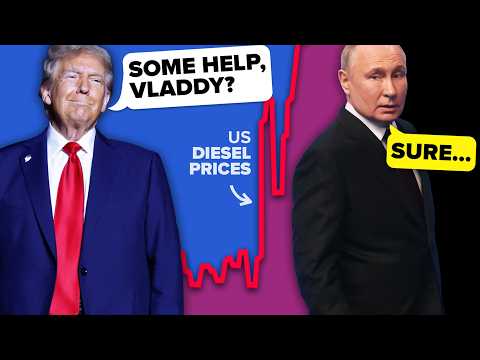
Good afternoon. It's uh September in Washington, but all eyes are on November. American politics Congress is about to head back to home districts and home states. There's a midterm election in November and on the minds of voters are data centers and diesel. Kevin, there's been some serious developments in Washington policymaking circles this week, especially with respect to diesel fuels, a topic you and I have been talking about here on Energy Shots for some time. >> Middle of the barrel, top of the list. So uh yeah, the president uh sitting here alongside uh Ukrainian President Volodymyr Zelenskyy says he's for restricting diesel exports. That was a that was a moment. That was on Tuesday.
>> And in in the days that followed, we saw analysts talk about the potential price impacts of this, which are not universally negative, meaning that they wouldn't necessarily bring prices down for all Americans, let alone the world. And industry has uh lobbied vociferously
against diesel export bans because it would cause all sorts of problems for refinery operations and their bottom line. But there is a sense of populism in the air >> You don't say. >> The good Senator Chuck Grassley tweeted this week something quite remarkable. >> Yeah, well, the and he's prolific and he also uses the same abbreviations that Prince used to use. Uh so I favor that. Um he he says he hopes the White House doesn't listen to big oil. Uh and of course Senator Grassley has a long history of of being on the side of ethanol. >> Mhm. >> And uh he's also if you go back to to 20 years ago, he proposed changing the tax treatment of refinery inventories to create a spontaneous taxable windfall to give $100 to every American. So he's not exactly a fan of refiners if you look at his history, but he says uh big oil doesn't need to charge sky-high diesel prices for Iowa farmers, truckers just filling up.
They should cut the price for diesel and get the dollars from other countries if you can embargo chips, you can embargo diesel. I mean, this is a remarkable uh statement. I mean, it like in in that um
we've seen over the last few years a lot more interventions. You've called it an age of intervention. Um the the case for and against embargoes on chips, the accelerated GPUs that power the AI revolution in those data centers that are other cause of worry in the energy system today. Um you know, those have been debated ad nauseam at CSIS and and in Washington, but now we're also saying we can embargo diesel, where the strategic value may be less, but the economic and political value may be more. Now, this of course is not the first time that policy makers have looked at product exports and said maybe we need to press pause here. Can you give us a little history?
>> Yeah, I'm glad you brought that up. We we say we have said here that history tends to rhyme and lately it's been rhyming like a rap song. So, if you go back 4 years, stop me if you've heard this story before, an embattled president facing a potential reversal in at least one chamber of Congress in the midterm elections amid high and rising fuel prices proposes or considers the proposal to ban diesel exports. That was where the Biden administration found itself actually in the second week of October of 2022, when Ukraine war was
tightening supply. And and I think it's important to understand that they didn't do it. Uh and I don't know the exact reason why they did not. There's a lot of good reasons for not doing it and we've discussed them here on this show. Uh but one of the one of the potential implications of doing it would be that you would see refiners run out of storage space. >> Right. >> They would run out of space for the diesel. Uh and we'll get into that a little bit, but they would probably end up cutting their production runs. If they cut their production runs, then the prices of all the fuels they made would start to increase as the supply declined. And then the question is what would the government do next? Would they use the Defense Production Act to compel operations, which is a power available under Title 1 of of that law? Uh what would happen next might not be as good as the initial price response after the the embargo or the ban went into effect. So, it was a complicated issue then uh and uh and I think it's a complicated issue now.
>> Why don't we talk a little bit about the driver of this? Um what what do we know about the in the response to both attacks on Russian refineries and the uh war in Iran causing closures to the Strait of Hormuz locking up a lot of refinery capacity in the Gulf behind the Strait? W- what why is this suddenly an issue for the United States? >> Well, it's been an issue because if you look at diesel prices from the start of the year when they were about $3.74 uh going all the way up to uh now well above $6.50 $6.50 this morning. Uh but
this this is a weekly average, so this is through the week of September 18th, which is the most recent week from which we have EIA data. You'll see that that it's $6.29 a gallon, that's a a pretty significant increase. It goes into everything hauling, heating, uh it goes in into harvesting. Uh so, it has potential inflationary consequences that could be severe and enduring. Uh and for for everyone from truckers to farmers, uh there's been a real sense of wow, this isn't good. You You turn to your officials in government, do something, you say. If you look at the exports, so the the orange line was the price. The export levels, uh if you go through the the four weeks through September 18th, are about 1.4 million barrels per day, which is actually inside of the five-year range. Uh that's that's not that's not abnormal if you look at the history of the the last five years. Uh it's near the top of the range, yes, but it's not completely abnormal. The inventory levels are about 6% below the bottom of the range for that most recent week, which is significant. Now, I mentioned 2022. I just want to give you some context here. If you think about days of demand cover, how much the inventory would cover if you ran it through the demand. In 2022 on October 14th, the week of EIA data, 25.4 days, which is very, very low. 29.5 days now, not as low. If you look at the refinery capacity utilization then though, 89.5% compared to 94%. Right now, our refineries are running flat out. There was more headroom then potentially, or there could have been. There isn't much, much room left now. If you look at the the net exports, so over the four week average, I gave you that 1.4 number, it was about 1.2 then, okay? But then if you look at the inventory levels, the actual physical barrels in US stockpiles, 106.2 million barrels. We are on the week of September 18th, 107.4.
Now, that those are low numbers, just to be very, very clear. And the EIA on September 9th in its short-term energy outlook projected that that number would fall below 100 in September, which may have been a bit of a snowball >> that got some of this conversation rolling. And in the the big picture then is in the wake of the war, in the wake of market disruptions from actually both these wars, we have a system that is running hard to the refineries are running hard to produce diesel. We're exporting more because global markets are short, and our inventories are falling. That's that naturally increases prices going into a fall season defined by harvest and defined by mid-term election, it's clear why Washington might want to act.
>> Yes, although we produce more diesel than we use. We produce a little over 5 million barrels per day, we consume roughly 3.6 million barrels per day, and so that balance can be exported. Now, there there are questions about what what would happen if you stopped exporting it, maybe that's a good reason to move to the next slide. What this shows are the the the capacity for storage from the EIA, a bit dated, the data goes back to 2024, the most recent survey, but it shows in refineries and in bulk terminals, how much capacity is available by Petroleum Administration Defense District PAD, the regions. So, East Coast, Midwest, Gulf Coast, Mountain States, West Coast, Alaska, Hawaii, 1 through 5. And 90% of the diesel exports that come out of the US are, give or take, about 87% over the last few months, are out of the Gulf Coast. Okay, so right now that's about 65 million barrels of storage capacity. We're at about 44 million. So, there's some ability for refiners to modulate production, but not much.
>> Right. >> And so, what are they going to end up doing? They can ship some of it using Jones Act waivers if they can get the tankers to the East Coast and West Coast, but ultimately, when this starts to fill up, when that orange dot reaches the top, you've run out of space. Long before you run out of space, >> Right. >> prices begin to decline. The economics of refining get very, very bad. >> We all We all remember the the early months of COVID when markets dropped out
and they they ran out of storage space, physical storage space in Cushing. It's an endpoint, but prices had to go negative because storage got so short.
What we're talking about here might not involve negative prices, but it's the same set of physical and market dynamics. As you get closer and closer to your storage capacity, if you can't get it out to international markets, you're going to have to The prices will drop. >> Well, rationally, what you would do is stop operating before you get to the point where you run out of space, reduce your operations to a point where you can work within the the available capacity. But the the problem with that is that refiners produce a range of fuels, and other fuels would be in shorter supply as a consequence of that.
>> What does this mean, you know, like we're we're still, as we're recording, not sure what policy might come from the White House, the exact form of it. We're going to talk about that in a moment. But what does it mean for the firms? Refiners are making a lot of money. Um, the run cuts for diesel have been very high. Is there Is there any case for somebody to say, "Well, they're making too much money, we need to knock the price down a little bit. >> Well, they also lose money periodically and they've had a number of years where they've done that rather dramatically. So, the market goes up and the market goes down. And I think the industry generally argues that they don't get a lot of support or help when the market goes down. You mentioned I'm glad you mentioned April 20th of 2020 when the WTI price fell to negative $37 a barrel.
$37 per barrel you had to pay someone to take the oil that you could not store. That was a grievous grievous crisis and it left behind a lot of economic wreckage that compromised US supply security. That's the risk the long-term risk here. There's another long-term risk too. Getting investors to back a sector that is vulnerable to this kind of government intervention gets a lot harder after that kind of intervention. And particularly if it goes a second phase with that Defense Production Act feature that could have happened in 2022. >> Right. Once you start intervening in the market, you might find that you want to intervene yet more rather than backing off.
>> Well, it's it's very very it's understandable why political leaders are vexed and why they want to do something. It's very difficult to to get reelected when it looks like you're not listening to your constituents. And so ahead of an important election for a president that's trying to retain his party's control in the Congress, you can understand why this looks a lot like 2022. But there are other considerations as well, Joseph. And one of them is that there are counter-parties who buy this diesel and they rely on it. In a world that's an increasingly turbulent place where they're looking for stable suppliers, the reputation of the United States as a stable supplier is also at risk. Tell us what we've got here.
>> Well, as you as you say, the reputation of the United States as an energy exporter, a factor in our energy dominance is that we can meet market need when the market is in need. And what we're showing here average for the last 30 days of seaborn diesel exports and where they go. We're missing here exports to Mexico and some net exchange with Canada that give you like the EIA's total number. >> You mean for the pipeline volumes that aren't in this chart? >> Exactly. >> Okay. >> But everything that leaves the Gulf Coast or another refinery or another path from the United States and goes abroad, we're tracking here using Vortexa data. We track the tankers that leave the United States. And this is showing us where shipments have gone in international markets over the last 30 days. We've load the US has sent out just under 1.5 million barrels per day of seaborne diesel and gas oil fuels out into the world. And look where it's headed. It's going to Mexico. It's going to largely to Brazil. In fact, I think I can zoom in and if you want some killer thousand barrels per day numbers, 155,000 barrels a day going to Brazil.
54 going to Peru. If we use two fingers
to scroll, our allies in Europe. Six
almost 60 to France. 50 to Spain. Um 70 to to Morocco. The point being Kevin,
that the United States in the age of shale, in the age of energy dominance, is now a global supplier. And when we think about interventions to improve the politics for November in the United States, we also have to think about what that does politically abroad both for our reputation and to the allies that we're trying to bring along in the Iran war, in the Ukraine war, and to the global global marketplace. I mean, if you cut off 1.5 [snorts]
million barrels per day, though I don't think that's actually anything that the White House is going to propose, you're adding a lot of shortage to a global diesel market already strained. >> Well, in 2022, our understanding was that the proposal the Biden administration considered would have looked at five-year averages in the five pads and they would have stopped or limited exports in those pads when inventories were below the five-year average until they had recovered above that level. Uh at the time they didn't have the same Jones Act waiver and the capability of theoretical capability to reallocate to the coast, but again that's that's a theoretical capability. You have to have the tankers, you have to be able to pay for them, and they're more expensive now in a world that's tight. And so I I think that this is a decision that it's being undertaken with some nuance. So the Secretary of Energy Chris Wright has said that maybe he he's looking at a voluntary plan. He's been talking to industry, he's been talking I I guess to his peers inside the interagency process, and it looks like they're coming up to a conclusion. Maybe this would be a good point to to hear from the Secretary himself.
>> Let's roll tape.
>> That's Secretary Chris Wright being interviewed by David Gelles this week >> uh for the New York Times. Full video available on YouTube. >> Subtle tweaks. >> Subtle tweaks, Kevin. >> Subtle tweaks. And the market did not think this was a subtle thing, right? If you we saw a a divergence between the Brent crude marker, the global price, and the WTI marker after this news broke cuz if refineries aren't going to be able to run as much, they're not going to buy as much US crude. Uh we saw movement in the futures prices for gas oil in Europe, price went up for for diesel in the US, price went down. Uh you know, a a tweak, a subtle tweak can have a big resonance when it comes to investment markets. And investment in markets. And and also there was a global problem, right? And it's not just the problems that we hear about so much. The refinery throughput in some of the importing countries in Europe is still quite low as well.
Capacity utilization is below where it has been a year ago in in Italy, in in France in particular, also in the Netherlands, a big refining center. So, in addition to China not exporting as much product, in addition to the Russian refiners that are well documented as having been offline, and of course in addition to the Middle Eastern supplies that have been impaired, there are other things going on in the global refining system. This is a hard problem to fix. One of the things that I I think we've talked about here on the show many, many times is that we we run the risk in this current age of I mean things happen fast in Trump time, right? So, we don't know what's happening right now as we're talking to you. And that brings me to infomo, a word we've used before. It's informational fear of missing out. I don't know what's going to happen in in the next few hours if indeed Friday is the deadline, but I think that subtle tweak or any sort of major policy move could have a sustained ramifications not just for prices and markets in the near term, but also for investment in the long term.
>> As we await an announcement from the White House, what are the things that the viewers should watch for when that announcement is made? >> Well, the details are going to matter. What are what are the parameters? How is it going to be implemented? One possible use of the International Emergency Economic Powers Act could be to to limit or block exports. There there are other tools. What are the what are the provisions that determine when the ban would be lifted? Where are there exceptions? I think we're going to want to try to get a sense of the the size and duration when it comes out, if it comes out.
>> I'll be watching how much of this is going to be a voluntary program, and what are the terms of being a participant in the voluntary program? Are there ways that the administration will be able to offer carrots or sticks associated with some sort of subtle tweak to the system to bring more diesel into the United States. We'll watch it and anxious. We'll be on Twitter and those who have joined us online, thank you so much. We hope you have an energetic rest of your day and we are signing off.
>> [music]