The (Associate) European Union and a Transatlantic Tech Update
Transcript
Machine-transcribed by YouTube. Expect errors in names, commands and version numbers.
Welcome to the Eurofile, a podcast by CSIS, where we look at Europe through a Washington lens. I'm your host, Max Bergman.
Hello and welcome back to the Eurofile. Today has been incredibly busy news day in Europe with Ursula von der Leyen delivering the State of the European Union address this morning in Strasbourg. For this week's news roundup, I'm here with Lexi Lennefelter. She's with the Europe Russia Eurasia program here at CSIS. And we're going to run through what Ursula von der Leyen said and what it could mean for Europe and what it means for transatlantic relations. Then we're going to turn to an interview with Emily Benson, a non-resident senior associate with the Europe Russia Eurasia program as well here at CSIS. She's the head of strategy at Minerva Technology Futures for really a wide-ranging discussion on the transatlantic technology space. Lexi, welcome back to the show.
>> Thank you so much. Great to be here. There are plenty of things we could zero in on from Ursula von der Leyen's address to European Parliament. But for some context through a wide lens, this was clearly a big moment for her. Her term still has a couple years left, but we can assume that she's starting to think about her legacy and how she's going to chart a distinct path forward for Europe, so to speak, both as a unified block and a geopolitical power. It seemed kind of theatrical. It was fun to watch as an American. There has been some reporting that the chamber was probably kind of half empty, roughly a third of the seats were vacant. She opened with the best of times, worst of times quote from Tale of Two Cities, which immediately kind of evoked the turmoil of the French Revolution. And she dove in by addressing Ukraine, Greenland, and alluding to the war in Iran, all without naming the US directly. Max, what did you make of that? How did you assess the vibes?
>> Yeah, I mean, maybe to set the stage, especially for Americans or even Europeans, because not that many Europeans like set of set the clock for the EU state of the union address. Although I think they should. It feels like if you sort of went to 1960 in the US and you sort of woke someone up and showed them this video, I think they would think that this is like the year 2150 and this is like the United States of America and something like because it feels like the future to me because you have this very futuristic backdrop because it's in the European Parliament in Strasbourg. This photo is sort of very modern building. It is a very American address. It is exactly like our State of the Union in that sense. It's this laundry list of a speech. It sort of sets the legislative tone for the European Parliament and for the European Council. It goes through all sorts of topics. Von der Leyen and it's only been going on really since I think 2010 I think is when it started. But now there's introducing of characters of people who have done great things. There was a really moving moment for a Danish firefighter who died in the line of duty fighting fires not in Denmark but across Europe and his mother and brothers were there and he was recognized. You had a Ukrainian former gymnast who lost a leg in one of the Russian strikes and then also she gave a shout out to the mother of an advocate for a child that committed suicide due to online bullying about the need for EU tech regulation.
So it has the kind of heartstring pulling moments. What is happening there is that she's trying to build a narrative, a story, give Europe its heroes of people who have done things on behalf of EU. So it has those same things that we see in our State of the Union address. And what was interesting you noted that a lot of empty seats. And that wasn't because oh, this isn't worth watching. It was because the far right parties were sending a signal that like you know, their objection. Now, what we have in the American context is sometimes American politicians don't show up as a form of protest but then often times it's a sort of who claps and who doesn't. And it would have been interesting if they were there because then they would have cameras going to them seeing them not stand up, not clap.
What do you clap for? But what was interesting about the speech to me is it does begin to reflect that there's a degree of partisanship at the EU level. Often times at the EU level it's been, "Oh, this is just sort of this technocratic thing. Everyone basically agrees. They're just sort of, you know, working technocratically through finance legislation or agricultural subsidies." But now there's big deal political fights happening on security policy, on climate. She mentioned climate quite a bit, on tech policy. And so it was a speech very much in the kind of center of European politics defending the center. And I think it was quite interesting of some of the things that she went into. I also have to say, here you have a president who speaks fluently in three languages throughout the speech and just sort of shifts between them.
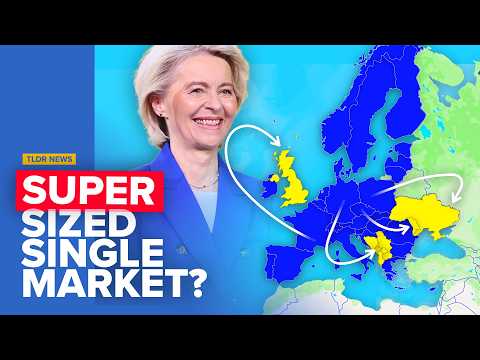
It's rather astonishing, especially for an American audience. Maybe not for a Canadian audience as Mark Carney was there and Canada was really front and center in this as well. >> Very true. And she definitely dove into kind of every possible policy area. She addressed Ukraine, she talked about Greenland, war in Iran. As I mentioned, all without naming the US. That was very interesting. I would love to hear your thoughts on that, but her real core focus was that Europe can't face all of the threats that it's facing as each individual natural member. It needs to be a unified block. This carried through when she was talking about AI, climate, security, economic competitiveness, all of the above. Speaking of politically fun and controversial curve balls, she also announced that the door could be open for Canada to become the EU's first associate member. Curious how you think about all of this and where you want to dive in first.
>> So I think there was just an undercurrent in this speech of America has gone rogue. The United States of America was not mentioned by name, but it was sort of hovering over I think lots of things that she discussed. She mentioned the you stood firm to protect on Greenland. Their Arctic was mentioned. It's this speech about the EU
trying to assert itself and defend its interests and its values in what is in increasingly hostile global environment. And in that hostile global environment, not mentioned is the United States as taking a hostile approach towards the European Union. And in that context, you then have Mark Carney, the Prime Minister of Canada, at the speech. He's going to give a speech to the European Parliament tomorrow. Front and center, Viorica talks about this associate membership, which is the way I think about it. So, the associate membership does not exist. It's not like a thing in treaties. There is no associate member, like the UK is not associate member. So, what does it actually mean? The way I think about it, I mean, this is a very sophisticated diplomatic analysis. I sort of view it as like kids going steady. This is like two middle schoolers that say like, "Okay, do you want to go out with me?" Yes, okay, I'll go out with you. And they start holding hands. There isn't like this isn't marriage. This isn't, you know, the Canada is not going to become part of the European Union. But, to be a little bit more serious, this I think is a firm signal and a commitment. And the United States does this all the time. We have all sorts of, you know, we're elevating our bilateral partnership to a bilateral super close partnership. So, that's to me what this is. This is a signal that the EU and Canada are going to lock arms. Now, if Canada elects a new government, let's say a far-right government, or if there's a new European Commission president, like this could all evolve and change. But, this is I think a signal that to businesses, to companies, if you're Canada and you're thinking about trying to invest in infrastructure, right now Canadian infrastructure is about coming from north-south. It's about connecting Canadian provinces into American states.
Well, if you want to start connecting east-west and basically start moving Canadian products, Canadian natural gas, Canadian oil, Canadian critical minerals and other things to Europe, well, you need to start probably figuring that out. And I think that's part of what this is signaling. Canada is going to start really focusing on trying to increase its trade collaboration engagement. And it could be things like the Erasmus program, which allows Europeans to study all across Europe. Maybe that's open to the Canadians. Maybe the Canadians pay into some parts of the EU budget, which is sort of what's happening on safe, which is the defense initiative. So, I think this is real, but it's also a clear signal Canada's in a trade fight with the United States. That Canada is signaling to the United States, we have options.
And the Europeans are signaling to the United States, we have options, too. We can go to Canada. Von der Leyen also mentioned all the trade deals that the EU has inked around the world. I.E., if you're going to be a problem for us, like we're going to adhere to our current values, which is that we believe as Europeans, or they believe as Europeans, in a liberal international order. >> That makes sense. I'll be excited to see if we can kind of continue with the situationship metaphor and if there'll be jealousy from the national capitals involved, but otherwise, I think it's a an interesting update. >> There's always a lot of pearl clutching.
You see this in quotes from national capitals already in stories in the Financial Times political. Oh, how how dare she? How dare she invent some new fake term about a partnership between two countries that doesn't really mean much, but could be significant. And it's like, oh, she didn't consult with us. So, this always happens. EU steps out in front. If she didn't say anything, and she was just like, it was a very milk-toast speech, then she'd be criticized for giving a milk-toast speech and not saying anything. Every politician is criticized, and we're seeing that there. >> Very true. Shifting gears a little bit, there were some big announcements on updated defense proposals. She spoke about European Security Council, updates on the safe defense loan program, and where the unused funds will end up going. Max, what were your thoughts?
What were the proposals that stood out to you the most? >> Look, I think what we are experiencing and what we're seeing is that the EU is entering the game on defense. That it it's got its nose under the tent of military and defense and it's going to expand and expand. And why? Because there is a clear need for this. And I think in particular, maybe to start, the European Security Council she basically laid out that the EU is going to come up with a proposal, come up with a plan for something like a European Security Council. And I think this is totally needed because Europe is such a foreign policy disaster. It is a total mess. It is a total nightmare.
There is no real person that speaks for Europe. I think it could be von der Leyen, but then the member states don't really want her to. You have Kaja Kallas and the EU High Representative for foreign policy. There's a lot of like critiques that she's too focused on Russia. I think some of those are on point. But the basic problem is that position is utterly impossible. And the reason why it's utterly impossible is because HRVP, the High Representative for foreign policy, you know, is a VP, has a foot in the European Council. So the European Council is the 27 member states and she's supposed to represent the views of the 27 member states that all don't have the same view on all sorts of things. And then supposed to have a foot in the European Commission.
And she's sort of like von der Leyen's kind of the boss of her, but not really the boss of her. So it's like the hierarchy is all very confusing. It's impossible to really have a common position. And so I think what is needed is a degree of moving away from just 27 have to issue a statement on an issue. And if you have 27 around a table trying to get a common statement, unless it's like Russia invading Ukraine and the EU's like that's bad, it's really hard to say anything real. So if you shrink that number and also bring in the UK and Norway, you then maybe get to something real. They have to see how they structure it. But I think there's a clear need to rethink the EU foreign policy apparatus and that was demonstrated there. On defense, I think the other things that were highlighted, the major one, you can already feel here, I think, NATO pearl clutching about von der Leyen pointing out all the Russian hybrid attacks on EU soil that are happening all around Europe of warehouses being blown up, drone sightings and incidents at airports. Leipzig Airport had an actual drone with an explosive attached to it.
So, this is a real problem. And the problem is that this isn't what NATO does. I'm just sorry. This turning hybrid attacks may sort of fall into NATO's, but this is basically also about protecting civilian infrastructure. And NATO is also not really doing I mean, they are doing stuff, but like there is a need for the EU to link your diplomatic economic and military tools together. That is currently doesn't happen across Europe. That definitely doesn't happen at NATO. And this is, I think, much more in the EU's bailiwick of they have tools available, especially on the civilian side, to respond to these sorts of events. This is about civilian infrastructure resilience. And it's about how do you retaliate to these sorts of things? Well, you know, what does NATO have to retaliate? They have like bombs and chips and things like that. But like the EU actually has sanctions. It has trade. It has tariffs.
It has other things that it can use. So, linking those two makes a ton of sense. And then on the defense projects, investing more in Ukraine's defense industry makes a ton of sense. It is sort of disappointing that not all of the safe money, the money that the EU allocated for defense has been used by European countries because the frugal states insisted that this be done through loans. So, you have to give loans. So, it's not like the best deal ever to get EU money. It's just like a slightly better interest rate. And so, for a lot of countries, it's like, "Ah, cooperating with others to do joint arms purchases will ruin the pay a bit more to not have to cooperate because if we cooperate, then like we might not get exactly what we want. So, I think the money is going to go to a good place and be probably better spent, but it does sort of I think raise some questions about how does Europe sort of rethink its defense enterprise defense procurement going forward as well.
>> I recognize as well the complete disaster that is EU foreign policy, but to put a cynical hat on, I'm wondering do you think any of this will materially change the EU's ability to conduct foreign policy, or do you expect this to just be new forms for bureaucratic infighting? >> I have been waiting for this conversation to be triggered for a very long time because look, there's been sort of fake Russian negotiations happening with Steve Witkoff and Jared Kushner with Ukrainians and the Russians and the EU is just not at the table. And the EU doesn't know who would put at the table and Kaja Kallas I think you know could be at the table, but she's just like the Russians will never talk to her. So, who represents the EU in these conversations because the EU is fundamental because the whole purpose of this war for Ukraine is not just their independence, but also to join the European Union and guess who has to have some sort of involvement and say and input into that?
Well, it's not the Americans here in Washington, but the EU. One other thing I should just say, she did also mention the need for defense enablers and this to me has been the obvious area for the EU to go into for a very long time. I've written actually numerous articles about this including with one current senior French official basically saying this is exactly where the EU should go. Why? Because member states simply cannot afford to buy huge fleets of air tankers are incredibly expensive to provide all these enabling capabilities. That's what the US provides at NATO. That is what we're supposed to bring to the table and if we're not going to be there, Europe has to provide it and it's not like a bunch of these small states are collaborating to then figure out how to do this. They are a little bit, but this is where the EU could provide I think a really sit on On of this, look at this from sort of what is your need to actually fight together and begin to start providing those capabilities.
>> As many questions as I have, I want to jump one more time for the sake of time to the biggest doom and gloom elephant in the room that was expected to be a top line item and was AI. She talked about it quite a bit in her speech. She did not mention China or the US by name on AI, but we know that the US tech industry as well as Chinese industry hold pretty hegemonic positions. The EU will continue to regulate these. Underline's top point that has been their strategic posture. I'm curious if you think her speech actually met the moment on AI or if she actually gave a nod to the strategic challenge that's real at this moment. We'll obviously talk about this more with Emily very soon.
>> Yeah, it's a good segue to the conversation with Emily. So, the EU as Emily will note is not a huge player, but I think what's significant in the speech is that you know, no one quite knows what the hell to do with AI right now. About AI, everyone's losing their mind here in Washington and across the United States. But, in Europe, I think the important signal is that the EU is going to regulate big tech. And that was not just conveyed on AI, which she sort of made very clear. The whole point about you don't want a robot to tell you you have cancer, I think was quite a powerful line. And she of course has a science background as a doctor. But, there was also a big point about social media regulation, about making children over the age of 13 and 15 so that if you're a minor that there has to be rules. And so, that signal is we're not backing down. The EU is not going to back down.
They're going to go after They're going to start regulating tech. And then she also made the point linking back to capital markets union and savings and investment union, the Draghi report. That wasn't a huge part of the speech, but it was still there and still noted that basically Europe's problem is not that it's regulations mainly, but the fact that it lacks these deep wells of capital. The other thing I should just say is that she did preview the need for
action on China. And that I think is something to really watch out in the fall. We have sort of talked about it that she mentioned China and what she said is that we're in dialogue, but these dialogues have to show results. And that I think is an important like signal that if they don't show results, the EU is going to have to do something. And so she's sort of gearing up for that. >> Very true and a nice transition because this definitely was a pretty sharp contrast to her speech in 2023 where she took more shots at China so to speak. She stopped short of any dramatic measures this year. In 2023 when she launched a formal anti-subsidy investigation Chinese electric vehicles, it felt like more of a combative moment versus now she called it a tipping point, flagged the kind of dangerous dependencies on Beijing for particularly critical raw minerals, but also notably the trade deficit with China stands at about a billion euro per day. So there was some alarm raised there, but definitely more of a collaborative diplomatic spirit and engagement which I think reflects more about the relationship between the EU and the US than it does about the EU and China changing. We're seeing that evolve and that will be an interesting point to hear more from Emily about in the conversation about tech.
>> Just one final quick thought and don't let me turn this into its own state of the union because I'm not going to go through every issue. It was notable also she spent a lot of time on climate and she did so in I think a way that was sort of different. We she talked about all the wildfires and climate disasters that were happening all across Europe and I think this was like quite impactful way of doing it and made sort of again, you know, sort of a appointed point to not mention America, but she said something to the fact of like this is happening and we believe in the science.
Sort of a direct rebuke to the American president who does not believe climate change is happening, but that the EU will continue forth with its energy transition goals. It is making real progress as she noted. So quite a really substance filled speech that had a lot of I think big signals about where Europe is headed and so there's going to be a lot for us to follow in the coming weeks and months here on the Eurofile. >> I think that is a great place to transition to our conversation with Emily Benson.
>> Welcome back to the Eurofile. In the past year and a half, tech issues have really come to royal transatlantic relations. This has in fact been an issue for many, many years, but it always feels that tech policy, the transatlantic tech relations put transatlantic relations, put US-EU relations on the cusp of an explosion. And we wanted to talk through all the things that are happening from the Digital Services Act to AI, to all the things happening in the tech policy space with one of the top people to talk to, and that's Emily Benson. Emily is
senior associate with the Europe, Russia, and Eurasia program. She's the head of strategy at Minerva Technology Futures, and she currently advises transatlantic clients on geopolitical risks that affect trade and investment decisions, primarily relating to AI, semiconductors, and other critical technologies. And previously, she served as a senior advisor at the US Department of Commerce, focusing on geopolitical risk in critical supply chains. She also directed formerly the CSIS project on trade and technology, and has worked on both legislative affairs, international trade law, and the EU-US context. Emily, welcome back to the Eurofile. >> Max, it's great to be here. I was thinking the other day about the last time I was on the show, which I believe was right after the Inflation Reduction Act passed, and we were talking about how upset the Europeans were over the EV tax credit. And based on what we'll discuss in the ensuing minutes, it seems very quaint that that was our big scandal of the time, and it actually wasn't even that long ago.
>> Yeah, that's sort of a blast from the past when the Europeans were super mad at America for doing something about climate. Maybe we'll shift to the current state of EU-US tech relations. Maybe you could just give us sort of the 30,000-ft view. I don't know what that is in meters, but what is the current state of EU-US tech relations? I mean, in my sort of vantage point, it seems like the EU has sort of taken its foot off the accelerator somewhat, not wanting to poke Elon Musk and Silicon Valley and that Washington too much, but yet we've seen some rather dramatic fines recently. Are things shifting? Where do things stand?
>> Yeah. Well, before we kick off, I just have to say thanks to Eric Brown, who is down the street at the competitor Carnegie Endowment. We've been working together at Minerva, and anything intelligible that I say today is partially credited to him. He's also living in Europe right now, and so we had a really fun time discussing our respective views on the topics for today, and the way that I would think about the macro, as you say 30,000-ft level, is in two buckets. There's the nothing's going on bucket, and then some stuff is happening bucket. Very scientific. In the nothing's going on category, what we've seen, especially in the last couple of weeks, is a very dynamic set of changes towards AI companies from the US policy vantage point. So, over the last weekend in mid-September, there's been a flurry of exchanges between leadership at Anthropic, OpenAI, calling for a slowdown in the AI race. Very interestingly, Xi Jinping has also expressed support for this dynamic.
Let's slow down this new era of an what's akin to an arms race. Donald Trump has come out and said actually he doesn't agree with that, same for tech CEO Jensen Huang of Nvidia. So, this is really interesting. We have the leading US technology and AI companies saying let's take a different stance on AI, and I think some of this is attributable to the fact that they're really trying to set market expectations about what could be a bumpy road. And so, saying, "Hey, we're voluntarily slowing down." will, in some ways, a price in what is likely to be slower demand over the longer run for some of the products that are coming out. Either way, there is a key player that is absent from this highly geopolitical conversation, and that is Europe.
They're not even in the room. In some ways, this goes back to a summit that happened between the US and China at the beginning of the Trump administration, which took place in Spain, and the European Commission was not invited. So, we have the same dynamic playing out again. And to make matters worse, just a couple of weeks ago, Nvidia actually acquired Hugging Face for $13 billion, and this is an open-source large language model that was created by three French entrepreneurs who ended up being based in New York instead of staying at Station F in Paris. [clears throat] And so, this The cumulative effects of where Europe stands really make them have to look in the mirror to say, "What can we do differently to enter the proverbial chat?" where they're not even in the room.
>> In some ways, the great irony here is I mean, this is all sort of happened in the last few days, and who knows how this will evolve, but it does seem like our AI companies, the big tech world of Silicon Valley, is suddenly racing toward in some ways the European response of regulation, the need for government involvement, and yet the EU is sort of nowhere to be found. I'm going to sort of put my former US State Department Arms Control hat on, and there would frequently be European complaints about US about Washington-Moscow negotiations over nuclear arms control that left the Europeans out. And we would say, "Oh, sorry, but, you know, we have the nukes, and they have the nukes. So, we're going to talk to the people that have the nukes. And that was always an issue. I mean, is that sort of what you think will happen here on AI that it's really a US-China conversation? And Europe, well, you're just not a player. Or is this an issue in which Europe really needs to get into the game?
And should be doing what is happening in the US economy where companies are throwing tens of billions, hundreds of billions into the AI race, quote unquote. >> Yeah, so if you actually look at the number of frontier models in the European Union, the EU has far more nukes than they do frontier models. And going back just one second to my other bucket, there is some stuff going on. There has been some activity recently. The European Commission has gone back to its roots, as you say, the key regulator of these advanced technologies. And they have designated OpenAI and also Reddit
as very large online platforms. So, think the historically big, you know, Mag 7 get from companies like Google and Meta. They have also, quite interestingly, designated OpenAI as a search engine. And so, this will put both of those two American companies under the purview of Digital Services Act regulations that cover speech. And
part of the intention here is to build in safety guardrails, primarily for minors online. Any additional movement here could upset the very fragile balance when it comes to DSA-DMA negotiations or activity between the US and Europe. I think one very interesting thing is going to be whether or not both the US and the European Union can deal with this emerging set of AI issues while also still playing this very tired game of discussing ad infinitum DSA-DMA
issues. Can they figure out a way to put those to the side and cooperate on AI? Or are we just in an era where everything is on the table all at once and regulators need to move much faster? >> Maybe to back up for a second. So, the DSA DMA Digital Services Act Digital Markets Act, the EU's efforts to regulate social media space with the DSA and the Digital Markets Act, basically big online platforms, the Apples, the Googles. Where are we with these regulations? I mean, it sort of seems like the EU has put in place regulations. They are offering fines. And yet, you know, Twitter or X in Europe doesn't feel all that different than X in the United States. How would you, maybe to take a step back, assess the EU's efforts to actually regulate
big tech. Has this been sort of a fool's error? And then, a second-tier question, which we'll get to, is is is this what is destroying or preventing Europe from having sort of a thriving AI sector? I think the answer is no, but maybe the first question is, how, you know, this era of the EU getting involved in tech regulation, what do you think it has resulted in? >> Well, here there are good analogies to be made to traditional trade. And going back to one of the EU's favorite institutions, the WTO, one question has perpetually been over enforcement. How does an institution sitting on Lac Léman in Geneva actually enforce the rules that it stipulates? And some people say, "Yeah, well, if you actually look at it, it can't be enforced unless the WTO has a military, which is laughable." The same is sort of true in the digital space, except it's even harder because the internet is so distributed, not only by geographic designation, but also by the number of devices. And so, it's extraordinarily hard to police.
Also, to use a trade analogy, if you look at the way the BIS, the Bureau of Industry and Security here in the United States has functioned historically, they've given very small fines. So, the Treasury Department's record fine was $9 billion and this was over a sanctions case actually related to Iran. The largest BIS fine was in the $300 to $400 million bracket and that is much more in line with the EU approach and so they've shied away from these mega tickets for
large online platforms that I think would carry much higher geopolitical risk in terms of economic retribution from the White House. >> So, essentially they've been offering sort of parking tickets to billionaires that don't matter that much and so we haven't quite seen the kind of real shift. But then I guess that begs the question, Emily, is why have US companies freaked out about EU tech
regulations and why here in Washington and in Brussels is there's this huge effort to basically say that all Brussels regulations represent sort of the end of humanity and any sort of uh technological progress. I'm slightly overstating. >> There's a confluence of issues here. One I think is the almost religious belief in the veracity of the Draghi report which is very free market oriented that blames regulation for having stagnated growth. I think some elements are true, others are overstated. I tend to agree with scholars like Anu Bradford who would point to the lack of a fully functional single market or language barrier issues as more systemic problems in accelerating innovation and integration across the continent. So, there is this belief that any regulation is inherently bad. I think for a lot of large tech companies and here they're justified in their concerns, they're worried that the EU will set the bar very high for other countries to follow.
This includes Japan, the Republic of Korea, Singapore and others primarily in
the context of a digital services tax. And so the concern here is that if the EU goes ahead and implements at the member state level a DST that others will follow. Over the summer, President Trump threatened France with a 100% tariff on wine, which having taste of Virginia wine, I think it would be a net negative for American consumers, but this is all over the potential imposition of a DST. >> Anu Bradford, who coined the term Brussels effect, I think is very much in play here and a lot of the concern is you note. I think it was Marita Shackey that I've heard at a conference once say that the idea that the reason why there's no big EU European tech firms are due to the tech regulations that are only a few years old is sort of laughable. And it gets to your point of there could be definitely regulatory issues, challenges of hiring people, setting companies, all of that does exist and that is sort of a challenge.
But really the massive pools of venture capital that exist in Silicon Valley and the reason why that doesn't exist is in part because there isn't sort of that integrated banking capital markets union saving investment union that we talked about on the show before. >> Yeah, and going back to the hugging face example where we have the Nvidia $13 acquisition, generational problem for the Europeans is going to be how to confront the rise of predatory or very aggressive American capital combing the European continent for new startups. So, when you have a trillion dollar IPO or maybe a couple trillion dollar IPOs, that really enriches the US tax sector and puts them at a much stronger point to be able to acquire new talent from Europe. And so, the possibility of brain drain or hostile takeovers is quite strong. And here I do expect much more activity from the European investment screening bodies that will do their best to keep young and new promising enterprises, especially with national security ties, for example, in defense tech on the continent, but it will be hard if the Americans come in with quadruple value offer. It'll be interesting to see how that plays out over the next 5 years.
>> I think this is a good segue into the issue of tech sovereignty. Here in Washington, we have an administration that sees sort of every dependence as point of leverage, and European governments are very integrated into the American tech stack, rely on American platforms like Microsoft, Google, Meta, you name it. What are you seeing on the tech sovereignty space? Is this just sort of a new EU buzzword, sort of like strategic autonomy, or is this something that you see actually happening where Europeans are looking to sort of really divest or reduce their dependence and reliance on American technology? Let me just use one specific example, when Marco Rubio goes after the International Criminal Court, which is based in The Hague, and then you had incidents where a judge that was sanctioned was dependent on US email accounts on US financial system. So, how do you see this tech sovereignty as an issue, and are you seeing examples of where Europeans are actually taking action to sort of de-leverage from the US?
>> The desire is very credible. The follow-through is unclear. We do have a couple of early examples that governments across the continent are beginning to de-risk, albeit in fairly limited ways. For example, in June of 2025, the Danish government began replacing Microsoft Office with Libre, which is open source. The Austrian military has also announced replacing some of its Microsoft kit. Amsterdam has also set a 2035 deadline to move away from US technology. So, we see this unfolding not necessarily at a national level in all cases. Some member states are certainly being proactive about it, but more of this activity is happening at the local jurisdictional level, which has a net lower impact. To be frank, there are not great alternatives for the US stock. If you look at cloud service providers, for example, 70% of cloud services are American-made. That's really hard. I think governments across Europe will probably go with diversification over a full rip and replace policy. There's an interesting political piece a couple of weeks ago that said more or less, I want 72 hours without using US technology, and here's how it went. And I'm actually very curious to see how far up the chain the
de-risking from US technology went, because if you go all the way up, let's say you eat an orange while you're out for a walk, or you have a cup of coffee at a cafe in Paris, the logistics supply chain that got your food and beverage to you probably relies on US cloud services. And this is a very concrete example, at least in my mind, of just how integrated our systems are. [clears throat] And so, expressing a geopolitical need to do one thing, and then building out a completely separate infrastructure system, is I've got questions. But, the EU is proceeding. They are planning to build much new capacity, so we'll have to see how that unfolds.
>> There is not like a switch to flip on tech sovereignty. And so, this is probably a gradual process. But, if you're an American company and you had, I don't know, 65% market share in Europe, and suddenly that's going to erode to 55%. That has real economic consequences, and probably they should have rethought their kind of efforts to really go after EU tech regulation. Was it really worth it in the grand scheme of things? But, we'll have to see. I maybe want to pivot to China, because the EU, we'll see. It looks like there'll be a lot of discussion about China coming in October, coming in the fall at the European Council.
Massive concerns about German deindustrialization and need to sort of protect against Chinese overcapacity. But the European concern here, while there's sort of a need to do something, the question is how does China retaliate? And critical minerals seem like an area where China could retaliate. And then there's a concern about what the US might do. So, how do you see China playing out and how does that sort of impact the tech world? >> Quite curiously, the EU is much more aligned with the traditional US approach towards China than it has been, for example, in 2016 or in 2020. So, von der Leyen has prioritized this de-risking approach, trying to build more resilient supply chains, only for the US to become
more of a wildcard in the bilateral relations that it maintains with China. The EU does have real leverage when it comes to de-risking. Show me one advanced technology supply chain that doesn't have a German input in it, for example. There is extremely educated talent across the continent. The EU also does have critical raw materials needed for advanced tech production. This includes critical mineral deposits in Sweden, Norway, Finland, Greenland, of course. And the EU's critical raw materials act from 2024 establishes certain domestic content thresholds. And so it's moving away from its traditional model of more interoperability towards a demand-side pull where they're trying to produce more to satisfy the European demand overall. I do think, going back to a theme discussed earlier, is that the US has a highly sophisticated financial apparatus. And what we've seen under Trump, too, is the administration moving forward with private equity venture capital firms to start getting critical mineral mining, processing, and production expedited onshore in the United States. The use of these financial tools, I haven't seen a strong amount of evidence that they're being used the same way in Europe. I will say that my sense, especially coming out of the G7 ministerial over the summer and the sub-working group on critical minerals, is that the EU does have a very sophisticated understanding of the individ