Is The Anti-Matter Rocket The Ultimate Engine?
Transcript
Machine-transcribed by YouTube. Expect errors in names, commands and version numbers.
Hello, it's Scott Manley here. Last week Elon Musk made a casual mention of a distant future where humanity spends trillions of trillions of dollars creating antimatter to send humanity to the stars. This is a bold idea for a future where humanity well leaves this star system. Of course, on a long enough time scale trillions of trillions of dollars aren't worth nearly as much. I mean just to put it this way, if we maintain the current inflation rate of like 4.2%, which is admittedly high, in 2,000 years a trillion trillion dollars will be like a couple of thousand dollars. Today, so that could buy you a short vacation. The question is to where in this future. But look, the point is that travel to other stars requires civilization level commitment of resources. Of course, we can already send things across interstellar distances. Pioneer, Voyager, New Horizons are all slow boating into the depths of interstellar space. They will be cold and dead before they arrive at any other stars. No, we'd like to go fast so we can cover those distances in less than a human lifetime.
Such as in the book or movie Project Hail Mary where the spacecraft probably hits about 99% of the speed of light. In that story, the spacecraft is fueled by the astrophage which stores ridiculous amounts of energy using the power of plot. Assuming we don't discover any new physics that we can exploit for faster rockets, antimatter propulsion looks like the end goal in terms of energy density and exhaust velocity. For high-speed travel, you want rockets with high exhaust velocities which translates into high specific impulse. A single rocket stage can get speeds on the order of maybe a couple of times the specific impulse of the propulsion system.
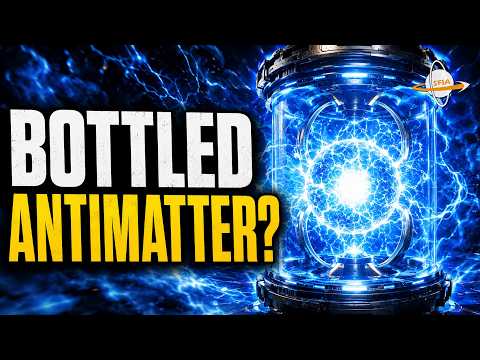
So, like in your basic chemical rocket, a chemical reaction in the combustion chamber produces hot gas that expands out the nozzle at maybe a few kilometers per second. And that's why these rockets move, you know, about a few kilometers per second, right? Nuclear reactions are vastly more energetic, and there are fusion rocket concepts that can throw a plasma at hundreds or maybe even thousands of kilometers per second because nuclear reactions are vastly more powerful than chemical reactions. Fusing hydrogen to helium converts about 0.7% of its rest mass to energy, right? E = mc². But, there's nothing faster than photons, and in terms of energy conversion, antimatter converts up to 100% of its mass into energy, and that is a lot of energy. A gram of matter converts to energy has an equivalent energy of about a 20-kiloton nuclear weapon. And for that, you would only need half a gram of antimatter combined with regular matter. Antimatter will do this the moment it touches regular matter. It is an extraordinarily potent and spicy substance.
Hello. Welcome to my fridge. Yes, sometimes I have to eat, and yes, while I do have, you know, the tube food that YouTube pilots eat while flying spy planes at 75,000 ft, myself, I'm a guy in the kitchen here. I actually like to cook. You know, cooking's one of those kind of zen things where you're following a recipe, you're using just enough of your brain to uh you distract yourself from the mundane things, which lets the really important things float to your head, and next thing you know, you've solved a problem and made a really delicious meal. But, of course, many of you are like, "Oh, I'm busy. I don't have time to like organize a full-on meal plan." But, you know what?
I have a solution. And so, in line with my catchphrase, this video is sponsored by HelloFresh. Yes. So, HelloFresh is a subscription service. You sign up, you tell them what you like, and they start sending you, well, the ingredients to make meals. This is a organic harvest chicken, spinach, and feta salad, and this uh sesame soy pork bowls. I think I'm going to go for the pork. And of course, pork may not be your thing. HelloFresh have options for every dietary need. They have high protein, vegetarian, pescetarian, you name it. It is America's number one meal kit service. So, yeah, this whole thing from start to finish took about 30 minutes and a lot of that was just waiting for the rice.
This stuff isn't rocket science, it's a lot tastier. So, use my code Scott Manley FM at hellofresh.com and that'll give you 10 free meals plus free shipping. Those would be applied in your cart when you check out for if you're a new subscriber. Yeah, Scott Manley FM. And of course, now back to the video. And that's what led Eugene Sanger to birth the idea of the antimatter rocket in the early 1950s. The reaction between matter and antimatter produces photons, photons which could be used for propulsion. At the time, there was only one discovered antiparticle, the positron. When a positron reacts with a common everyday electron, it annihilates it to two or more photons. And if you could say have a mirror that reflects those photons, you would have a rocket with the exhaust made of photons. And the idea of propelling interstellar spaceships with antimatter was popular enough and well-known enough that it was sci-fi writers introduced it into Star Trek, right? With the dilithium crystals being one of the key maguffins to harness the awesome power of antimatter.
The reality is of course nowhere near as simple because it never is. It's often said that a rocket engine is just a controlled explosion. The combustion chamber and the nozzle contain the hot exhaust and ex directed in one direction so that by the conservation of momentum, thrust is generated in the other direction. Well, in an antimatter annihilation reaction, the reaction products are hard radiation, gamma ray photons, mesons, neutrinos, other short-lived energetic particles, the kind of particles that'll barely notice your feeble human attempt to contain and control them. Neutrinos in particular can pass through light-years of shielding without interacting with any of it. And then, there's the difficulty of creating and storing antimatter until it's used. So, sure, the simple idealized notion that seduced scientists and sci-fi writers in the past probably doesn't work. But, in the last 70 years, there's been a lot of thought given to how to harness antimatter in a way that actually agrees with the laws of physics.
So, let's start with acquiring antimatter. It's not really something that you can mine or collect. It's something that you make. Uh and the way that you make it is you create very energetic particles in a particle accelerator and you smash them into targets. And all that excess kinetic energy you've given them ends up being converted into new particles, into new matter. But, to balance the equation, if you create a particle, then you have to create its complementary antiparticle. So, if you create an electron, you'll also get a positron. A proton popping into existence also creates an antiproton. So, your particle accelerator to blast protons into a target, and some of the particles coming off at relativistic speeds are antiparticles. Now, you just need to capture those without touching them, slow them down, and ideally combine the captured positrons and antiprotons together to make antihydrogen. And right now, this is a phenomenally inefficient process that converts way less than 1 millionth of the energy put in into stored antimatter. Now, it is also possible to just find antiprotons floating around near the Earth. Uh those cosmic rays that hit the Earth generate antiparticles, and those can get trapped inside the Earth's magnetic field, inside the Van Allen belts. Some estimates put the production and capture rate at about 25 nanograms per day. Uh you could build some contraption to capture those and store them. Earth is convenient for us, but the amounts are tiny. 25 nanograms combined with regular matter releases energy equivalent to about 1 kg of TNT.
Saturn is a much better prospect apparently because the rings increase the area over which cosmic rays can scatter, but the amounts you get are still tiny compared to the chemical energy compared contained in the average rocket. And the capture and storage processes involve electromagnetic field and hard vacuums because antimatter is so allergic to regular matter. The ideal storage of anti-hydrogen involves cooling it to a snowball of hydrogen ice and then levitating it with electrostatic fields. And I just want to pause for a second and imagine the average snowball making a multi-megaton nuclear explosion. Global thermonuclear snowball fights. Even at the temperatures that hydrogen is solid at, it still has an annoying tendency to evaporate and those molecules escaping the surface will annihilate against the walls of the container. So, to stop random molecules evaporating from the surface, it needs to be cooled even more down to about 0.01 Kelvin. And then, of course, you need some of it for your engine and power plant. So, you have to then use a laser to vaporize a tiny amount off surface and then carefully collect that and transport it to where it's needed. So, assuming that we've somehow solved the manufacture and storage of antimatter, what kind of propulsion actually works?
Something you can actually contain those furious energies and just not explode into like nasty radiation. Well, as a baseline, your antimatter annihilation reaction produces a lot of energy which ultimately will end up as heat in the structure. And to stop your structure melting, you're going to need to cool it down, so you flow coolant through it. So, why not just make a rocket engine with that coolant? Take a block of tungsten with channels in it, spray anti-hydrogen onto it, the energy released by that heats up the block, and now to cool that block, we run hydrogen over it. That heats up and blows out an exhaust, you make a thermal rocket.
Well, congratulations, you've just invented a slightly better nuclear thermal rocket. Upsides are that you don't need to worry about critical masses or reactivity, and since you don't care about neutron activation, you can pick elements with the highest melting point, and you only need a small amount of antimatter to actually make this work. Downside is that in terms of specific impulse, it's only marginally better than existing nuclear rocket designs. You can also evolve this in the same way as you would with a nuclear reactor, create a liquid reactor or a gas core reactor without all the headaches of trying to maintain critical in an ultra-hot uranium plasma.
You can just inject antimatter directly into hydrogen flow if you want, and watch it turn to plasma as it absorbs a prodigious release of energy. That'll get you a plasma core antimatter rocket with exhaust velocities of up to about 50 km per second with thrust half hundreds of tons. That is comparable in terms of specific impulse to an ion thruster, but with actual usable thrust, and of course, lots of waste heat. Lots of waste heat. But, there are far more interesting things you can do with antimatter. As I said, nuclear fission is annoying because you have to maintain the reactor core in a state of criticality, but when an antiproton hits a nucleus, it will split that nucleus in a similar way to a fission event. So, you can drive a subcritical fission reaction by spraying it with antihydrogen. And this is called antimatter catalyzed fusion, and you can use it to make tiny nuclear explosions and capture the thrust using magnetic fields. You don't even need to use traditional fissionable elements like uranium. Lead will undergo fission if you hit it with antiparticles, although compared to the cost of antimatter, weapons-grade uranium is actually quite cheap.
Now, depending upon the design details, the exhaust velocity could be as high as 70 km per second, which is better than the hydrogen gas core, but with very radioactive exhaust. So, uh similarly, there's antimatter catalyzed fusion pulse engines, which use antimatter to drive a mini hydrogen bomb. You've probably heard of the original Orion concept, which explodes nuclear bombs near a pusher plate to move a spacecraft. This is a surprisingly plausible concept, but it suffers from only being able to be used at very large scales. Like it's great for moving cities around, not so good for pushing space probes. Because the needs bombs need to have a critical mass of material means you can't shrink the warheads below a certain size. And on top of this, the larger you make the warheads, the more efficiently get. So instead of relying on a chain reaction to kick this off, you just drive the primary fission reaction with antimatter and uranium. Maybe a microgram of antimatter driving the fission off, well, 235 micrograms of uranium. Enough
to kickstart a small fusion explosion. But now to go to the very top end of the specific impulse scale, we have to look at the hard radiation that is being emitted from pure annihilation reactions. Now for complex particle physics reasons, the radiation emitted from antihydrogen annihilation is gamma rays and pions. Roughly speaking, protons and neutrons and their antimatter counterparts of made are made of three quarks or anti-quarks. Specifically, they're made of two up quarks and a down quark. However, pions are made of a quark and an antiquark and are part of a whole family of particles known as mesons. So when protons and antiprotons annihilate, the three quarks for each these pair up with an antiquark counterpart and those shoot off.
So these pions being produced are made of quarks and anti-quarks. That's matter and antimatter in a lethal embrace. That makes them very unstable and they decay rapidly, but how rapidly depends on how the quarks in those pions have paired up. If an up pairs with an anti-up quark, then the pion is a neutral particle and decays almost instantly with lifetimes measured in attoseconds and they decay into gamma rays. But, if an up and a down get mixed up, then you'll end up with this charged version of a meson or pion and this can't decay quite as quickly because charge needs to be conserved. So, to carry away that charge, they need to generate a particle and to do that they need to violate uh your particle conservation numbers and that means they need to use the weak nuclear force. So, these uh charged pions will decay into a uh muon and a
muon neutrino. A muon is basically like heavier electron. Uh so, this decay happens but it happens very slowly because the weak nuclear force is a lot weaker than the other ones, hence it's called the weak force. I mean, it's literally like a billion times slower than those uncharged pions which disappear almost immediately. Thanks to the uh weakness of the weak force, these things last something like 20 nanoseconds which is an eternity compared to their uncharged compatriots. In that time, these charged particles have moved about 20 m or more before the decay happens. And so, my point is that while a bunch of energy comes out as gamma rays and neutrinos, a fraction of this energy is coming out as high-energy charged particles which enables something called the beam core antimatter rocket. And as you're probably guessing, we can use electromagnetic fields to direct those high-energy mesons in one direction, generating an exhaust with a velocity of about 1/3 of the speed of light. You still need to deal with all the heat from those gamma rays and that's the limiting factor for the thrust. The better you can deal with the heat, the higher power you can run the core of the engine.
So, how how big are we talking here, right? One realistic spacecraft design using the beam core antimatter engine was described by Robert Frisbee and his design is roughly 400,000 tons with 165,000 tons of antimatter and a similar amount of our regular hydrogen. It's 700 km long with most of the length being radiators. With a beam core engine at one end generating enough thrust to accelerate at maybe 0.01 G carrying 100
tons of payload. That'll get you up to about 1/4 of the speed of light. And if you want to slow down at the other end when you get there, that'll only get you to 1/8 of the speed of light. And you know, if you then want to make a return trip, then your top speed is like 6% of the speed of light. But regardless, let's just say this is one-way trip. If you accelerate at 0.01 G to 12.5% of the
speed of light, that'll take about 12 years to reach that speed. By that point, you've covered about 3/4 of a light-year. Then you cruise. Like every 8 years you cover about 1 light-year. And you take another 12 years at the other end to slow down and stop at the other end. So this is a mission even to the nearest star that takes 50 years. And actually, this 700 km or 400,000 ton
monster that Frisbee came up is just the upper stage in a four-stage rocket he designed to get that 100-ton science package to the destination in maybe 20 years. And at a few percent of the speed of light, you can actually use the drag of the interstellar medium to slow down a little for free. So that actually helps a little. You could save less fuel for braking and instead use more of your fuel for going faster. Now granted, this was a 2003 design study speculating about a ship that's probably centuries or possibly millennia down the line. Technologies can of course change, but fundamental physics is largely going to remain the same. Between all the technologies, we see a general trend of needing a secondary propellant to carry away the heat if we want high accelerations. Or instead, we have huge radiators, huge spacecraft, and lower accelerations in exchange for moving at a decent fraction of the speed of light.
I like to think that at some point in the future, these design tradeoffs will be made in an actual spacecraft design that could bring humanity to the stars. I'm Scott Manley. Fly safe.