Lockheed’s Vectis Is More Fighter Jet Than Drone
Transcript
Machine-transcribed by YouTube. Expect errors in names, commands and version numbers.
Loheed Martin's legendary skunk works is continuing to invest in its new AI piloted drone fighter that they call Vectus with the aim of getting this loyal wingman into the air next year and
not long after that if they have their way delivering the US Air Force a pretty significant boost in both capability and survivability for its drone fighters. So, let's talk about what we learned about this new drone jet and what it says about Lockheed's vision for the future of the collaborative combat aircraft mission. I'm Alex Hollings and
this is Air Power.
Later this week, I'm flying out to Loheed Martin's F-35 production facility in Fort Worth, Texas to get a tour of how they build these fighters and to watch the roll out of Germany's first new stealth jet. And as luck would have it, that same firm is making headlines this morning for unveiling a full-sized mockup of their forthcoming Vectus drone and releasing some pretty tantalizing details about the aircraft itself. So, I figured I'd put together a quick video about Vectus before I hop my flight to go learn more about F-35s. So, bear with me for this lightly scripted dive back into Vectus. And I will be back next week for you guys with the depth that you're more accustomed to. Now, the Air Force currently has two drone fighters or collaborative combat aircraft already in active production and expected to reach operational service before the close of this decade.
They're Anderil's FQ44A Fury and General Atomics, literally just renamed FQ42A
Vengeance. Now, both of these drone fighters were designed to be operated by third-party artificial intelligence that takes its combat cues from a human pilot in another aircraft. And it isn't hyperbole to say that the command and control element of these drones combined with establishing new human machine teaming tactics for combat represent the very cutting edge of military aviation today. But in some ways the drone fighters themselves should be seen more as stepping stones than a finish line even as they make their historic entry into active service. You see, these collaborative combat aircraft or CCAs were purpose-built to support the air-to-air combat mission. each carrying a pair of A120 AM RAM radar guided air-to-air missiles or similarly sized weapons like the new A260 to fly air superiority operations with the first American aircraft that will boast drone wingmen in the fight, America's forthcoming upgraded F-22 Raptors. But the Air Force, not to mention the Navy and the Marine Corps, all have much broader ambitions for this new class of tactical aircraft than air superiority alone. Now, for its part, the Air Force refers to Fury and Vengeance as increment one CCA fighters, meant to be relatively inexpensive and designed to deliver that drone wingman capability to the Force as quickly as possible. Then increment one will be followed by increment two which doesn't currently have disclosed requirements established.
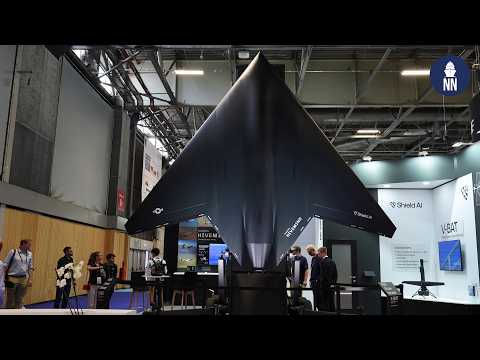
And then increment two is meant to be followed by increment 3 and so on. And that's where Lockheed's hoping to step in with Vectus which is an internally funded collaborative combat aircraft aimed at delivering much higher degrees of both capability and survivability than could really be offered by the Air Force's first tranch of fighter drones. Now, Loheed first announced Vectus to the world back in September of 2025, and we talked about this platform and its potential back then, but at this week's Air Force Association Airspace and Cyber Conference, the firm released a laundry list of new details that helped flesh out this concept a bit, and I thought that was worth discussing. Now, Loheed Martin has claimed to incorporate technologies into this drone that were developed for its fifth generation fighters, the F-22 and F-35, as well as
their sixth generation fighter entry that ultimately lost out to Boeing's F-47 proposal for the next generation air dominance contract. And what that really means is Vectus is not a budget fighter, but rather a truly high-end asset that may well offer some capabilities that even exceed that of piloted fourth gen fighters, particularly when it comes to stealth. Now, we also now know the dimensions of this new fighter drone at about 34 ft long and boasting a 38T wingspan, making it about 3 ft wider than an F-35A. Now,
that makes this platform a group five UAS with a pretty significant margin, which is the largest class of drones and the same class that's occupied by platforms like the FQ42 and 44, not to
mention the MQ9 Reaper and the RQ4 Global Hawk. Now, we also learned that this aircraft will be powered by a single turbo fan engine, but what type or what thrust class has not been disclosed, and as far as I can tell, neither has whether or not it will be after burning. The most apparent difference between Vectus and an increment one drone like the FQ44 Fury
also happens to be the one that Lockheed's officials are the most reluctant to discuss and that is low observability. Now, the very small FQ44 Fury was designed to carry its twin AM RAM payload externally, which combined with that single standing vertical tail makes it pretty fair to assume that the design prioritizes its small size and its aerobatic capability more than its stealth. But Vectus, on the other hand, has an overtly low observable design, and Loheed officials in the past have described it as the most survivable CCA offering on the market. Now, the jet's stealthy plane form, its well-defined chine, its lack of any standing vertical tail surfaces, its recessed dorsal intake, and what sure looks to me to be radar absorbent edge treatments, all point toward a pretty heavy emphasis on all aspect stealth, more akin to a sixth generation fighter than really any of the CCA drones we've seen so far. And that could make Vectus exceedingly difficult to detect, let alone to target. Now, that dorsal mounted intake isn't completely flush with the airframe, but it is certainly set pretty low in the fuselage, and that would benefit both its stealth and its aerodynamics, meaning its efficiency in terms of range. But it can absolutely come at the expense of performance while flying at high angles of attack or during aggressive maneuvering. And that suggests, at least to me, that it's a design that prioritizes avoiding detection rather than evading inbound missiles. And it's also worth pointing out that while Vectus is all but certain to come with a higher sticker price than the CCA's in production today, using stealth to increase the platform survivability is also a way to arguably
bring down overall costs. If a mid-range, not particularly stealth CCA costs 20 million bucks and has a 50% attrition rate in contested airspace, but a higherend stealthy drone cost 35 million and can bring that attrition rate down to 10%. Well, it becomes more cost effective to field fewer higher-end drones than more of those less survivable ones. If you take the price of that lower-end drone, $20 million a piece, and divide it by its survival rate of 50% or 0.5, you'd get a cost for
each drone that makes it back and can be reused of about $40 million. Then take
the more expensive and stealthier drone at a cost of 35 million each and divide that by a survival rate of 90% and you get a cost of around 38.9 million per returning drone that can be reused for an actual savings of around $1.1 million per surviving aircraft. Now, according to the war zone, Loheed Martin's general manager for the skunk works, Ron Felin, also highlighted the value of that top-mounted air intake when operating from austere environments, pointing toward the air force's really heavy emphasis on agile combat employment, or ACE operations in recent years. Now, ACE operations basically call for widely distributing your air assets across a whole swath of austere air strips, runways, patches of highway, flat parts of dirt, and more. All to complicate targeting for adversary planners. And that could be really really important for CCA style drones, maybe even more so than for crude fighters because those drones tend to lack the range or the ability to conduct supersonic sprints that are possible in their piloted fighter counterparts. So you might have to base them in different places to support the same jobs. Now, unlike increment 1 CCAs, which are focused pretty exclusively on supporting airto-air combat operations, Vectus is meant to be a truly multi-roll platform.
Even shown launching both what appears to be an A120 AM RAM and dropping a GBU53B small diameter bomb 2 from internal weapon bays in Lockheed's new promotional renders. And that internal bay of course boasts the same sort of serrated angular edges that we've all come to expect on stealthy aircraft. Now, it's also worth noting that Loheed's new promotional video showed operators commanding Vectus drones from a ground station that looks a bit like a futuristic MQ9 setup rather than solely
from the cockpits of other fighters. And that highlights that this more broadly capable drone fighter is meant to be able to conduct at least some kinds of operations without any direct oversight from a manned aircraft. All while relying on high degrees of onboard autonomy to be able to respond to inbound threats like surfaceto-air missiles rather than waiting for a command to be relayed from that ground control station to react. That's really one of the biggest challenges facing MQ9 Reapers today. And while we're talking about control and autonomy, it's also worth talking about how Loheed's got pretty substantial experience in that space. I mean, they obviously played a direct role in converting an F-16 into the X62 Vista that's currently being used to conduct air-to-air intercepts of human piloted fighters under AI control and has been dogfighting human piloted fighters under AI control for years now already. But their practical demonstrations of me and unmanned teaming actually date back even further than that Skyborg program that's still going on. More than 10 years ago now back in 2015, Loheed Martin's have raider 1 program saw that same X62
autonomously conduct formation flights alongside a crude fighter. Really sort of laying the groundwork for CCA drones to come. By 2017, that X62 served as a
surrogate CCA using the same onboard autonomy software to conduct an air-to ground strike mission exercise while reacting in real time to a dynamic threat environment and what was called Havraider 2. Then in 2022, Loheed Martin
announced Project Carrera, a $100 million effort to pair F-35s with air launched drones that were called Speed Racer at the time, but were well, let's be honest, very similar, if not the same thing, as Lockheed's recently unveiled Comet, or common multi-m missission truck drones. In 2024, Loheed Skunk Works teamed up with Iowa's operator performance laboratory to use one of their L29 Delphin jets as a surrogate CCA and controlled by that same autonomy software that L29 engaged a variety of virtual adversaries while flying in the very real sky, conducting head-to-head dog fights to air strike support operations to even missile intercept missions. Now, according to Dr. Tom Mach Schnel from the Iowa Technology Institute that L29 performed even better in the real world than it had in their simulated environment. Now, there are several other Lockheed AI piloting efforts underway. Some that we've talked about on this channel and certainly a bunch more behind the veil of classified funding. According to Lheed's OJ Sanchez, the firm has even already begun simulating air combat missions in a digital environment that include a single F-22 Raptor serving as the coordinator for four Vectus drones. And in the past, Loheed Martin has also disclosed conducting similar simulations with a single F-35 effectively controlling as many as eight CCA style drones. Now, Loheed Martin's officials would not directly address the price point of Vectus, only saying that the target is to be competitive in the CCA space, but they did acknowledge that the platform's going to cost more than a treadable or the semi-disposable drone fighter designs that are being offered up by some firms and that the Air Force, Navy, and Marine Corps are certainly also interested in. In a real way, Vectus is being presented as a huge stepping stone towards CCA style drone fighters that offer similarly broad mission sets and capabilities to today's piloted fighters. And when you combine that with a really heavy emphasis on low observability, I mean, we should expect this platform to cost well into the tens of millions of dollars. After all, if Ander's Fury and General Atomic's Vengeance are expected to ring in at between 20 and 30 million bucks a fighter, a substantially more capable platform is certain to cost even more. And that actually points to the biggest question I still have about Vectus, and that is what signals is Lockheed Skunkworks getting from the Pentagon about this effort. You see, public discussions about increment 2 of the CCA program have really suggested that the Air Force might be looking for cheaper, more attraable, or even disposable drone wingmen designs from increment 2, leaning even harder into that affordable mass that those kinds of CCAs could deliver. And while there is certainly no shortage of firms competing for a chance to become the Pentagon supplier of choice for those cheaper drones, Lockheed seems to have its sight set squarely on developing and fielding AI enabled fighter drones that are just way more capable or way more goldplated than the Air Force has acknowledged having an appetite for. But while there are no lines of accounting that are already allocated for higherend CCAs, Lockheed seems pretty confident that there is a market for them. And to that point, they are self- financing the production of five prototype Vectus drone fighters. The first of which is already being built to begin flight testing next year. All again without a clear demand signal, at least in the public sphere, that the US military is even in the market for what they're selling. But conversely, it's hard to make the argument that platforms like Vectus aren't just the inevitable result of the development work being done in the CCA space today. I mean, to some extent, increment one needs to crawl so increment 2 can walk and so on and so forth. But at some point in the not too distant future, those challenges are going to be a thing of the past. And the only logical places to go from there is either increased volume or increased capability to create a high low mix of uncrrewed platforms and standoff systems. And that is in fact how Loheed Martin pitched its ecosystem of drones and missiles going back as far as 2022 with their lowcost cruise missiles like comet or the common multi-m missission truck meant to carry sensor payloads and serve as singleuse drones. while slightly pricier ISR and CCA style drones take on a bit less risk and then higherend or exquisite reusable drones taking on even less risk and then finally crude aircraft operating the furthest removed from those threats and as I've argued in the past development of CCA drones throughout at least the American aerospace industry so far has to some extent really mirrored the development of tactical aircraft as a whole just on a much more abbreviated timeline. For decades, just about every major mission set came with a purpose-built aircraft to do that job.
But as systems began to mature and technology started to shrink, we began to see those roles consolidate into fewer types of jets. There was a time when attack aircraft like the A6 Intruder or A4 Skyhawk would handle airto ground operations while fighters were relegated to air-to-air duties. But then in 1991, an FA18 Hornet became the
first fighter in history to seamlessly transition from engaging an airborne target to a surface target with just the flip of a switch. And seemingly overnight, specialized attack aircraft began to disappear from American rosters in favor of more modern multi-roll fighter designs. And likewise, electronic warfare aircraft are still a vital element of American air operations. But increasingly, advanced fighters are now carrying their own powerful electronic warfare capabilities, while others are finding their way to air launched drones that could be carried by any tactical aircraft as this process continues. And likewise, the Air Force's CCA plans to date have called for specialized single mission platforms like the air-to-air focused FQ42 and 44. And in keeping with
that, most CCA drones that are flying today tend to have a pretty singular focus. Now, there are some like Kratos's XQ58 that is rapidly maturing into a full line of different but similar drones for different but similar jobs or like General Atomic's Gambit line which shares a great deal of commonality across a whole series of drones but that are nonetheless different aircraft. And that makes perfect sense for the current state of CCA or drone wingman technology. But it seems clear that Loheed's not aiming for the current state of things with Vectus. Loheed is aiming to hop out in front. And Lockheed is not aiming for Vectus to be as expensive as the more complex modern fighters that have to carry bags of meat in them like the F-35 which Lockheed also builds. And in order to meet that criteria, they say they've placed a heavy emphasis on not just designing and testing the platform in a digital environment, but also using that same approach to streamline production. Now, Lockheed officials explained that they worked to minimize the amount of tooling that each component requires while also simplifying the design to maximize the ease of assembly. This is something we're hearing from a lot of firms lately, maybe and most of all. And doing that, Lockheed says, will not only keep costs down, but it'll also improve production capacity because you could build more drones in less time. So, what do you think? Is Lockheed right to be investing so heavily in a drone fighter that's this much better in terms of capability and stealth than the ones the Air Force is asking for? In my mind, it is a winning bet just as long as Lockheed can stomach the cost for as long as it might take for the defense apparatus to be ready for these higherend CCA offerings. And I would imagine that they do know something we don't. But I'm interested to hear your perspective. Sound off in the comments below. And while you're at it, let me know if you've got any questions to ask about F-35 production while I'm out there in Fort Worth, Texas. And with that, we'll end this episode of Air Power from Sandbox News. I'm Alex Hollings. Make sure to download the Sandbox News app that's available for iOS now to get access to all of our great written content and all of the videos that we produce. If you got anything out of today's video, make sure to click like and subscribe down below and leave me a comment so I know what I should cover next. And of course, don't forget to tap on that bell icon so you never miss a drop from Sandbox News.