Hacker News (YC)
Sean Carroll explains the biggest ideas in the universe – Full Interview [video] (2025)
Comments
Transcript
- I like to say that physics is hard because physics is easy, by which I mean we actually think about physics as students.
You know, we took classes, we read books. And it was hard because there's all this new stuff, all these ideas, all these equations that we don't come across in our everyday lives. But the reason those ideas are hard and those equations are there is because physicists have a technique that has been amazingly successful, which is to take all the messy world around us, with all its peculiarities and specificities, and to boil it down to really, really simple systems.
I'm Sean Carroll. I'm a physicist and philosopher at Johns Hopkins University, host of the "Mindscape" podcast, and also author of a bunch of books, most recently "The Biggest Ideas in the Universe" series,
including "Space, Time, and Motion" and "Quanta and Fields."
You might imagine or remember when you were taking physics courses, there were frictionless surfaces, there were pendula that rocked back and forth perfectly. We're always idealizing. We're always imagining there are no complications and then we're putting them back in. That's a strategy that would completely fail if you tried to do it for psychology, or biology, or political science. But for physics, it turns out to work incredibly well. There's a joke that physicists like to tell each other. They don't like to tell it to others 'cause it's not very funny. But the idea is that a dairy farmer wants to improve his yield, more milk out of the cows.
And for some reason, he approaches a physicist, and says, "Could you look at my farm and tell me how to get more milk out of the cows?" And the physicist thinks about it, and he comes back with a sheaf of calculations, and he says, "Okay, first, imagine a spherical cow."
I know it's not that funny, but the idea is that the first thing the physicist is gonna do is try to imagine a simpler situation. Real cows are not spherical. It'll be a very different dairy farm if the cows were spherical. But you can calculate the volume of the cow and the metabolic rate of the cow much more easily if it were spherical. And the joke of course is that that doesn't work in dairy farming, but it works really well when you're considering a spherical universe, or a spherical solar system, or a spherical atom.
The first really huge revolution in physics was the existence of classical mechanics, handed down by Isaac Newton and others. It took a while. Newton was building on the shoulders of giants. But before Newton, there was Aristotle. And Aristotle says that things have natural places they wanna be, natural ways they want to move. And Newton says something completely different. He says if something is not acted on by a force,
it's gonna continue in a straight line at a constant velocity forever. And if it is acted on by a force, I can tell you how it'll move. I have an equation to do that. Physicists like to simplify things a great deal. But billiards, you know, the pool game, is pretty close to being simple. It's not exactly because, you know, when you hear those balls click against each other, that sound is giving off energy and it's kind of wasteful. But in principle, if you had no friction, no sound, no air resistance, the balls bouncing around the pool table,
let's also imagine there's no pockets, so the balls can just bounce off the edges of the table forever, they would go forever. They wouldn't stop, right? The energy contained in the system remains constant. And the laws of physics, as Laplace points out,
suffice it to predict exactly what the balls are gonna do at every moment given what they're doing right now. So to the extent that it's okay to ignore friction, and noise, and things like that, not only is it true that if you imagine hitting the balls
and watching them move, you could predict exactly what's gonna happen on the basis of the laws of physics, if somehow you could take a snapshot later in their motion
so you know both where they are and how fast they're moving, so maybe a little clip of a movie, then the laws of physics would let you go backwards and reverse engineer what exact configuration the balls were in. We don't perceive that in our everyday world because the world is full of noise, and dissipation, and air resistance, and things like that. But in the pristine, perfect world of imagined classical mechanics, the past and future work equally well. You can go from any one moment to any other moment. It's interesting that Newton came up with the framework of classical mechanics in the 1600s.
And people were very excited, you know, physicists, mathematicians, philosophers. They didn't really have physicists at the time, they were all considered to be natural philosophers. But they worked on it. You know, they thought about the motions of the planets and things like that. And the implications of this idea are profound for how we think about what physics is, what physics tells us, because it wasn't realized until Pierre-Simon Laplace over a hundred years after Newton, but the structure of classical mechanics implies that if you knew the position and velocity
not just of one particle but of every particle in the universe, and you knew the laws of physics, and you had infinite calculational abilities, none of these are at all plausible, but we're imagining right now, then the laws of physics would determine what happens next
at the next moment, and the next moment, and infinitely far into the future, and for that matter, indefinitely far into the past.
So you can take any one moment in the history of the universe, according to classical mechanics, and the information contained in what is going on at that moment is sufficient to fix what will happen at every other moment in history. And Laplace, who is quite imaginative about these things, put it in terms of a metaphor. He says imagine a vast intelligence, later commentators dubbed it Laplace's demon. He didn't call it that. He was famously an atheist. He didn't like to talk about demons. But the demon, the vast intelligence, who could know everything about the universe at any one moment, Laplace says, to that vast intelligence,
the past and future are an open book. You would know everything because what happens now fixes the entirety of space and time, the idea that the laws of physics fix what's going to happen in principle precisely and exactly if you know what's happening right now. So this became known as the clockwork universe paradigm.
The universe clicks along in perfect accord with the laws of physics forever. Now, this might bother you a little bit if you wanna think, well, wait a minute, I'm a person, I'm a human being, I have the ability to make choices. I'm not determined by the laws of physics. And both scientists and philosophers thought about that. They still don't agree on what the right way to think about it is. But the favorite way to think about it is the following. In principle, if you knew exactly everything
that was going on in the universe, you could predict the future. Now, classical mechanics isn't quite right. Eventually we're gonna talk about quantum mechanics, so that's another thing you have to keep in mind. But to the approximation that classical mechanics is good,
you are determined in what is going to happen. But guess what? You don't know all the positions of all the atoms
and all the molecules that make up you. Indeed, you literally cannot know them
because the memory storage capacity to know all that would be at least as big as your brain, if not bigger. And if you made your brain bigger, now you just have more molecules to keep track of. It is impossible to actually have a real Laplace's demon
in the universe. It's just a thought experiment to make vivid the implications of determinism. So philosophers have settled on what they decided to call compatibilism in the sense that, on the one hand, the deep down, microscopic laws of physics are perfectly deterministic, or they're not if you're in quantum mechanics, but they're pretty deterministic anyway. But since you don't know it, you should be asking yourself, what is the best I can do?
What is the best way that I can try to understand human beings given the vastly incomplete information I have? I know about, you know, my friends' personality,
and, you know, their predilections, and their traits, but I don't know every neuron in their brain. And under those circumstances, you will model, you will think about a fellow human being or about yourself
as an agent capable of making choices. Everyone does that, and that's the right thing to do because you are not Laplace's demon.
Isaac Newton, you may have heard, was a smart fellow. And one of the interesting things when you invent a whole new way of doing physics, if you're right and it becomes successful, then later on people kind of take it for granted. They're like, "Yeah, this is how the world works or whatever." But at the time, you're still very careful, and Newton was himself super-duper careful about all the assumptions that went into his theory, and what their implications were, and so on. One part of classical mechanics is the idea of space and time both separately existing and being absolute.
There is a meaningfulness to that. There's no preferred position in the universe. You can be anywhere you want, the laws of physics work the same. There's not even a preferred velocity to the universe. This was figured out by Galileo, and Newton kind of took it on board. If you started everything moving at one mile per hour to the left, the world will look exactly the same. There's no actual frame of rest that you can measure.
But there is space and there is time,
and everyone agrees on what those two things mean.
When I say I am one mile away from a certain other point,
everyone in the universe agrees you are one mile away. Yes, that is correct. When I snap my fingers and say, "At the moment I snap my fingers, a certain thing is happening in Los Angeles," everyone agrees that indeed at that moment, that's a well-defined concept to say what is happening at some point far away, not just Los Angeles but Alpha Centauri or the Andromeda Galaxy. It turns out those assumptions are not quite right.
And it was a journey to get there, as it often is. It started in the 1800s with the invention of electromagnetism. So there are all these new phenomena that people were thinking about since Ben Franklin flew his kite and studied lightning coming down. It was James Clark Maxwell who put the whole story together after work by people like Faraday, and Ampere, and so forth.
And what he realized is there's two fields pervading the universe, an electric field and a magnetic field. And he wrote down some equations that these fields obey, and they sort of play with each other and push around charged particles and things like that. People were very happy at the existence of electromagnetism. They started thinking about what it all meant. And what they realized is that the sort of way that space and time are treated in Maxwell's theory of electromagnetism is different than the way they are apparently treated in Newton's theory. In particular, Maxwell's equations predicted a special velocity. There's no special velocity in Newtonian mechanics.
Every velocity is created the same. Maxwell says there is something called the speed of light.
It is the speed at which waves in the electromagnetic fields move. And naively, you look at the equations and everyone measures the same value for the speed of light. It's a constant of nature. How can it possibly be the case that everyone measures the same speed for light even if they're moving with respect to each other? So for a long time, for decades, people, physicists, bashed their heads against this problem. They came with very elaborate schemes to get rid of it. And it was Einstein, Albert Einstein, in his great paper in 1905, who first said you should get rid of the idea
of these waves traveling through a medium.
You should think of the electromagnetic waves as really being the thing that exists. And when the equations tell you everyone measures the speed of light the same, that's because they do. Take that seriously. All you have to do is entirely rejigger your thoughts
about what space and time are. And in fact, it wasn't until two years later, when Herman Minkowski, who was a mathematician who had been one of Einstein's professors, said, you know, the right way to think about Einstein's theory is to say that space and time aren't separate anymore,
to imagine there's one thing called spacetime.
And different people, different observers moving in different ways through the universe, will divide it up into space and time differently. There's no objective true fact about, when I snap my fingers now, what's happening light years away. That's gonna depend on who's doing the observing and who's doing the measuring. It can all be explained very beautifully by imagining a single four dimensional spacetime instead of separate space and time. Einstein himself was not impressed by this move. Einstein was a hilarious character because he was a physicist's physicist. He was very mathematically adept. You know, don't believe the stories that Einstein wasn't good at math in school. He was very good at it.
But he wasn't in it for the math, he was in it for the physics. So he learned as much math as he needed. And when Minkowski says, "I have some new math that unifies space and time based on Einstein's theories," Einstein himself was like, "Yeah, I don't need that. That's like extra mathematical nonsense." He soon changed his mind 'cause it turns out that that move from space and time being separate to being combined is super useful going forward, including,
10 years later he would invent his general theory of relativity that include gravity into the spacetime story.
When Einstein put together what we now call the special theory of relativity, the idea that there's no preferred standard of rest in the universe, but also, everyone thinks the speed of light is the same, all you have to do is imagine ultimately that space and time are glued together, that was a radical reworking of the framework of physics.
You know, Newton's idea of separate space and separate time,
absolute and agreed upon by everyone, had been there for hundreds of years. And when you do that, when you say, "Okay, I'm gonna completely invent space and time in part because I wanna match this wonderful theory we have,
Maxwell's theory of electricity and magnetism," you have to go back to everything that was a success in your previous way of doing things and say, "Does it still work?" The biggest success of Newtonian classical mechanics was gravity, the famous inverse square law of gravity.
Newton posited that if you have two objects with two different masses, they have a gravitational force that will pull them together that diminishes as one over the square of the distance between them.
And that simple rule plus the framework of Newtonian mechanics is enough to match exactly what you see in the sky in terms of the planets moving around. It's enough to launch a rocket and get it to the moon. So Einstein comes along and says, "Well, okay, can I make a version of Newton's theory of gravity that is compatible
with my new theory of special relativity?" And after trying, he said, "No, I can't." You have to do something much more dramatic. And what he realized is that gravity is a special force of nature. You know, Maxwell talks about electricity and magnetism. If I wanna know what the electric field is at one point in space, it's very easy to do. I put a positively charged particle, a negatively charged particle, they get pushed in opposite directions by the electric field. But Einstein realized that every particle reacts the same way to gravity. If I have a very heavy particle and a very light particle and I drop them, Galileo showed that they drop at exactly the same rate.
They're not pushed around in a different way. So because of that, gravity seems to disappear
if you only look at it in a tiny region of the universe. If you are in a sealed box and you are dropping things and going, "Oh, I have gravity here," you don't know that for sure. Maybe you're in a rocket ship, and the rocket's accelerating, and you're being tricked into thinking you have gravity. So Einstein, because he's Einstein, he's very smart, you know, you or I would go, "Huh, that's interesting," but he says, "I think what that means is that gravity is not a force on top of spacetime,
it's a feature of spacetime itself." What feature could it be? Well, my ex-professor, Minkowski, says that spacetime has a geometry. It's one combined thing. And there are equations telling me how particles move in it.
Maybe that geometry is curved. Maybe it's not like a flat tabletop like Euclidean geometry.
Maybe it's warped, and bent, and dynamical, and changes in response to the existence of mass and energy
and things like that. It's a good idea to have. It takes you a lot of effort and a lot of mathematical work to figure it out. So 10 years later, in 1950, Einstein finally completes
what we call the general theory of relativity. And the general theory of relativity says spacetime is a four dimensional thing, that four dimensional thing has a geometry, it's pushed around by matter and energy, and we experience the curvature of spacetime
as the force of gravity. When Einstein and Minkowski figured out that space and time are both two different ways of slicing up spacetime, what does that mean?
What does that mean, like, in our guts, right? What does it visually or measurably imply?
You know, in space, there's something called the distance between two points. If you say, you know, I'm here in Washington DC
and a friend of mine is in Los Angeles, there's a distance between those two cities, and we all agree on what that distance is because implicitly, we're imagining the shortest distance path, right? The straight line that connects these two points. But of course if you actually travel between these two cities, you won't exactly necessarily take that much distance 'cause you're gonna go right and left. You're not gonna go exactly on a straight line. So in space, we're all very, very used to the idea
that different paths have different lengths, even if they start and end at the same point. In special relativity, now that space and time are unified,
what that means is that time is like that.
The time you personally measure on your wristwatch
is very analogous to the distance that you travel
moving on some path. What that means is that rather than being a universal thing that everyone agrees on, time depends on the trajectory you take
through the universe. The most famous example of this is the twin paradox. You imagine two twins, they don't have to be twins, but it's more vivid if they are, 'cause you think of twins as being the same age, okay? One twin just doesn't move, just stays home. This is the lazy twin. And they get older, like the rest of us all do.
The other twin hops in a rocket ship that moves out very close to the speed of light, you need to move close to the speed of light to feel the effects of relativity, and then comes back.
And so they left at the same time, they were the same age,
they come back to the same point in space and the same point in time. But the twin who traveled is now younger. The twin who traveled has experienced less time
than the twin who stayed home. And the reason why is because they took different paths through spacetime. Space and time are similar to each other but not exactly the same. That's why, in space, the shortest distance path
is a straight line. But in time, the longest time path is the straight line.
The twin who stays stationary and doesn't move, that's moving in a straight line through spacetime, that's the one that feels more time pass before the other twin comes back. When people hear this stuff about relativity and moving through space and things, what they want to say is, "Oh, so you're saying that time moves more slowly
when you're traveling near the speed of light." No, I do not want to say that. I very much do not want to say that. What is the rate at which time moves? It is one second per second. You're being tricked by your use of the English language because you move through space and it makes perfect sense to say I am moving at one meter per second, or two meters per second, or whatever. The rate at which you move is the number of distance you traveled per unit time.
But the amount of time you travel per unit time is always one. Now the accumulated time along two different trajectories
can be different. That's the origin of something like the twin paradox, or when gravity comes into the game, the amount of total time you experience will be less
if you're deep in a gravitational field than if you're out there in interstellar space, where gravity is not that important. So in general relativity, being a strong gravitational field is much like moving out there close to the speed of light.
If you had someone stay back here on Earth, someone else go near a black hole, for example, a black hole is the strongest kind of gravitational field you can have. Don't go in to the black hole because then you can't come back out. But if you go near it and then you come back, you will be younger than the person who just stayed behind. You will have experienced less time. Your wristwatch is still clicking at one second per second, but the accumulated amount of time is different because you have taken a different path through curved spacetime. And "Interstellar," the Christopher Nolan movie, this was wonderfully illustrated.
Kip Thorne, who is a Nobel Prize-winning physicist, was the executive producer and one of the instigators of that movie, and he put all of his physics knowledge in there about wormholes, and black holes, and gravity, and time travel. So up until the very last scenes, when they're in the library and everything goes haywire, all the physics in that movie is completely respectable. One thing that is true even in Newtonian ways of thinking about space and time or in Einsteinian ways of thinking about space and time is that these fundamental laws, as Laplace's demon shows us,
work forward and backward in time. Knowing everything about the universe in one moment predicts the past, as well as the future. That's because what we think of as the fundamental laws of physics do not have a directionality to time. They treat the past and future the same. But there's clearly a direction to time in the world. I remember what I was doing yesterday. I might guess what I'm gonna do tomorrow, but I don't remember it in the same way. I have no photographs or memory books of the future.
I was younger. I will always be older in the future. What is going on with that? And the answer is it's not the fundamental laws of physics,
it's the collective behavior of many, many things in the universe that start out in a special state. It goes back to the idea of entropy from the 1800s,
the idea of the disorderliness of a system, the randomness, the disorganization. And entropy increases with time. That's the famous second law of thermodynamics. Why does entropy increase with time? Because there are more ways for a system to be arranged in a high entropy configuration than a low entropy one, by definition, and the universe started in a very special low entropy state. Nobody knows why that is true. This is a mystery to cosmology. But the entropy of the universe was very, very low to start and it's been increasing ever since. And us having memories of the past but not the future,
the ability to have records, the fact that we age in the same direction, this is all because entropy is increasing in one direction rather than the other.
I'd like to think, if you were a physicist circa 1895, okay,
the very end of the 19th century, you would've been forgiven for thinking that we were almost there. We were almost having a complete theory of nature in our grasp. Because they had the idea of particles, right? You know, the idea even of atom was a little bit sketchy to a lot of physicists in the 1800s, but they eventually caught on. And they were beginning to realize that atoms were made of other particles, protons, neutrons, electrons, and so forth. And then the particles which make up matter are pushed around by fields, by the electric field, by the magnetic field, by the gravitational field, and so forth.
So you have this sort of two-part harmony. Matter is made of particles, forces come from fields.
And all of the effort in the future of physics would be figuring out what are all the particles, what are all the fields, and then you'd be done. There were a couple of clouds on the horizon.
One of them ended up being relativity, the fact that the symmetries of Maxwell's theory of electromagnetism were different than the symmetries of Newton's theory of classical mechanics. But the others were that there were certain properties of matter and materials that didn't quite seem to make sense. And I'm gonna be ahistorical now. Let's pop forward to like 1911. They were putting together the picture of the atom that is the cartoon you've always seen, right? There's a little nucleus at the center of the atom and electrons are circling around it like planet's orbiting a star. This is called the Rutherford atom model, after Ernest Rutherford, who was a brilliant experimental and theoretical physicist.
And this was entertained and people liked the idea
that electrons were kind of like little planets, but they instantly figured out it can't possibly be right,
because that electron orbiting the nucleus
would give off electromagnetic waves. It's a moving particle. Moving charged particles give off light. All of the light you're looking at right now came from some electron in motion, moving around. So you can calculate. You can say if the electron is moving around in orbit around the atomic nucleus, if it gives off light, it will lose energy and spiral into the nucleus, how long should that take? And the answer is every atom in the universe, including the ones in the chair you're sitting on or even in your own body, should collapse to a point
in a hundredth of a billionth of a second. So that clearly does not happen. The idea that electrons are like little planets in a solar system is just wrong. And this and other things, black-body radiation and other experimental results, convinced people that there wasn't this clean division between particles and forces. They said there's aspects of light, which is supposed to be a wave, which are particle-like. Einstein said that. There are aspects of particles like electrons that are wave-like. Louis de Broglie, following work by Niels Bohr and others, said that. And this whole thing coalesces almost exactly a hundred years ago in 1925
in the theory of quantum mechanics. And almost right at the same time, two different versions of it came out. Werner Heisenberg had his version called matrix mechanics. Erwin Schrodinger had his version called wave mechanics. They show that they were actually mathematically equivalent. But quantum mechanics, I like to say, it was the second of two big ideas in the history of physics. The first big idea in physics was classical mechanics.
Relativity is a pretty big idea but not as big as classical mechanics or the second big idea, which is quantum mechanics. Quantum mechanics throws away classical mechanics
and replaces it with something very different. It says that electrons are not particles or waves.
They act like waves until you look at them,
and then they look like particles. That is a very, very difficult thing to swallow, and physicists are still trying to figure out what to make of it. It's so much fun reading the history of how these ideas developed 'cause today we're just taught the final result, but, you know, they didn't know what was going on back in the early days. In 1926, Erwin Schrodinger presents an equation, what we now call the wave function. It's a dopey name for a very important idea. So think of that little electron, instead of orbiting in a circle, it's a wave.
It has a profile around the center of the atom. And the equation works very well. It's still the equation that we use today. But then you have to ask, okay, semi philosophical question,
what is the wave function? What is it telling us? And Schrodinger thought, well, okay, in some cases electrons act like waves, in other cases they act like particles. Maybe the equation says that if you start
with an electron wave all spread out, it will sort of localize itself near some point and it will look like a particle. It turns out not to be true. The equations don't care about your feelings. It's the opposite. If you start out with a localized electron wave, it will spread out all over the place. So it was yet another physicist, Max Born, different than Niels Bohr, who pointed out the right way
to think about Schrodinger's wave function. He said think about what happens when you measure a property of the electron, like its position, or its velocity, or whatever you wanna measure. He says what the wave function is doing is it's telling me the probability of getting a different measurement outcome. In particular, if you want the math, you square the wave function, that tells you the probability of seeing the electron somewhere. And this was just bizarre and crazy for all sorts of reasons. People didn't like the idea that probabilities were involved at all. Of course there's probabilities when you flip a coin, but that's just 'cause you just don't know everything there is to know about the coin.
Since the time of Newton and Laplace, we thought that physics deep down was perfectly deterministic. And here's Max Born saying no, it's not. That was difficult to swallow. But the other thing that's difficult to swallow is why in the world is the idea of measuring
or observing something showing up in the fundamental laws of physics.
That had never happened before. Of course you have to think about measuring things and observing things, but it was always imagined that if I measure the position of a planet or something like that, in principle I can do that measurement completely benignly
without disturbing the system in any way at all. And what Born is saying is that when you measure an electron, you instantly and dramatically change its wave function.
And to tell me what the fundamental laws of physics are,
according to what became known as the Copenhagen interpretation of quantum mechanics, after the city where Niels Bohr, and Werner Heisenberg, and others were doing their work,
part of those fundamental laws are a set of rules that say
here's what's what happens when you measure the properties of a system. So quantum mechanics is the only theory in the history of physics that has rules about measurement outcomes and has measurement playing an important role in what those laws are. And if you ask, well, what is a measurement, what counts,
do I have to be conscious, can a video camera do a measurement? The answer is we're not gonna tell you the answer to that. We don't have an agreed upon set of criteria for when a measurement happens. And this is known cleverly as the measurement problem of quantum mechanics.
There's various plausible resolutions to it, but we don't agree on what the right one is. Very often in physics, learning physics, teaching physics, doing physics, it's very helpful to visualize things, either precisely
or maybe in some toy kind of metaphorical way of doing things. But we have to keep in mind it's not necessary
that there be an accurate way to visualize certain things.
We have to accept that the world is not here to make things easy for us. So when it comes to the wave function of quantum mechanics,
we're a little bit stuck. There are simple cases, like if you have one electron and that's it, no other particles, you're talking about the wave function of one electron, you can actually visualize that. If you just think about space as two dimensional to make your life easy, the wave function is a function. You're cheating a little bit because rather than having a value, it's a complex number,
that means to say a real part plus I times an imaginary part, where I is squared to minus one, but okay, who cares? What you need to know is there's a profile, there's a shape.
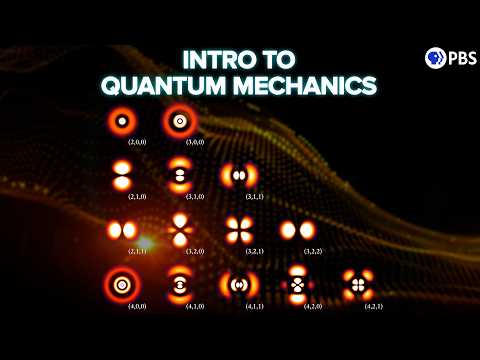
There's basically a value at every point in space which says this is the wave function of the electron at every point in space. So go ahead and visualize it. If you ever took chemistry class and you saw those images of what are called orbitals in different kinds of atoms, those are literally pictures of wave functions.
Those are values of the wave functions, different shapes the wave function of an electron can take in an atom. But just to show you that the universe is not gonna always go that easy on you, sometimes you have two electrons that you care about.
And one of the most profound features of quantum mechanics, which separates it from classical mechanics, is that you don't have a wave function for electron one
and a separate wave function for electron two. Because remember, the job of the wave function is to say, what is the probability that I measure something, right? So when I have two electrons, I can have the probability of seeing one electron anywhere in the universe, and I also have the probability I see the other one everywhere in the universe, but they can be connected.
Maybe I know that the electrons are one centimeter apart,
but I don't know where they are, right? If I measure one of them, then I instantly know where the other one is, but I don't know ahead of time where either one of them are. This is the phenomenon called entanglement. And what it means is that rather than having one separate wave function for one particle and a distinct one for the other one, which would mean there's no connection between them, the wave function tells me the probability of both particles at once. Mathematically, if you want the details, you assign a complex number to every pair of positions,
the position of particle one and the position of particle two. You wanna visualize that? Good luck. You're not really gonna be able to do it unless you can visualize complex functions in six dimensional space. But that's what it actually is. We can write it down, and we can deal with it, and we can go back to what things look like when it's just one electron if you wanna really wanna visualize things, but at some point we have to trust that the equations know what they're doing. You would think, from the name quantum mechanics,
that quantum mechanics has something to do with quantum, which is a word made up to denote a discreet amount of stuff. It comes from the fact that in the early days of inventing quantum mechanics, when you had radiation coming from hot, radiating bodies
or when you had electrons in orbits around atoms,
there were discrete possible energies you could observe.
Light is absorbed at certain frequencies by a gas and not at other frequencies. When an electron changes energies inside an atom, it goes from a certain energy to another one without being in between, without sort of continuously evolving from one energy to another. So there was this idea of a quantum jump from one state to another. But that discreetness is not fundamental to quantum mechanics. It's not built in. It's not because quantum mechanics says the world is discreet, it's made of pixels, it sits on a lattice, or anything like that. It's because the opposite. Quantum mechanics is a story of waves, but sometimes waves only vibrate with certain discrete sets of frequencies.
Think of a string attached to two ends, like on a guitar, or a violin, or whatever. You can pluck the string, and given the tension of the string and the distance between the ends, it will vibrate. It will give you a certain note. But the same string is also able to vibrate
at twice the frequency. There's the fundamental frequency where the string vibrates as a whole up and down, and there is the next overtone where it sort of vibrates half and half on different sides,
and then a harmonic series, there's a way that the string can vibrate so it goes up and then down and up again, that's three times, and so on. So a discreet set of possible frequencies
comes out of the motion of a continuous string vibrating.
And likewise, the continuous wave function, in certain circumstances, can only vibrate with certain discrete frequencies. And so that's why electrons have discrete energies in atoms.
Now, quantum mechanics is a framework,
just like classical mechanics is. Classical mechanics doesn't say what the world's made of, it gives you the fundamental rules and you pick out,
oh, the world is made of particles, or fluids, or whatever, and here are the forces acting on them, and you plug that into the framework of classical mechanics.
Quantum mechanics is the same way. Most of what you talk about when you first encounter quantum mechanics, electrons, and photons, or whatever, you're applying the rules of quantum mechanics to particles.
But we've known, since the time of Maxwell at least, that there are also fields, right? There's the electric field, the magnetic field, the gravitational field, maybe there are others. So we can also apply the rules of quantum mechanics to fields. And lo and behold, we get what is called quantum field theory. Quantum field theory then is not a replacement or an improvement on quantum mechanics. It's just the rules of quantum mechanics applied to fields rather than particles. And what happens is you take a field, so a field is the opposite of a particle. A particle has a location. A field exists everywhere, but it has a value at every point.
So the electric field is a little arrow at every single point in space. It has a direction and a length. And then you say, okay, that's a field, I'm gonna apply the rules of quantum mechanics to it. So I'm gonna invent a wave function for the field. And I'm gonna say, what is the probability the field looks a certain way doing certain things? And the math just goes through exactly like an electron
sitting in an atom. There are certain discreet vibrational frequencies
of the field. And that shows up in particle physics experiments
as particles. The field vibrates a little bit, you think you're looking at one particle. If the field vibrates a little bit more, now you think you're looking at two particles. And you can match up exactly the mathematical descriptions on both sides. So the resolution to this early mystery of quantum mechanics, why do electrons or photons behave like particles sometimes,
behave like waves other times, the answer is, number one, they're waves. That's what they are. They're waves in a field. Not only is there an electric field and magnetic field, there's an electron field for the electron particle, there's a neutrino field, there's a quark field. Everything is made of fields. But number two, when you apply the rules of quantum mechanics to fields, they show up in our experiments like particles. So this is why it explains this distinction that things act like waves when we're not looking at them and appear to us as particles when we do. If we think back to that late 19th century physicist who thought matter was made of particles, forces come from fields, what happened to that guy?
Like, where is he now in the world where everything's actually fields, but they look like particles when you apply the rules of quantum mechanics to it? Well, it turns out there are two different kinds of fields, fermions and bosons. And the difference is, are you allowed to stack up vibrat