The Air Force Wants A Cannon to Shoot Down Drones
Transcript
Machine-transcribed by YouTube. Expect errors in names, commands and version numbers.
Drones and a bevy of ballistic missiles are forcing some pretty big changes throughout the entire US military. Marines are getting anti- drone 5.56 rifle rounds. The Army is testing small soldier jammers. The Navy is firing off Hellfire missiles to shoot down drones. And now the Air Force is interested in a groundbased medium caliber gun weapon system to defeat not just drones up to Group 5, but also subsonic cruise missiles. This groundbased air defense or G-bad mission was typically handled by the army. And this was a really great relationship when things like sprawling bases were the standard and the threats from the air were a little more predictable and not coming in swarms.
The proliferation of lowcost but really capable and accurate drones and ballistic missiles is forcing every military branch to just Thanos things and do it themselves. And so the Air Force is getting into the G-BA business.
>> I'll do it myself. >> So, let's go over what the Air Force is asking for and why, and then we will get into how it could use them and use our imaginations a bit as to what this actually might look like. But before we get back into that, we're going to talk about my relationship with caffeine because it's complicated. Like many Marines or just service members in general, I built what some might call an unhealthy relationship with caffeine. First through energy drinks and then later on through coffee. These days, caffeine and I do still hang out every single day, but I don't always want a cup of coffee or an energy drink. And there is such a thing as too much caffeine. So, I started trying out caffeine and nicotine-free ultra pouches. So, for years and years during the Marine Corps, after the Marine Corps, I've been a morning person and I wake up early. I still wake up every single day at about 4:00 in the morning.
But now with these Ultra Pouches, I'll pop one in in the morning. Gives me a nice clean little energy boost because waking up at 4 kind of sucks. And then, you know, I'll come home, go about my day, have my coffee still, then I'll pop another one in the afternoon when I'm starting to get a little tired. but they come in different flavors and honestly they're kind of nice to have around. The Clean Boost is delivered via vitamins B6 and B12, Eltheanine, Alpha GPC, and
Infinity PX. They also have a lot of different flavors and honestly, my favorite one is Wintergreen. It just tastes clean and fresh and I like it. So, go ahead and give them a try at takeultra.com and use code task and purpose to get 15% off. That's takera.com and code taskandpurpose to get 15% off
your order. And when they ask you where you learned about them, you go ahead and you tell them task and purpose. And of course, thank you to Ultra Pouches for sponsoring this episode. On September 3rd, the Air Force posted a request for information or RFI seeking information on this groundbased medium caliber gun weapon system. Now, an RFI is not a guarantee, and the Air Force was very clear in saying this was only for market research purposes. The next step would be an RFP or a request for proposal, and
that would have more specific requirements and maybe give us an idea of how much they're willing to spend on this. But they did also say that there was no promise that an RFP would even be issued. So with this RFI, they just really want to know more about what industry could build for them to provide persistent defense in support of United States Air Force assets. As the RFI says, there are 15 baseline requirements in this RFI, and I wasn't going to read every single one of them because it's just a lot. I was just going to put them up on the screen and let you all read them, but then I thought, hey, not everybody actually watches the entire video through and some people may not be able to read and that's okay, too. So, I'll read them out and then we'll go into some of the bigger ones in more detail. The first one they listed was salvo probability of kill versus cruise missiles and group one to five drones.
And that's two different requirements. Basically, this is how likely a single salvo is to kill the target. A group five drone typically flies above 18,000 ft. And as far as size, think of something like an MQ9 Reaper. So, group five are the biggest and then group one are the smallest. And those are more like the FPV style drones, quadcopters, commercial things you can just buy. They're small. And as you can imagine, it probably takes less to kill those than it does something the size of an MQ9 Reaper. Then we have effective slant range, elevation coverage, magazine depth, raid handling, integrated sensor capability, C2 system integration, system interoperability, cost per engagement, manpower, built-in test or bit, transportability, weapon safety, and multi-domain engagement capability.
Before we get into the real meat and potatoes of these requirements, we should explain a few briefly. First, effective slant range tells us how far the gun can reach in a straight line, while elevation coverage tells us how far through the vertical arc it can aim, including whether it can engage something almost directly overhead. Together, they help define the volume of air that the system can actually defend. This is important because the gun can't aim straight up or at least to an extreme elevation, and the ceiling it can engage at is relatively low. That's an obvious weakness that can and will be exploited. This also means multiple systems will be needed to defend an area and cover those blind spots. And knowing these things helps figure out how many systems overall will be needed.
Multi-dommain engagement capability is interesting, but we're not really quite sure what they mean here. It could be that they want to be able to hit targets in the sky, but also on land or water. If these systems are intended to be light and mobile, and more on that in a minute, it makes sense that it could pull double duty and maybe act as an offensive weapon as well. Maybe the Air Force isn't just going to stop at stealing the Army's GBA mission. Maybe this is really their way into getting armor and tanks and start doing the whole combined arms maneuver warfare themselves. Or it could also be that the system would operate in a multi-domain command network and take targeting info from other sensors that aren't native to the weapon. Regardless though, it's important. So, those were the things that I promised I would be brief on and I broke that promise. But that's just the way it is and I guess you'll just have to deal with it. Now, let's talk about some of the bigger ones and those are magazine depth, cost per engagement, and raid handling. because if it cannot check all those boxes, then this whole exercise is it's just kind of pointless.
With yet more Air Force aircraft hit on the ground as a result of Iranian drone and missile strikes in the region and dozens of Patriot interceptors used in defense, cheap weapons are getting pretty expensive for the US and even our state-of-the-art air defenses appear to be easily overwhelmed. It's important to remember though that what this gun will not solve, at least directly, is that ballistic missile problem. The idea is to let a cheaper, deeper magazine weapon handle drones and cruise missiles so that the Patriots and other expensive interceptors can be freed up to reach the targets that a gun like this just can't. So, the Air Force rightfully wants something that can fire more than a handful of interceptors before needing a complicated reload. and they don't want to spend several times what the target costs with each shot. Now, on to raid handling, which is just the ability to take on a lot of targets all at once.
What volume the Air Force has in mind for this is not public, but for the system itself, what it can do will depend on its range, target acquisition, and engagement speed, and how much it takes to kill each target. That gets complicated with mixed threats arriving from different directions and altitudes, especially if friendly aircraft are also operating nearby. The Air Force is willing to compromise on a few things which are called obviously trade space attributes. Yeah, I know that really isn't obvious, but these are an acknowledgement that no system can do everything. The first compromise they're willing to make is munition performance versus munition cost/gun capability.
Basically, this is just how capable a round can be and what it can accomplish and how much it costs. Next is organic sensor capability and phenomenology. Now, I know that you all watching and myself included know exactly what this is, but just in case, it's just what sensors the system will carry on itself. And phenomenology is just what each sensor is actually looking for and detecting. Finally, and this might be one of the bigger ones, at least so far in my opinion, and that's rapidly deployable. If it can be packed up and move relatively quickly and easily, the Air Force is willing to look the other way on a few things. We've talked a lot about the Marine Corps's expeditionary advanced base operations or Ebo, the Army's multi-dommain strategy, the Navy's desire to build more and smaller boats, and the Air Force's efforts to reopen long dormant airfields in the Pacific dating back to World War II and B29s. All of those things have one thing in common, and that's that footprints are getting smaller and more spread out.
This is because that now no matter where you are, you have to assume that you can be targeted. The days of sprawling air bases and logistics hubs appear to be over. But the problem, and this is a very big problem, is that we still need some form of these, maybe not so large, but still we will have to defend them. The Air Force has been training to use distributed airfields on highways and other austere locations. It is a great strategy to make targeting harder and not be completely reliant on permanent and obvious airfields. Because airmen here would have to move quickly, their defenses also have to move with them.
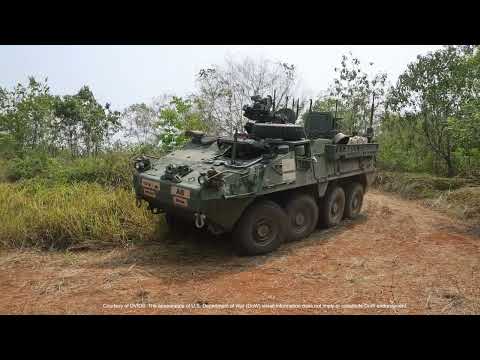
Relying on finite army air defense units would also add another deployment dependency. And the army has its own air defenses to worry about. The only thing is, like we said before, we really don't know what the Air Force wants this to look like. The only thing in the RFI that gives a clue is lightweight, modular, and transportable footprint that can be swiftly projected into austere theater environments. This could be something like a 30mm cannon strapped to a JLTV like the Marine Corps's Mattis. Or maybe it will be a shipping container that pops out a cannon and some sensors similar to how the Grizzly system works with Jagums. Ryan Matal has a rendering of its Sky Ranger 35 turret on a pallet which also makes a lot of sense. And we also have to remember that this will exist inside of a layered defensive system. This isn't the Air Force's first foray into GBAD. They are buying or developing several other counter UAS systems like the Thor and the Molnir which are microwave weapons.
And then there's the XMattis which uses electronic warfare and they have a lot of other systems that they're developing. But this would add a dedicated mediumcaliber cannon missing from those layers. Whatever form it takes though this is still only market research. The Air Force has not selected a gun, a caliber, or even committed to buying a single one. But the RFI shows just how much the airbase problem has changed. So, now we wait for an RFP to give us a clue on what kind of form factor or caliber they intend to use on this, which will tell us exactly how they envision carrying out this mission.
As always, leave your thoughts down below in the comments and let us know what you think about this. All right, so now it's channel update time and today we're going to do something a little bit different. I will do my best to keep it brief, but it is September 11th. It is the 25th anniversary of September 11th and that impacts people in a lot of different ways. If you were alive for that time, you certainly remember if you were old enough where you were and how it changed your life. A lot of people grew up with this reality. A lot of us, like me, uh did not. So, it impacts people differently. As I was editing the video, I thought maybe I was coming across a little insensitive here and I didn't really get to what I wanted to. A lot was going on in my head. And when I riff on these things, I kind of lose focus sometimes, especially if it's a more emotional thing or whatever. Um, but I didn't want to come across as insensitive towards 911. It was a horrible thing. 911, nearly 3,000 Americans died. It set in motion the global war on terror where millions of people have died in that and a lot of Americans as well. It was a terrible day. It was tragic. A lot of people know a lot of people who died in those attacks. So, I didn't want to come across as offensive or anything like that. Maybe I'm maybe I wasn't. Maybe I'm just, you know, overthinking it, but I just wanted to make sure that you all know I'm not trying to offend anybody here. Now, we'll get back to the video.
I say this all because September is also suicide awareness month. Now, I'm not
huge on the awareness things, like we don't know what the [ __ ] suicide is, right? Um, but it is it's still something that we should talk about when it makes sense. And so months like this do give people an invitation, me included, to talk about these things. And I know we talk about military suicides, veteran suicides, but it's a problem that impacts everybody. We have a lot of people that aren't military or veterans. We have a lot of people who are. It doesn't really matter who you are. Suicide doesn't give a [ __ ] who you are. suicide. I've known a lot of people in my, you know, Marine Corps days for a while there. It was, you know, you'd hear from somebody that you haven't heard from in a while and it's like, "Oh, hey, did you hear about this guy?
He killed himself. That sucks." Right? As time went on from when, you know, my deployment was 2011, 2012. As the years went on, I started hearing less about people who killed themselves. And that's because so many people had um and then March of 2025, my own father killed himself. Um he wasn't a veteran or military or anything. He was an airplane mechanic and a carpenter and then a farmer. He uh his idea of retirement was to start a farm with my little brother in Nashville. It's called Mubberry Farms. If you're in the area, they have a really great store. Check it out. not to plug it, but it is kind of his legacy and I I want to preserve that, too. Um,
and it sucks, right? Like he didn't give any warning signs. There was no note left. There was no reason. It just happened and it doesn't make sense and it never will, right? That's just the way it is. So, if you're in that spot, if you think you're even close, please, I'm I'm I mean, I'm literally begging you. I do anything
for that phone call to stop it. So, if you're in that spot, please just take a deep breath, think about it, and call somebody. Call somebody or if you're throw me an email, kyle.guntaskpurpose.com. Not going to give out my phone number because I'm not a psychopath, but email me, you know, just, hey, I need I need a break or something. Just do it. It's not worth it. Things do get better. I've been on the edge too before myself personally. And it's hard to see over that over that wall, right? But there is something beyond that wall. But you're going to have to climb it. You're going to have to work for it. But people can be around you to boost you up. But if you don't ask for help, it's kind of hard for them to do it. So please, if you find yourself in that spot, take 10 seconds. That's it. 5 10 seconds. Call somebody. Text somebody. just stop and
just think and just know that you are loved. People love you and people rely on you to be around for their own health and well-being. And when you remove yourself from them, it it breaks a piece of them. And that's really hard. So, I've never really talked about it. Um, it's hard to for obvious reasons, but I I want it to at least mean something more than it's just really shitty. Uh,
so if you need help, go get it. You know, not to be tough love, but you have to take care of yourself. That's just the way it is. No one else is going to care for you like you can care for yourself, but you got to do it. So, if you need help, there are people to help. I can help. Other people can, too. I got to shut up now. Uh, I'm Kyle, your friendly ginger man. You are all dismissed. Thank you so much for being here, for listening to that. I don't need sympathy or anything like that. I've made my peace. Um, I just wanted to maybe do some good somewhere and so I'll talk about it when it makes sense. Uh, but thank you so much for being here again. I'm Kyle, your friendly ginger man. You are all dismissed and I will see you next