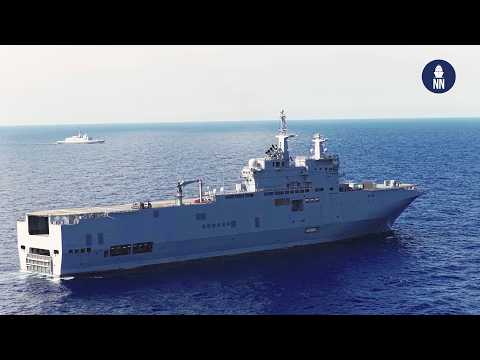
America's Lincoln carrier is looking ROUGH after 286 days at sea
Transcript
Machine-transcribed by YouTube. Expect errors in names, commands and version numbers.
The USS Abraham Lincoln has finally arrived in Thailand for a welldeserved port call that's all but certain to be immortalized in safety briefs for years to come. And new footage gives us a pretty good glimpse at just how rough this deployment has been. And I don't just mean for the crew, but also for the ship itself. Now, this stop in Thailand marks the Lincoln's first full port stop since its deployment began in November of last year with a total of 286 days
spent at sea, including a whopping 28day
stretch that didn't even see the ship make a brief stop near shore to resupply. And it is really important for me to emphasize here that this ship and its 5,000 or so crew weren't just at
sea. They were in an active combat zone launching and recovering over 10,000 aircraft sordies and defending against inbound anti-hship missiles and drone attacks launched by Iran and its proxies. And while it is true that this isn't the longest amount of time a carrier's ever spent at sea, it's important to keep context in mind here. The Lincoln's been deployed to what is objectively a very unpopular conflict
marred by dozens of apparent ceasefires that immediately fell through and serious logistical challenges that only compounded the very tough circumstances experienced by all the sailors and marines on board. Now, I never served on a Navy ship, but I can attest from direct Marine Corps experience that suffering is always easier when you got two things. The first is asurances that your suffering's worth it. And the second is an end point to look forward to. The Lincoln's deployment was supposed to end almost 4 months ago. And that's a long four months to keep fighting with no confirmed end in sight and crappy chow when your ship's over.
But let's talk about how rough the Lincoln's looking right now. because you know that all that running rust has already gotten the attention of Chinese social media accounts pretending that rust on a warship means something it doesn't like this one that popped up in my feed just a little while ago. So, first of all, I do think I should point out that the longest amount of time a Chinese aircraft carrier has ever spent at sea was just 40 days. and they only managed that earlier this year, somewhere near the middle of the Lincoln's 286 spent at sea. So maybe these accounts just aren't familiar with what an aircraft carrier actually looks like after a real deployment. But what does all that rust actually mean for the US Navy? Well, an aircraft carrier is basically a giant steel tub floating in one of the most corrosive environments you could fit it in. Rust just needs water, oxygen, and iron to get started.
But if you add salt to the mix, the party really heats up. As Navy Sea Systems Command explains, addressing that rust buildup is a multiplestep process that starts with cleaning the area, followed by removing the rust with a needle gun and other tools, and then of course cleaning the area thoroughly again before applying multiple different primer coats and then finally a top protective coat. And when you multiply all that effort by a ship that's more than 1,000 ft long, you would basically have to have a full team on board doing nothing but needle gunning and painting throughout your entire deployment to stay on top of it. And that just isn't feasible even when you're not launching 10,000 combat sorties. And importantly, on older ships like the Lincoln, there are strict rules about how and when you can grind away at that paint because the older coatings contained really high levels of lead and other toxic materials. And it's also really important to understand how big the difference is between running rust, like we mostly see here, surface corrosion, which is sure to be happening at places on the ship, and pitting or structural corrosion. Or maybe a better way to say that is there's a really big difference between a rough-l lookinging ship and a ship that is actually having its performance or capabilities compromised by the rust. So while rust is an important thing to address in ship maintenance, it isn't something that we should be expecting sailors to be focused on in the middle of combat. I don't think anybody wants to see sailors hanging from ropes repainting the side of a hole on a carrier as it launches combat sordies. And anybody who tells you that seeing rust on a warship returning from a 9 and a half month deployment means anything other than it was a long deployment has all but certainly never spent a day at sea. And even more so, I'd contend they have no idea what they're talking about. Rust is what happens when you put metal boats in seawater. And that's why the US Navy spends about $6 billion a year fighting corrosion. And there are continuous non-stop efforts to find new, better paints and materials that could limit this problem even further. The rest is just the internet hyperbole machine doing what it does best and Republicans and Democrats pretending that that rust is either bad or fine, depending on who's currently in office. Anyway, here's hoping the crew with a Lincoln leaves at least some beer for the citizens of Thailand when they leave, but I sure as heck wouldn't count on it.