Why NASA's new Roman Space Telescope is a huge deal
Transcript
Machine-transcribed by YouTube. Expect errors in names, commands and version numbers.
This is the Nancy Grace Roman Space Telescope or simply Roman for short. If you're a fan of Hubble or the James Webb Space Telescope, this is just as big of a deal. It's actually a NASA flagship mission that will help humanity unlock even more knowledge about our universe than ever before. Formerly known as the Widefield Infrared Survey Telescope or W First, NASA renamed it after their very first chief of astronomy, Nancy Grace Roman, who also is known as the mother of Hubble, having helped make the beloved Hubble Space Telescope happen. And this new Roman telescope is like having 200 Hubble telescopes. Actually, in some ways, it's like having a thousand of them, cuz it's a thousand times more capable at observing the night sky. It's packing some absolutely incredible technology. that will make it not only much more powerful than Hubble, but also the perfect complement to the James Webb Space Telescope. I'm Tim Dodd, the Everyday Astronaut, and today we're going to tell you everything that you need to know about the incredible new Nancy Grace Roman Space Telescope.
We'll talk about where it's going, how it'll get there, what it'll do when it's there. We'll compare it to Hubble and James Webb. We'll go over all the amazing technology on board, all to help you get excited about the Nancy Grace Roman Space Telescope and understand why it's a really big deal. Okay, let's get
started.
Okay, right at the top here, I'm just going to be calling this Roman, like how we say Hubble and web, just to keep things short. And I think we should start off by going over just how powerful this thing is and how it compares to Hubble and Web. Physically, Roman is almost identical in size compared to Hubble. It's 12.7 m long and 4.4 m wide versus Hubble's 13.2 m long
and 4.3 m wide. They both share the same primary mirror diameter of 2.4 m, which is an existing common size for spy satellites, but we'll talk about that more later. Now, comparing their sizes to James Webb is a little bit more complicated since Web was about 16.2 m long and 4.6 m wide when it was folded up inside the fairing for launch. But once it was deployed, it's just massive. That enormous sun shade is 21.2 m long
by 14.2 m wide with an enormous 6.6 m
wide primary mirror. Roman is right in the middle of the two as far as mass goes. Hubble was 11,110 kg at launch. Roman is 10,500 kg and web
was 6,200 kg. So physically it's similar
to Hubble. So what makes it so special?
How could a telescope of similar dimensions be anywhere near 100 times more powerful? Well, as you can imagine, with 36 years of sensor technology between Hubble and Roman, electronics have improved quite a bit. Roman's wide field instrument or WFI is about 300 megapixels with 18 separate Teladine
H4RG10 detectors that are each 496x 496
pixels. And what's amazing is it has a
huge field of view compared to Hubble. Now with telescopes, it's not really necessarily about the resolution per se because the actual per pixel resolution of any given star is pretty much the same between Hubble and Roman. But Roman's angle of view is so much wider. So when Hubble looks at a bit of sky and it looks like this, Roman can achieve that same level of detail. But it can also see all of this in the same image. This means that one image from Roman is effectively equal to about 200 images from Hubble. But not only that, it can slew faster and reset quicker, giving it about 1,000 times the surveying speed.
In 1 month, Roman can observe what would take a century for Hubble to observe.
Okay, now we're talking. In other words, scientists will be able to take Hubble level detail of our entire Milky Way galaxy. Something that would have taken a lifetime basically with Hubble that can now be done in a very short period of time. But ultimately having this wide field view of our universe will make it easy to study over time. You could observe a section of sky and then come back let's say a month later or two and do the same thing and then you can look for changes between them and that's actually where this becomes really powerful by covering so much sky in such great detail allows for greater opportunities to catch events like supernovas or exoplanets transiting their star or even help us better understand general relativity and dark energy models. So how does this all compare to web? We've been talking a lot about how it compares to Hubble. Well, where Roman's resolution is great over a wide field, James Webb is even more detailed in a small region. So, we can essentially zoom in to further investigate something that we might see pop up with Roman. James Webb has about seven times the aerial ratio with its mirror system. And that means it's even more sensitive for collecting faint light from distant objects. So, web is a zoomedin telescope, while Roman is a wide-angle one. To be more precise about this, Roman's pixel scale is 0.11 arcsecs per pixel, while web can get up to 0.063 arcsec pixel with its long wavelength sensors. Couple that resolution with web's ability to see mid infrared wavelengths. It means that it can see light from further away. So, these two telescopes will be a match made in heaven. Roman will do, you know, more frequent observations of a large swath of sky. And when something interesting happens, we can use web to point at it and it can zoom in to do even more detailed observations. But perhaps the biggest upgrade to Roman is the sheer amount of data we're going to be receiving from it. Like literally data, not just figurative to its, you know, view of the sky or anything. I'm talking about over a terabyte of data every
single day. Compare that to Hubble. That's up to about 3 GB per day. And James Web, that's up to about 60 gigabytes per day. Roman will be sending an absolute boatload of data of up to about 1.4 terabytes per day down to
Earth. So over its five-year primary mission, this could end up being 20 pabytes of data. And what's exciting to me is there's no proprietary period for this data, meaning data will be released immediately and it's fully public. So that actually means that you, me, and independent researchers can comb through data as it comes in. I mean, who knows? Literally, maybe you could be someone who might discover some massive breakthrough with its data. But perhaps one of the coolest things on Roman is a technology demonstrator for a genius coronagraph instrument. A chronograph is something that blocks out the blindingly bright light from our sun or from other stars. Traditionally, telescopes will obscure the bright light with some kind of physical disc or object like an artificial solar eclipse, which allows for imaging dimmer things like solar corona or in this case exoplanets. But instead of trying to physically block out the stars light with an object, they're using a combination of discs with complex patterns and light blocking stops to phase cancel the bright light, effectively making a star invisible. But the really clever part here is that there'll be tiny micro distortions as light bounces off the mirrors and that will reduce the effectiveness of this device. So in order to counter these micro distortions, there is 234 teenytiny little actuators in a 48x 48 grid that can adjust the instrument's mirror in increments as low as just 10 pometers, which is about the diameter of a hydrogen atom. And with this fancy coronagraph, they're hoping to directly observe the light from exoplanets that are 1 billion times dimmer than the stars that they're orbiting, which is extremely exciting. There's one more thing about the physical capabilities of Roman that I find very exciting. It's refuelable. Finally, they fit it with the ability to be grappled robotically and refueled in space to extend its lifetime beyond its 5-year primary mission lifetime and even beyond its 10-year extended mission potential. It uses hydroine as a monor propellant for 24 thrusters. There's 16 5 Newton reaction control thrusters and eight 22 Newton maneuvering thrusters. In general, it won't consume much propellant when it's pointing the telescope around. That's usually what the reaction wheels do. But sometimes you have to dump the reaction wheels, meaning they spin up so fast and sometimes they can get saturated because they can't spin any faster. So you have to slow them down. And normally when they slow down, they would end up spinning the telescope in the opposite direction. So you have to counter that spin down with a thruster firing. The larger thrusters are what do the correction burns and the vibration orbital insertion burn that will get it into its final destination. Which brings us to our next point. Where is this telescope going and how's it getting there? Roman is heading out to the Sun Earth Lrangee Point2 or L2, which is the gravitational sweet spot where a spacecraft can stay positioned behind the Earth relative to the sun. It's about 1.5 million km away from Earth and it's the same region where James Web is.
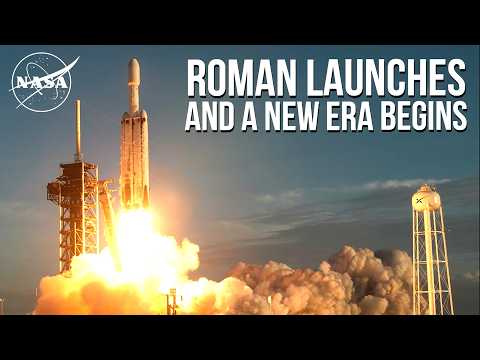
It offers up access to the entire sky, unlike Hubble, which is in low Earth orbit and has a big giant Earth blocking a good bit of the sky at any given time. In order to get a spacecraft that weighs over 10 tons all the way out into L2, it requires a heavy lift vehicle. So, Roman will be riding on SpaceX's Falcon Heavy rocket. And luckily, it is light enough to be within the limits of still recovering the side boosters. So, this launch will be epic. After launch, it'll take about 30 days to get out to L2 when it will do its vibration orbital insertion. Then it'll do a comprehensive system checkout for another 70 days or so. After 100 days, it should begin science operations. Another really interesting thing about this telescope, well, besides the actual mission and hardware itself, is the fact that it somehow was completed under budget and ahead of schedule, which are two things that are simply unheard of in the aerospace industry. So big shout out to NASA's Gddard, L3 Harris, BAE, SpaceX,
and all the others who actually made that possible. Now, some of this might be thanks to the fact that the main bit of hardware was donated from the National Reconnaissance Office. Yeah, there was actually a surplus reconnaissance satellite that NASA adapted for astronomy, but it still required substantial reworking and planning to turn it into a worldclass flagship space telescope. So, the fact that it was ready ahead of schedule and under budget is literally being studied by NASA. So, that's the exciting new Nancy Grace Roman Space Telescope. I absolutely cannot wait for this to launch and be online. I feel like we're really going to be opening our eyes to the universe like we never have before.
So, what do you think? Are you excited? Were you excited before this or recently? Cuz honestly, this one kind of came out of the blue for me. I feel like I only started hearing about it or really knowing too much about it just in the last few months. And I still feel like it's not as of the recording of this video hasn't made like mainstream popularity yet. And I feel like it deserves a lot more credit. Like I feel like this is at least as important as Hubble and Web. So I don't know how are you feeling about it. Let me know your thoughts or questions in the comments below. As always, I owe a huge thank you to my supporters, especially our Patreons and our mission directors that you see here on screen. uh as well as all of you that support OnX as subscribers or YouTube members or even those of you that watch over on Nebula at nebula.tv/ everyydayastronaut. Uh yeah, honestly uh it means a lot that people are still supporting humanmade content. So, thank you so much. Another fun way to support the channel is to head on over to everydayastronaut.com/shop where you can find shirts like this. Our trans lunar co-shirt or this Artemis metalcore hat or lots of other fun stuff, our orange tothecore shirt, our slow roll towing t-shirt, our dressear, our heat shield collection, and lots more at everydayastronaut.com/shop.
Thanks everybody. That's going to do it for me. I'm Tim Dodd, the Everyday Astronaut, bringing space down to earth for everyday people. You are go with throttle up. Yeah. Heat.