The First New Nuclear Fusion Idea for Decades
Transcript
Machine-transcribed by YouTube. Expect errors in names, commands and version numbers.
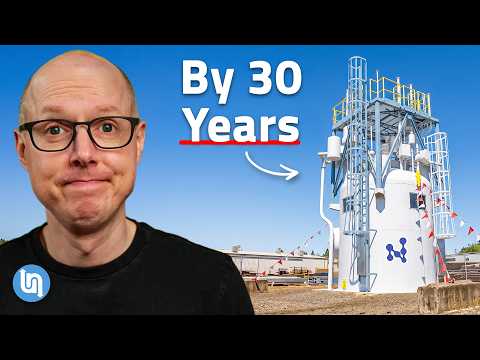
A nuclear fusion startup in New Zealand has just put forward the first idea for the nuclear fusion technology for decades. They're called Open Star Technologies and they're the only startup which works on an approach that's called a levitating dipole that everyone thought was fundamentally flawed, but they've turned the bug into a feature. Let's have a look. Oh, I have a new gadget. Look at this. Is it a bird? Is it a Plaud? No, it's the Plaud Note Pro, a searchable external memory for all the conversations I don't want to sit through twice. It can record speech continuously for up to 50 hours, transcribe it with speaker labels, create different summaries from the same recording, and make everything AI searchable. But Sabine, just use a phone, you might say. Drain my phone battery, download all the recordings, use another app to transcribe them, and then another app to search them? I don't have time for this. Plaud is a one-stop solution. Also, with Plaud, you can be sure that your data's safe. You get 300 minutes of transcription per month for free with paid plans available if you need more. So, if you spend most of your time on the beach, Plaud probably isn't for you, but if you handle a lot of verbal information, Plaud can make your life much easier. And they have a 30-day no-questions-asked return policy. Click the link in the description, use my code to get 10% off. And now, back to the episode. OpenStar Technologies just published a paper with a new design for a commercial nuclear fusion machine that they say is predicted to produce 208 megawatts of net electric power. To put this into context, that's about the power output of a small gas power plant.
They call their design Tama Nui, a name that's derived from the Maori word for sun. But what's new about it? Open star has bet on the levitating dipole approach. That's a variant of nuclear fusion that works with magnetic confinement. The usual approach is a tokamak or stellarator in which one has the fusion plasma inside strong magnets that usually form a sort of torus. The biggest challenge for these approaches is to keep the plasma levitating inside the containment vessel because it's super hot and when it touches the reactor walls, that will damage them. In the dipole fusion reactor, the plasma vessel does not have a hole in the middle. Instead, one levitates a big torus-shaped magnet inside the vessel.
And this magnet is what creates the dipole field. If the magnet's superconducting, the field can be strong enough to trap the plasma and heat and compress it hopefully enough for fusion to set in. The idea is kind of similar to the tokamak but putting the magnet inside the reactor vessel so has two major advantages. The first is that it removes some instabilities in the plasma just because the geometry of the magnetic field is different. The second is that because it's easier to keep stable and the magnet's in the middle, you need fewer of the magnets and that makes it cheaper. But as usual, there are trade-offs. The issue is that this idea brings in a new instability, which is that now you have to keep the magnet in place. Worse still, you now have the magnet inside the plasma and that makes it much more likely it'll get damaged.
The biggest problem is the fast neutrons that are produced in deuterium-tritium fusion. Because they're neutral, they can't be trapped or redirected with the electric and magnetic fields. They'll degrade the magnet quickly. Now, one could use different fuels instead, like for example, boron that would not produce neutrons or not as many neutrons. But the problem with such other neutron-free fusion fuels is that the temperature one must reach is dramatically higher than for deuterium-tritium fusion, which is also bad. And this is why, in a nutshell, the dipole fusion approach pretty much hasn't been pursued, though it's been around since the 1980s. MIT then had a small test device which ran from 2004 to 2011, and the Japanese have a small research facility, but that's basically it. But if not the levitated dipole, then what's new? And the news is that Open Star has come up with a way to make this idea compatible with deuterium-tritium fuel. Their idea is no groundbreaking new physics, it's rather a very down-to-earth management proposal. They say, "Shield the magnet as well as you can, and then make sure that you can replace the shield when needed." So, the weakness of the approach becomes a maintenance problem.
Concretely, they say they want to use a superconducting magnet of barium and copper, that's fairly standard. Around the magnetic coil, they have a shield of tungsten and boron carbide. This is because this material can withstand a lot of heat, and it's also good at absorbing neutrons. That too is fairly standard. What's new is that the magnet is not one block, it has a main section and an outer section. They accept that this outer section will get damaged, and instead try to find way to cheaply replace it in regular intervals. So, they plan on a mechanism by which, after about a year, the entire magnet module is removed from below by robots, and then put in a radiation-safe room to replace the damaged parts. They estimate that this replacement itself would take about 2 weeks, and that this can be done about 10 times, after which the other parts have to be replaced as well. It's basically the fusion reactor of Theseus, except every plank is radioactive and the philosopher has died. In summary, Open Star has not solved nuclear fusion, but they have proposed a serious engineering route for a strange old fusion idea that previously had a big problem. Also, I think there's a bigger lesson here. Other startups should spend more time thinking about the question of regular maintenance because it'll be a major contributor to the running cost.
And next time your computer runs into a problem, just try turning it off and replacing the radioactive middle bit. Thanks for watching. See you tomorrow.