Diving into Trump’s unusual shipbuilding plans, plus an SMD expo floor tour
Transcript
Machine-transcribed by YouTube. Expect errors in names, commands and version numbers.
got some big Navy news. So, of course, we brought on our air warfare reporter. >> What am I doing here? >> Boats, man. Boats. >> Oh, okay.
>> Welcome to Breakout. I'm Lee Faren. I'm here with >> Michael Marorrow. >> You'll notice that Michael Marorrow is not our naval warfare reporter. He's our air warfare reporter. Uh, and there's been big news in the Navy, but our Navy reporter, Diana Stansancy, is out on a muchdeserved vacation. And there's a running joke in the office that whenever Michael is on vacation, there's huge news on his beat. So this time, we thought we turn the tables a little bit and force him to come on and talk about someone else's beat. >> Right. And unlike myself, Diana actually
managed to write a couple stories about these topics before she left. >> Right. So, we're talking about a big national security memorandum out of the Trump White House late last week uh that makes a number of uh directives. Diana actually already wrote two feature stories about all this on our website right now. Check them out. Take note, Michael. >> Mhm. >> Uh, but the first one, what are we talking about first? >> So, I think the biggest news is the plan
to get possibly some US ships built in foreign shipyards. >> Right. That's the Trump has directed the defense department to look at potentially getting US Navy ships built by foreign shipyards and an expansion of what is they're calling the Finland model. This is after ice breakers icebreaker plan. And the idea is that a foreign shipyard would be allowed to build at least two ships of certain classes and then they have to promise to build ships in the US, >> right? And that would either be their own actual shipyard or they take a direct, you know, equity stake in an existing shipyard and then build those ships there.
>> So you can imagine there's already a bit of controversy about this especially from American uh ship workers who obviously they are saying that no American ships need to be built by American companies on American shipyards, >> right? There are similar concerns in Congress too. I mean this has been a continuing conversation for years. Uh foreign shipyards have been viewed as a way to really uh break the bottleneck on uh ship building here in the United States. But like you said, you run into problems of should US dollars be flowing overseas when really, you know, the argument is that capacity should be built here within this country, >> right? And the administration would say this gives uh ships to the Navy faster and it also makes a big promise that there will be more work for American workers in the future from those foreign shipyards. And the next big piece of this very closely related is a call for a fifth public shipyard.
>> Right. So this is another thing that has been needed has been viewed as needed for a while to to increase the the throughput of ship building in this country. But space isn't really a problem, right Lee? So there's there's a bit of a space problem, but we've Diane spoke to some analysts before she went on vacation. They're like really what you're looking at is workforce issues. It doesn't matter that much to have a fifth shipyard if you don't have the people to man it and to build ships there. There's also the question of cost, how much this is going to cost once they find a site and build it up, how long it's going to take. A lot of logistical uh obstacles to overcome for this one. But you know the secretary of defense has to just uh provide a report back to Trump in I think 120 days about whether this is feasible or not right and if it does alleviate the Navy ship building problems I could see the administration pushing forward with that one. And finally we get to the piece that actual air warfare does come in quite a bit to this one. This is about the change to the EOS system. What is EMOLs?
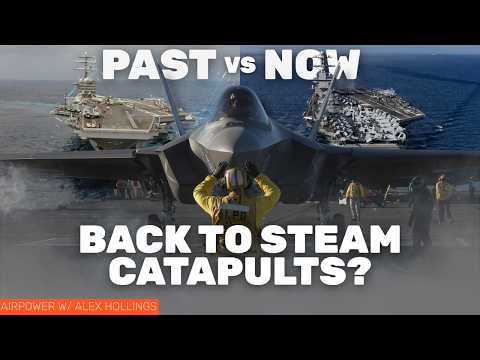
>> Yes. So EMAs is the electromagnetic aircraft launch system. It's what? It's the new technology used on aircraft carriers to launch aircraft off of their decks. Uh Trump doesn't like this technology very much. Uh so if you saw this news last week uh that Trump ordered this change for uh Ford class carriers, it seems like there's a there's a plan that has to be presented on how to uh rip this out of uh you know
an aircraft carrier under construction and possibly implement it for for future carriers. And this put steam launchers in instead of the electronic ones as the idea. And this did it did to me. I thought it kind of came out of nowhere. I didn't really realize this was a thing. But you've said like if you've been paying attention, Trump has been calling for this for nearly a decade. >> This is this is vintage Trump. So uh this for those who have watched, you know, this ship building issue for years did probably did not come as much of a surprise. >> Yeah. So again, we have some logistical issues there. Are they actually going to rip out the current system, replace it with steam? Are they going to put steam into ships under construction as they are? A lot of questions there still, >> right? So, you know, obviously introduces a lot of technical complexity, more cost growth. So, you can definitely see Congress probably getting involved.
>> So, it's I mean, all these things may have a rough road ahead, but you know, to listen to the administration, they're saying they're necessary to rebuild the Navy to really project US power on the high seas. We'll see where it goes from here. >> Administration is really trying to make some waves. >> Make some waves. Very nicely done. All right. Anyway, we come back from the break, we're going to hear from Daniel, who went to SMD last week. >> At Leonardo DRS, our agility helps bring the ability to dominate in any scenario on any platform, helping our war fighters accomplish the mission and get home safely. Leonardo DRS, our agility,
your advantage. SMD is known for big things. Big interceptors, big radars, big constellations up in space. But you and I, >> we're going the opposite direction. We're going to see the small things. We can see the components that make up the systems. So, one company that's components is got shown some of these
and they can go on any number of platforms from satellites to airplanes. And I am told that something new are kind of these switches here. They're making them smaller and smaller because they have to fit in the smaller and smaller cases. Another one is the pneumatic activation systems. Uh this is, I'm told, will goes in the F-35 that actually releases missiles. So, it's air powered and it mechanically releases a missile that fires out of the F-35. Quantum computing can seem very theoretical. There's an actual quantum computer working right now in Huntsville, Alabama for national security reasons. The computer in Huntsville, it uses D-Waves and kneeling quantum computing technology. And this is what the processor unit looks like.
Often times when reading about all these systems, you might just be thinking, hey, these are all just vehicles for sensors. And indeed, a lot of times it is. So this high-owered microwave sensor from Radiance Technologies can actually be moved from a satellite to an airplane and it can detect any number of threats below them. Rough seas, rough roads, and near misses can really damage your electronics. So we're going to see some absorbers to help prevent any problems out on the battlefield. Enodine has a number of shock absorbers and a lot of different systems. For example, this metal one here. If you look at the picture over there on the rolling airframe missile on the bottom, it's dampening a lot of the shock.
This absorber here is dampener here. You may have seen it and not noticed it on a Patriot canister. It'll be here on the side because they need to be dampened not only from road travel, but also for a near miss. There's going to be a lot of vibrations and these still need to be usable. So, that's a requirement for the Patriot canisters. That's just a small taste of what you can see at SMD and we have comprehensive coverage you can see at breaking defense.com. >> Thank you Daniel. That's it for us this week on the breakout. Uh remember to like and subscribe so you get these videos in your inbox when they're ready.
And Michael, did you know we're on podcast? >> We are on podcast. So wherever you get your podcast, make sure to search for Breaking Defense and you can find us there. >> Nicely done. Until next time, I'm Lee Farren >> and I'm Michael Marorrow.